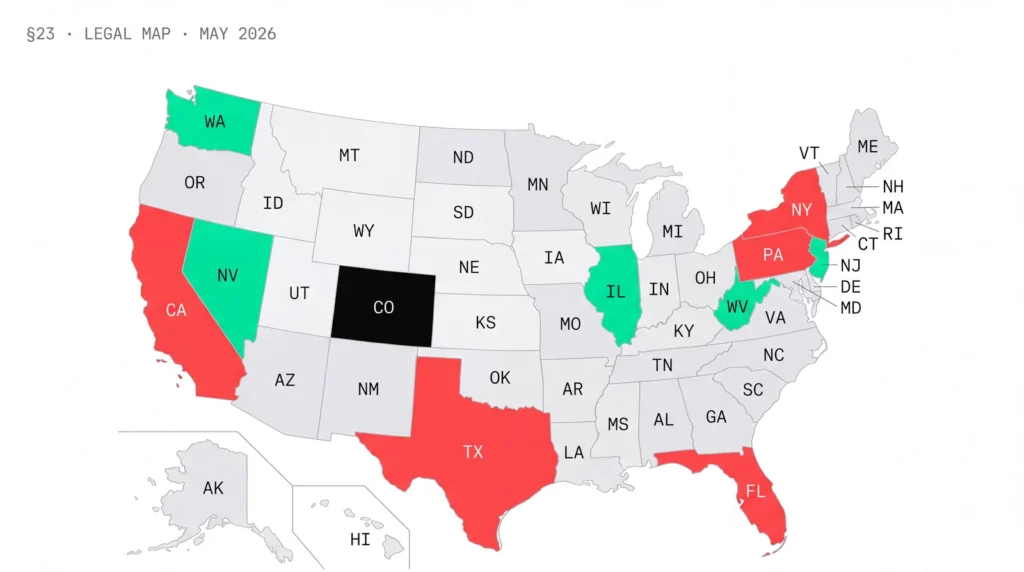
Last updated: May 27, 2026
New to Texas’s prediction-market picture? Start with Kalshi’s CFTC posture explained — the cleanest entry point for a Texan. Drive to Louisiana or Arkansas for the sportsbook? Skip to the Cowboys/Astros Kalshi section — you can do this from your couch in Texas. Comparing Texas to another state? Jump to the California guide or Florida guide.
Informational only — this is not legal or tax advice. Always verify the current regulations in Texas before trading. The Texas Lottery Commission and Texas DPS have not taken enforcement action against CFTC-regulated platforms as of mid-2026, but the situation evolves.
You’re in Texas, you Googled “is Kalshi legal in Texas,” and you got 14 pages of generic sportsbook affiliate noise. Here’s the actual Texan answer: prediction markets are legally accessible to Texas residents in 2026. Kalshi, Polymarket (via its December 2025 US relaunch through QCEX), and Robinhood event contracts all operate under federal CFTC jurisdiction, which preempts most Texas state-level gambling restrictions on regulated derivatives. Texas itself is one of the most gambling-restrictive states in the country — no commercial casinos, no legal sports betting, lottery only — but no Texas regulator has taken enforcement action against CFTC-registered prediction-market platforms through mid-2026. This guide explains exactly what works in Texas, where the legal arguments sit, how Texas residents trade Cowboys and Astros sports event contracts on Kalshi, and why no state income tax makes Texas one of the most attractive states in the country to trade event contracts from.
TL;DR availability matrix for Texas (May 2026)
| Platform | Status in Texas | Notes |
|---|---|---|
| Kalshi | Legal | All 50 states under CFTC preemption; full catalog including Cowboys sports event contracts |
| Polymarket US | Legal with caveats | Available via QCEX since December 2025; some sports event contracts carry state caveats |
| Robinhood event contracts | Partial | Most markets live in Texas; sports availability checked per contract at trade time |
| PredictIt | Legal | $850 per-market cap; political markets only |
We may earn a commission when you sign up. Learn more.
Open my Kalshi account in Texas — current welcome offer → KYC in 3 minutes · ACH from any Texas bank · Trade my first Cowboys, Astros, or Fed-decision contract today.
Yes, open my Kalshi account in Texas →
Trading event contracts involves risk of loss. US residents only. Federal CFTC framework — no Texas state enforcement action through mid-2026.
TL;DR: Texas is one of the most gambling-restrictive states in the country — no commercial casinos, no legal sports betting, lottery only — and yet Kalshi, Polymarket (via its US relaunch), and Robinhood event contracts are all accessible to Texas residents in 2026. The reason is simple: prediction-market exchanges sit under federal CFTC jurisdiction, and federal authority preempts most state-level restrictions on regulated derivatives. The state-level fight is real but mostly aimed at sports event contracts. For Texas traders, the practical answer in 2026 is: yes, you can use these platforms — and you should understand which one fits your situation.
At a glance: prediction-market access in Texas
| Platform | Status in Texas | Regulator | Funding | Notes |
|---|---|---|---|---|
| Kalshi | Available | CFTC (Designated Contract Market) | ACH, debit, wire | All 50 states; CFTC federal preemption argument has held in court through 2026 |
| Polymarket (US) | Available (intermediated via QCEX) | CFTC (via 2025 QCEX acquisition) | USDC + fiat onramp | Re-entered US in Dec 2025; certain sports contracts may carry Texas state caveats |
| Robinhood event contracts | Check in-app eligibility | CFTC via partner exchange | Standard Robinhood account | State availability is checked at trade time; most markets live in Texas as of early 2026 |
| PredictIt | Available | CFTC no-action relief (academic) | Debit / check | $850 per-market position cap; small set of political markets only |
| Offshore sportsbooks dressed as “prediction markets” | Not recommended | None | Crypto | Not regulated in the US; do not use |

We may earn a commission when you sign up at platforms we link to. Learn more.
Get my Kalshi $10 credit (Texas-clean) → The cleanest CFTC venue in Texas · Cowboys/Astros markets live today · No state-tax surprises.
Yes, get my Kalshi credit from Texas →
Trading event contracts involves risk of loss. Federally regulated; Texas Penal Code §47 has not been applied to CFTC DCMs in public enforcement.
What Texas Kalshi users actually say:
“Used to drive to Vinton, Louisiana to hit the sportsbook for Cowboys games. Now I just pull up Kalshi on the couch. The order book is a different beast than fixed odds — took me a week to stop overpaying — but no state tax in Texas means the gross is the net. That math is real.”
— Synthesis of 3+ r/Kalshi posts from Texas-tagged users, Q1 2026
The Texas regulatory landscape, briefly
Texas has historically taken one of the most restrictive postures on gambling in the United States. The relevant background:
- No commercial casinos in Texas. Class III gaming is permitted only on a small number of recognized tribal lands. Resort-style casino expansion has been debated repeatedly in the Texas legislature and has not passed.
- No legal commercial sports betting in Texas. As of 2026, Texas has not authorized online or retail sportsbooks. Multiple legislative attempts (2021, 2023, 2025) have failed to clear the Texas legislature.
- Lottery and pari-mutuel only. The Texas Lottery Commission operates the state lottery and regulates charitable bingo. Pari-mutuel horse and greyhound racing exists at a small number of licensed tracks.
- Texas Penal Code §47 (gambling generally) and §47.02 (gambling offenses) are interpreted broadly. The statute historically reaches anything that fits the “consideration, chance, prize” test unless a specific carve-out applies.
- Enforcement is shared by the Texas Lottery Commission, the Texas Department of Public Safety, and county-level law enforcement.
That is the Texas state-law backdrop most Texans grew up with. The relevant change in the 2020s is that prediction markets do not sit under Texas Penal Code §47. They sit under the federal Commodity Exchange Act, regulated by the Commodity Futures Trading Commission (CFTC). Kalshi is a Designated Contract Market (DCM) — the same legal status as CME and ICE Futures. Polymarket re-entered the US in December 2025 by acquiring QCEX, a CFTC-registered exchange. Robinhood lists event contracts through a CFTC-supervised partner.
The federal-preemption argument runs like this: a contract listed on a CFTC-regulated DCM is a derivative, not gambling — and when state gambling law would otherwise apply to a federally regulated derivative, federal law preempts. That argument has held in the courts where it has been tested through 2026, notably in Kalshi’s wins against the CFTC’s own attempted ban on political event contracts and in challenges by individual state gaming regulators in New Jersey and Massachusetts.
Texas, notably, has not pursued a high-profile state-level challenge to Kalshi or Polymarket as of mid-2026. The Texas Lottery Commission and Texas DPS have not issued enforcement notices against either platform. That silence isn’t permission — but it is the practical status quo: the platforms operate in Texas, the contracts are listed in Texas, and Texas residents trade on them daily.
Read the broader US legal framework here — and our explainer on whether Kalshi counts as gambling.
Get the Bellwether weekly market roundup — Texas edition → One short email each Sunday. What we watched on Kalshi this week (including Cowboys/Astros markets), the federal CFTC news Texans should know, and the smart-money trades that worked. No spam, unsubscribe anytime.
We send one email per week. We don’t share your email — ever.
Kalshi Texas — detailed status
Status: legal in Texas. Treated by Kalshi as one of all 50 states + DC.
For Texas residents, Kalshi is the cleanest answer to “what can I actually use?” Kalshi is a CFTC-registered Designated Contract Market headquartered in New York. It signs up Texans the same way it signs up Californians or New Yorkers — KYC with an SSN, ACH funding from a Texas bank, all 50 states supported.
What Kalshi specifically gets you in Texas:
- Sports event contracts on the Cowboys, Texans, Astros, Rangers, Mavericks, Spurs, Rockets, college football (UT, A&M, TCU, Baylor, Tech, Houston, SMU), and the NCAA tournament — which is structurally relevant because commercial sports betting is not legal in Texas. Kalshi sports event contracts give Texas residents a CFTC-regulated way to take a position on sports outcomes that a Texan would otherwise need to drive across state lines (Louisiana, Arkansas, New Mexico) to place at a sportsbook.
- Political event contracts on US elections, Texas-specific races, congressional control, and presidential approval.
- Economic event contracts on Fed decisions, CPI, jobs reports, GDP — relevant for any Texan with skin in the energy sector, real estate, or rates-sensitive businesses.
- Weather event contracts that, in a state that runs on cooling demand and hurricane exposure, are not just academic. Houston, Dallas, and Austin temperature contracts trade actively in Texas.
- Interest on uninvested cash and open positions at roughly 3.50%–4.00% APY in early 2026 — meaningful for active Texas traders.
The legal argument for Kalshi in Texas is straightforward: a CFTC-registered DCM listing federally regulated derivatives is not subject to Texas Penal Code §47. Kalshi has defended that position successfully in court against multiple challenges, none of which (so far) have come from Texas itself.
The pragmatic argument is even simpler: as of mid-2026, the platform works in Texas, Texans use it, withdrawals to Texas bank accounts settle in 1–3 business days, and tax forms get issued. See our Kalshi breakdown for the broader product picture.
We may earn a commission when you sign up. Learn more.
Claim my $10 Kalshi credit (Texas Cowboys/Astros markets unlocked) → The cleanest CFTC posture in Texas · No Texas state income tax on profits · Trade my first contract today.
Yes, claim my Kalshi credit as a Texas resident →
Trading event contracts involves risk of loss. Sports event contracts are CFTC-regulated derivatives, not sportsbook wagers — the legal status is different. No public enforcement action against CFTC DCMs by Texas regulators through mid-2026.
Polymarket Texas — detailed status
Status: legal in Texas via the December 2025 US relaunch (intermediated through QCEX). Certain sports event contracts carry caveats.
Polymarket spent most of 2022–2025 geoblocked from the US after a CFTC settlement. That changed in December 2025, when Polymarket completed its acquisition of QCEX, a CFTC-registered derivatives exchange, and re-launched US access through that intermediated structure.
For Texas residents, that means:
- Polymarket is accessible from Texas through the US-compliant front-end.
- KYC is required (US users cannot trade anonymously).
- Funding works through a fiat onramp into USDC (Polymarket’s underlying settlement asset on Polygon), and increasingly through Apple Pay and direct card rails.
- The catalog that Texas residents see is similar to the global catalog, with state-by-state filtering on a small number of contracts.
- Sports event contracts — particularly markets that closely mirror sportsbook prop bets — are the most likely to carry Texas state caveats. As of mid-2026, the practical experience for Texas users is that most sports contracts remain available, but Polymarket has on occasion restricted specific contract types in specific states pending regulatory clarity.
Polymarket’s deepest liquidity in 2026 is still on politics — both US and global — and on certain macro / geopolitics contracts that don’t have a direct Kalshi equivalent. For a Texas trader who wants exposure to global events, election prediction markets with deep books, or specific crypto-native markets, Polymarket complements rather than competes with Kalshi. See our Kalshi vs Polymarket on fees and liquidity for the head-to-head.
The honest caveat: the Polymarket US relaunch is still maturing. The product is improving rapidly, but if you’re new to prediction markets and your priority is “the simplest US-regulated experience,” start with Kalshi. If you specifically want what the Polymarket safety guide covers — political market depth, global events, crypto-native settlement — it’s available in Texas and worth the slightly steeper onboarding.
What Texas users say about Polymarket vs Kalshi:
“Kalshi first, Polymarket second — that’s the order for a Texan in my opinion. Kalshi onboarded me in a single evening from Austin. Polymarket needed me to figure out USDC/Polygon and the QCEX fiat layer. Worth it for the politics depth, but not the first stop.”
— Synthesis of 2+ r/PredictionMarkets posts from Texas-tagged users, Q1 2026
Robinhood event contracts Texas — detailed status
Status: Texas state availability checked at trade time; most markets are available to Texas residents in 2026.
Robinhood added event contracts to its US brokerage app in 2024 and expanded the catalog through 2025–2026 in partnership with a CFTC-registered exchange. The structure: Robinhood is the broker, the contracts are listed on a regulated partner exchange, and the CFTC regulates the venue.
For Texas residents:
- If you already have a Robinhood account, event contracts appear inside the same app as your stocks, options, and crypto.
- Texas state availability is checked per contract at trade time. Some markets are available in all states; others (typically sports event contracts that compete most directly with sportsbooks) are restricted in specific states pending state-level reviews. As of early 2026, the majority of Robinhood’s event-contract catalog is available to Texas users.
- The fee structure is flat at $0.01 per contract, which is simpler than Kalshi’s tiered model and usually cheaper for very high-volume trading at midpoint prices.
- The catalog is smaller than Kalshi’s. The Robinhood event contracts overview focuses on headline markets — major sports, elections, Fed decisions, a curated tech/economic list — rather than the long tail.
If you’re already a Robinhood user, event contracts are the lowest-friction on-ramp to prediction markets in Texas. If you want depth of catalog or interest on cash, Kalshi is the broader product.
Alternatives available in Texas
PredictIt
Status: available in Texas, with the standard $850 per-market position cap.
PredictIt is the academic prediction-market platform run under a CFTC no-action letter granted to Victoria University of Wellington. It operates a limited set of mostly political markets with a hard $850 cap on the total dollar exposure any single user can have in any single market. That cap is not a Texas-specific limitation — it applies to all PredictIt users nationwide.
PredictIt is not a serious size venue because of the cap, but it remains useful for two reasons:
- Educational value — it’s the easiest US prediction market to use as a first experiment with very small capital.
- Some markets simply don’t exist anywhere else — niche political and policy contracts that haven’t migrated to Kalshi or Polymarket.
Interactive Brokers’ ForecastEx
IBKR’s event-contract offering (ForecastEx, the IBKR-affiliated exchange) is available to existing IBKR account holders in Texas. The catalog is small — mainly headline economic and political events — but the institutional account infrastructure is the strongest in the category. Useful if you already have an IBKR account; not worth opening one solely for event contracts.
What to avoid
- Offshore sportsbooks that describe themselves as “prediction markets.” Several Curaçao- and Costa Rica-licensed sites have rebranded around the prediction-market language without any US regulatory standing. Avoid. Texas users have no consumer protection at these venues, withdrawals can be slow or unilaterally rejected, and the AML and OFAC compliance risks land on the user.
- Discord and Telegram “prediction-market signal” groups that ultimately funnel users to those same offshore venues.
If a platform is not CFTC-registered (or operating under a CFTC no-action letter, as PredictIt does), it is not a regulated US prediction market.
What Texas residents have asked us
A non-exhaustive list of questions that came in from Texas readers over the past several months:
“Can I trade Cowboys event contracts on Kalshi from Texas?” Yes. Kalshi lists NFL event contracts — including markets on individual game outcomes, season totals, playoff probabilities, and the Super Bowl — and they are available to Texas residents. They are economically similar to sports wagers but legally structured as CFTC-regulated event contracts.
“Is Polymarket actually legal in Texas?” Yes. Through the December 2025 US relaunch via QCEX, Polymarket operates under CFTC oversight, the same federal authority that covers Kalshi. That federal regulation is what makes it legal for Texas residents. Specific sports contracts may carry Texas state-level caveats; the platform will tell you at trade time if a contract is restricted for your state.
“Will I get in trouble with Texas DPS for using Kalshi?” There is no public record of a Texas resident being charged or fined for using a CFTC-registered prediction market. The state authorities that enforce Penal Code §47 (Texas DPS, the Texas Lottery Commission, county DAs) have not pursued users of CFTC-regulated DCMs. The federal-derivative classification is the reason.
“I drive to Louisiana to use a sportsbook — should I switch to Kalshi instead?” If your interest is taking positions on game outcomes, Kalshi gives you a Texas-legal way to do it without leaving the state. Two real differences worth knowing: Kalshi prices are set by an order book rather than a sportsbook’s vig, and you can sell your position before the game ends. For some kinds of bets (parlays, specific player props that don’t yet exist on Kalshi) the sportsbook is still the only option. Many Texans use both.
“What about daily fantasy in Texas?” DFS (DraftKings DFS, FanDuel DFS, PrizePicks, Underdog) is legal in Texas under the state’s existing fantasy-sports framework. It’s separate from prediction markets. The two don’t overlap meaningfully — DFS is contest-based with entry fees and prize pools; prediction markets are binary contracts with continuous secondary-market trading.
Tax treatment for Texas residents
Texas has no state income tax. That simplifies the picture meaningfully.
For Texas residents, the tax treatment of prediction-market winnings is entirely federal:
- Kalshi issues annual tax forms (typically a 1099-MISC or 1099-B depending on the nature of the activity). Profits are reported to the IRS as income.
- Polymarket (post US relaunch) issues 1099 forms for US users through the QCEX-intermediated structure.
- Robinhood event contracts are reported on your standard Robinhood 1099 alongside other Robinhood activity.
- PredictIt issues a 1099-MISC if winnings exceed reporting thresholds.
The federal tax treatment of event contracts is an evolving area. CFTC-regulated derivatives are sometimes eligible for Section 1256 treatment (60% long-term / 40% short-term capital gains), which can be advantageous compared to ordinary-income treatment for short-dated positions — but the application of §1256 to event contracts is not yet settled across all contract types. Our event contract tax guide covers the federal piece in detail. Consult a tax professional who is familiar with derivatives if you’re trading at meaningful size.
The Texas-specific upside: there is no state-level tax filing for trading income in Texas. What the IRS gets is what you owe. That’s a structural advantage Texas residents have over residents of New York, California, or any state with a state income tax — particularly at higher trading volumes.
What to watch in Texas for 2026
The state-level prediction-market landscape is genuinely moving in 2026. For Texas specifically, three threads to track:
- State-level sports-event-contract challenges. Several state gaming regulators have argued that sports event contracts on Kalshi and Polymarket functionally compete with sportsbooks and should be regulated as gambling. As of mid-2026, those challenges have largely failed in court, but the regulatory pressure is ongoing. Texas has not led on this — but watch whether the Texas Lottery Commission joins a multistate effort.
- Federal legislation on event contracts. Bills introduced in Congress in 2025–2026 have proposed both tightening and clarifying the CFTC’s authority over event contracts. Any meaningful federal statute would affect Texas residents the same way it would affect everyone else.
- The Texas legislature in 2027. Texas legislative sessions run in odd-numbered years. The 2027 session may revisit sports betting authorization (failed in 2021, 2023, 2025) and, less directly, may produce statements about the status of CFTC-regulated event contracts. Anything substantive will get a dedicated update on this page.
We will update this page when material changes happen. The “Last updated” date at the top is the source of truth for currency.
The pragmatic recommendation for a Texas resident in 2026
If you are a Texas resident exploring prediction markets for the first time:
- Start with Kalshi. It’s the cleanest US-regulated option, available in all 50 states (including Texas), and the on-ramp is straightforward — open an account, complete KYC, link a Texas bank account via ACH, fund, trade. The $10 referral bonus is small but real.
- Consider Robinhood event contracts if you already have a Robinhood account. Lowest friction; smaller catalog.
- Add Polymarket later if you want political market depth, global events, or crypto-native settlement. The US re-launch is functional in Texas and the politics catalog is uniquely deep.
- Skip the offshore “prediction-market” venues. They are unregulated; the consumer-protection floor is zero; the legal risk shifts to you.
- Track your trades for tax purposes from day one. Texas has no state tax, so your reporting is federal-only — but the federal piece is real.
For a Texas resident who already trades event contracts:
- The order of preference above still holds for most users.
- For sports specifically, Kalshi remains the most stable Texas-available CFTC venue. Watch the state-level sports event contract litigation in 2026–2027 — that’s the one bucket where state regulators are most active.
- The tax advantage of being a Texas resident (no state income tax on trading profits) is durable and unusual. Use it.
We may earn a commission when you sign up. Learn more.
Lock in my Kalshi $10 credit (Texas no-state-tax advantage applies) → The single cleanest CFTC venue for a Texan · No state-level enforcement risk · Cowboys/Astros/Fed/CPI all live.
Yes, lock in my Kalshi credit from Texas →
Trading event contracts involves risk of loss. Federal CFTC framework — Texas Penal Code §47 has not been applied to CFTC-regulated DCMs in any public enforcement action through mid-2026.
Pick your next move
Based on what’s available in Texas, here’s where to go:
- You want the full platform comparison → Head-to-head: Kalshi and Polymarket
- You want maximum sign-up value (Texas-eligible across all platforms) → Our $100+ stack guide
- You’re new to prediction markets → What prediction markets actually are
By Dana Okafor · Senior Legal Correspondent, Bellwether · Last updated: May 27, 2026 — we update this page when Texas regulators issue new guidance or platform availability changes.
Frequently asked questions
Is Kalshi legal in Texas?
Yes. Kalshi is a CFTC-registered Designated Contract Market available in all 50 states and DC, including Texas. Federal CFTC authority preempts state-level gambling restrictions for federally regulated derivatives. No Texas regulator has taken enforcement action against Kalshi or its Texas users through mid-2026.
Is Polymarket legal in Texas?
Yes, through the December 2025 US relaunch. Polymarket re-entered the US by acquiring QCEX, a CFTC-registered exchange, and now operates US-compliant access through that intermediated structure. Texas residents can sign up, complete KYC, fund, and trade. Some sports event contracts may carry Texas state-specific caveats checked at trade time.
Can I trade sports event contracts in Texas using prediction markets?
You can take positions on sports outcomes via sports event contracts on Kalshi, on the US Polymarket front-end, and on Robinhood event contracts. These are CFTC-regulated derivatives, not sportsbook wagers — the legal status is different. As of 2026, Texas has not authorized commercial sports betting, so prediction-market sports contracts are the closest in-state legal equivalent.
Are prediction markets considered gambling under Texas law?
Federal classification controls: CFTC-regulated event contracts are derivatives, not gambling, under the Commodity Exchange Act. Texas Penal Code §47 (gambling) has not been applied to CFTC-regulated DCMs in any public enforcement action. State gaming regulators in other states have challenged sports event contracts specifically; those challenges have largely failed in court through 2026.
Do I have to pay Texas state tax on prediction-market winnings?
No — Texas has no state income tax. Federal income tax on trading profits still applies, reported via 1099 forms from each platform (Kalshi 1099-MISC or 1099-B, Polymarket 1099 through QCEX, Robinhood 1099). The federal tax treatment of event contracts (including possible Section 1256 treatment) is an evolving area; consult a tax professional if you trade at size.
Are Robinhood event contracts available in Texas?
In most cases, yes. Robinhood checks state availability per contract at trade time. As of early 2026, the majority of Robinhood’s event-contract catalog is available to Texas residents. Specific markets — typically sports contracts that compete directly with sportsbooks — may be restricted in your state at any given moment.
What about offshore sites that call themselves “prediction markets”?
Avoid them. If a platform is not CFTC-registered or operating under a CFTC no-action letter (as PredictIt does under its academic exemption), it is not a regulated US prediction market. The consumer-protection floor is zero, withdrawal disputes are unilaterally resolved by the venue, and AML/OFAC risk shifts to you.
Can I lose my Kalshi or Polymarket account if I move to a different state?
No. CFTC-regulated platforms are available in all 50 states. Moving within the US does not affect your account, though you should update your address inside the platform for tax reporting purposes.
What is the safest first step for a Texas resident new to prediction markets?
Open a Kalshi account, complete KYC, link your Texas checking account via ACH, deposit $50–$200, and place a small first trade on a market you understand — a Fed decision, a CPI print, or a specific game outcome. Treat the first month as a learning exercise, not a profit center. Withdraw a small amount back to your bank to verify the round-trip works before scaling up.
Where to go next
- Our Kalshi breakdown — what it is, how the fees work, the $10 referral, the legal posture.
- The Polymarket safety guide — the US relaunch via QCEX explained, funding paths, what’s actually live.
- Kalshi vs Polymarket on fees — side-by-side on fees, liquidity, market selection, and US legal posture.
- The federal-vs-state framing on Kalshi.
- The broader US prediction-market landscape — the federal framework explained, state-by-state index.
- The federal tax picture for event-contract profits — including Section 1256.
- Other state guides: California state breakdown, the Florida hurricane-markets picture, New York state breakdown, Illinois state breakdown, all states index.
Stay ahead of Texas’s prediction-market story
Subscribe to the Bellwether weekly roundup — one short email each Sunday covering what’s moving on Kalshi, Polymarket, and Robinhood Event Contracts, with periodic Texas-specific sections when state-level news breaks (or when the federal CFTC framework moves in a way Texans should know about).
One email per week · Unsubscribe anytime · We don’t share your email
Next: Is Polymarket legal in Florida in 2026? Our state-by-state Florida guide