Are prediction markets legal in the US? The state-by-state 2026 guide
How we make money: we earn a commission if you sign up for Polymarket or subscribe to KalshiSpy through our links. We earn nothing from Kalshi, Robinhood, FanDuel, DraftKings, Novig or OG. Rankings are not for sale. Full disclosure
This is information, not legal advice. CFTC orders, state lawsuits and appeals-court rulings can change the picture within weeks. Before you rely on anything here for a deposit, a trade or a business decision, check the platform's own state screen and talk to a lawyer licensed where you live.
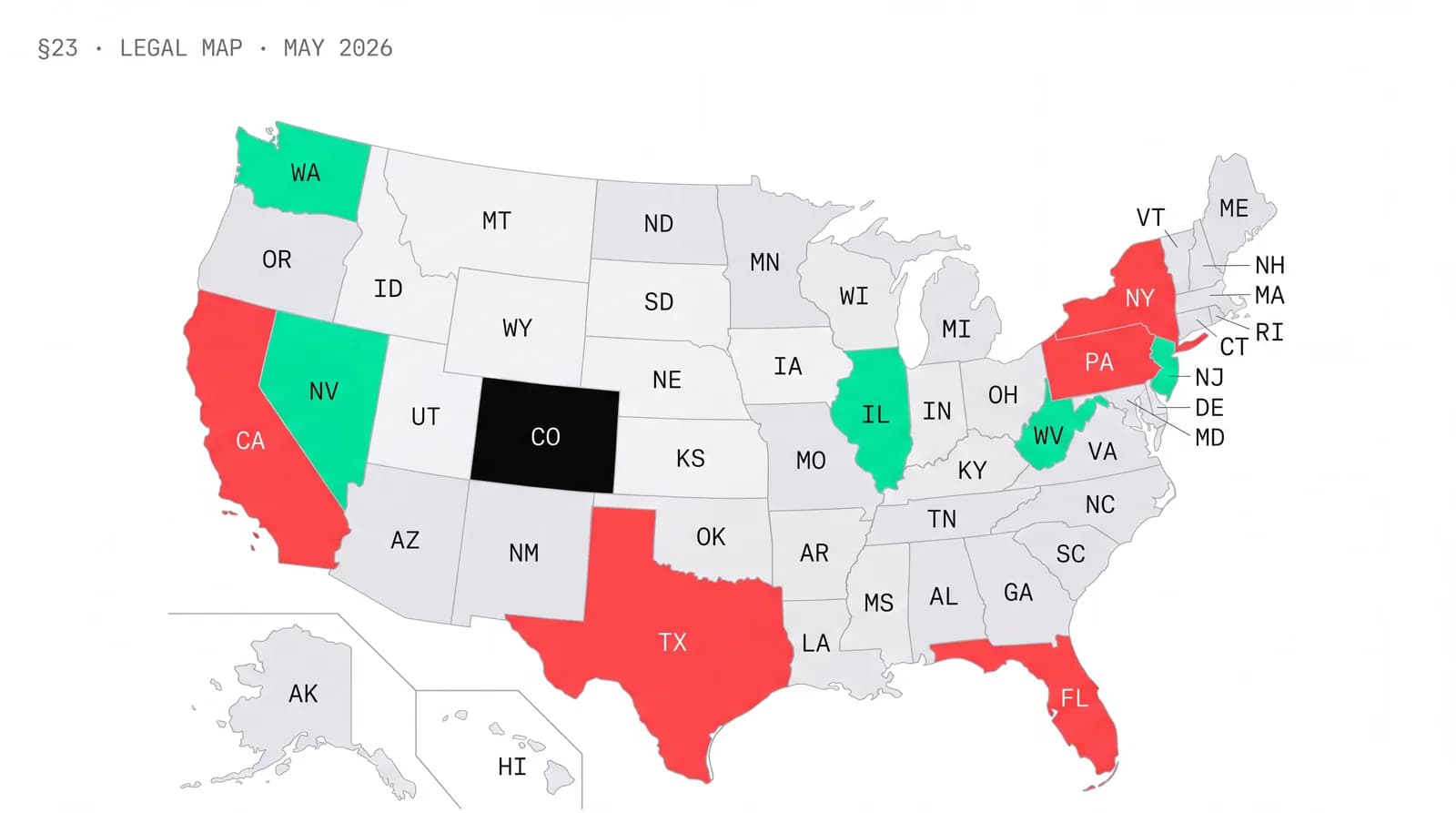
Prediction markets are legal at the federal level when they run on an exchange registered with the Commodity Futures Trading Commission (CFTC). The state level is a different matter. As of mid-October 2026, 21 states are contesting Kalshi in court or by order, three federal appeals courts have split on whether states can ban sports event contracts, and New Jersey has asked the Supreme Court to settle it. Political and economic contracts are mostly untouched, with two exceptions: Nevada and Washington have both forced Kalshi to stop offering election contracts to people in those states.
Answers in brief
- Are prediction markets legal in the US? Yes on CFTC-regulated exchanges. Which contracts you can trade depends on your state, mostly for sports.
- Is Kalshi legal in all 50 states? It accepts users in every state, but sports contracts are blocked or paused in Nevada and Michigan, Washington and Nevada block election contracts, and several other states may now enforce against it (OddsShopper tracker, October 15, 2026).
- Is Polymarket legal in all 50 states? No. Polymarket US is widely reported as unavailable in Arizona, Illinois, Massachusetts, Maryland, Michigan, Montana, Nevada and Ohio (OddsShopper).
- Is Robinhood legal? Yes. It is a CFTC-registered futures broker. Maryland and Nevada residents cannot trade its sports contracts, and Michigan residents cannot open new ones (Robinhood, October 2026).
- What did Kalshi v. CFTC decide? A federal district court ruled in September 2024 that the CFTC could not block Kalshi's election contracts. The CFTC dropped its appeal in May 2025, so that ruling stands.
- What is the open question? Whether federal commodities law stops states from treating sports event contracts as gambling. The Third Circuit said yes; the Ninth and Sixth Circuits said no.
Balance scale: CFTC-regulated prediction markets versus state restrictions
How federal regulation works
US prediction markets fall under the CFTC, which regulates derivatives under the Commodity Exchange Act (CEA). The CFTC treats a contract that pays out based on whether an event happens as a swap. Exchanges argue that because the CFTC has exclusive jurisdiction over swaps traded on registered exchanges, state gambling law cannot reach them. That argument is the core of every state fight.
A platform can reach US users in three ways.
1. Designated contract market (DCM)
A DCM is a CFTC-registered exchange. It must:
- register with the CFTC and accept ongoing oversight
- self-certify each contract before listing, with the CFTC able to review it
- run trade surveillance and market-integrity programs
- keep customer funds segregated
- clear trades through a registered derivatives clearing organization
DCMs offering event contracts in 2026 include KalshiEX (designated November 2020), QCX (bought by Polymarket in July 2025), Ludlow Exchange (Novig, designated June 16, 2026), Rothera (Robinhood's joint venture with Susquehanna), DraftKings' exchange (built on Railbird, which DraftKings bought in October 2025), Crypto.com | Derivatives North America, ForecastEx and CME Group, whose contracts FanDuel Predicts lists.
2. No-action relief
A narrower route: CFTC staff say they will not take enforcement action against a specific product on stated terms. PredictIt runs this way. The CFTC tried to withdraw its relief in 2022, PredictIt sued, and the two sides settled in 2025. A July 2025 CFTC letter let PredictIt raise its per-market limit from $850 to $3,500 and removed the old 5,000-trader cap (CFTC Letter 25-20).
3. Broker access
A registered futures commission merchant (FCM) can give its customers access to contracts listed on DCMs. Robinhood works this way. Robinhood Derivatives, LLC routes event contracts to KalshiEX, ForecastEx, Rothera or the North American Derivatives Exchange (Crypto.com's) (Robinhood). FanDuel Predicts and DraftKings Predictions also sit in front of registered exchanges.
Swap or bet: the legal argument
The exchanges' case runs like this. A swap has value that depends on a future event, trades on a regulated two-sided exchange with continuous prices, and settles against an objective source. A bet is a wager against a house that sets the line and takes the other side. A Kalshi contract on "Will the Fed cut rates in December 2026?" fits the first description: it settles on the FOMC statement, prices move as traders buy and sell, and Kalshi does not take your trade.
States answer that the label does not change the substance. A contract that pays out if the Chiefs win is, in their view, a sports bet. Courts have increasingly agreed with them on sports. The Ninth Circuit wrote in August 2026 that Kalshi's contracts are "sports gambling, regardless of whether Kalshi calls them swaps." A California tribal case decided in September noted that Kalshi now offers point spreads, totals, player props and parlays (SBC Americas).
Kalshi v. CFTC: how election contracts became legal
The CFTC had blocked Kalshi from listing contracts on which party would control Congress, relying on a CEA provision (Section 5c(c)(5)(C)) that allows it to bar event contracts involving "gaming" and other listed activities against the public interest. Kalshi sued.
- September 2024. The US District Court for the District of Columbia ruled for Kalshi.
- October 2024. The D.C. Circuit refused to pause that ruling while the CFTC appealed, and Kalshi listed election contracts before the November 2024 election.
- May 2025. The CFTC moved to drop its appeal, and the D.C. Circuit dismissed it. The district-court ruling stands (Covers, May 2025).
Earlier versions of this guide said the D.C. Circuit ruled on the merits in 2024. It did not; the appeal was dropped.
Federal permission does not settle the state question for elections either. Nevada's state-court injunction covers Kalshi's election contracts, and a Washington court order from August 13, 2026 requires Kalshi to stop offering sports, election and several other categories to Washington users (OddsShopper).
The sports fight: where the courts stand
| Court | Date | Result |
|---|---|---|
| Third Circuit (New Jersey) | Apr 6, 2026 | 2-1 for Kalshi; state cannot enforce. New Jersey petitioned the Supreme Court on Sep 2 (No. 26-299) |
| Ninth Circuit (Nevada) | Aug 28, 2026 | 3-0 against Kalshi; state may apply gambling law. Kalshi sought rehearing Sep 9 |
| Ninth Circuit (California tribes) | Sep 16, 2026 | Tribes likely to win under the Indian Gaming Regulatory Act; sent back to district court |
| Sixth Circuit (Ohio, Tennessee) | Sep 25, 2026 | Against Kalshi; Kalshi sought rehearing Oct 9 |
| Tenth Circuit (Utah) | Sep 8, 2026 | Emergency injunction denied; Utah may enforce during appeal |
| Fourth Circuit (Maryland) | Argued May 7, 2026 | Pending; Maryland has paused enforcement |
| Second Circuit (New York, Connecticut) | Pending | Kalshi appealing losses in both states |
| Seventh Circuit (Wisconsin) | Pending | CFTC's injunction request denied Jul 29 |
| Eighth Circuit (Iowa) | Pending | Kalshi appealed Sep 15 |
Source: OddsShopper Kalshi legal tracker, updated October 15, 2026.
A split this clear between circuits is the usual reason the Supreme Court takes a case. If it takes New Jersey's petition, a decision would probably come in 2027.
State-by-state reference (as of October 15, 2026)
This table lists every state where at least one major platform has a restriction or a live legal fight. Always check in the app before depositing.
| State | Kalshi | Polymarket US | Robinhood (sports) | FanDuel / DraftKings sports |
|---|---|---|---|---|
| Arizona | Federal injunction protects Kalshi (May 5); state asked Ninth Circuit to lift it for sports | Not available | Available | No |
| Connecticut | Injunction denied Aug 10; Dec 2025 cease-and-desist stands; appeal pending | Available | Connecticut order applies (our Robinhood review) | No |
| Illinois | Partial injunction for Kalshi Oct 2 (state guide) | Not available | Available | No |
| Iowa | Injunction denied Sep 8; appeal pending | Available | Available | No |
| Kentucky | State and federal suits pending | Available | Available | No |
| Maryland | State paused enforcement pending Fourth Circuit | Not available | Not available | No |
| Massachusetts | State-court sports injunction stayed; SJC ruling pending (state guide) | Not available | Available | No |
| Michigan | Sports dark under Sep 1 injunction | Not available | No new sports since Sep 9 | No |
| Minnesota | State platform-ban law preliminarily enjoined | Available | Available | Yes (MN is a sports state) |
| Missouri | AG cease-and-desist; no suit as of Oct 15 | Available | Available | No |
| Montana | State agreed not to enforce pending Ninth Circuit rehearing | Not available | Available | No |
| Nevada | No sports, election or entertainment contracts for anyone in Nevada (state guide) | Not available | Not available | No |
| New Jersey | Protected by Third Circuit ruling (state guide) | Sources conflict | Available | No |
| New Mexico | State and federal suits pending | Available | Available | Yes |
| New York | AG suit Jul 31; CFTC emergency order keeps Kalshi open (state guide) | Available | Available | No |
| Ohio | Sixth Circuit loss; state may enforce | Not available | Available | No |
| Rhode Island | Injunction motions argued Aug 3; no ruling | Available | Available | Yes |
| Tennessee | Kalshi's injunction stands until the Sixth Circuit mandate issues | Available | Available | No |
| Utah | Lost in district court; state may enforce during appeal | Available | Available | Yes |
| Washington | Court order bars sports, election and other categories | Available | Robinhood has stood down (our Robinhood review) | No |
| Wisconsin | CFTC injunction denied; appeal pending | Available | Available | No |
All other states and DC: no reported court order or enforcement action against Kalshi, Polymarket US or Robinhood as of mid-October 2026. FanDuel Predicts and DraftKings Predictions list sports contracts in 18 states: AK, AL, CA, DE, FL, GA, HI, ID, MN, ND, NE, NM, OK, RI, SC, SD, TX and UT (SI, RotoWire).
State guides: California, Texas, Florida, New York, Illinois, Massachusetts, Nevada, New Jersey.
Polymarket US
Polymarket bought QCX LLC and its clearinghouse, QC Clearing, for $112 million in July 2025. The CFTC's amended order of designation, announced on November 25, 2025, allows Polymarket to run an intermediated US platform and onboard customers and brokers directly (Covers). Earlier versions of this guide dated the deal to December 2025; that was wrong.
What US users should know:
- It is a separate product. Polymarket US requires identity checks, takes dollar deposits and runs under CFTC rules. The international, crypto-settled Polymarket is closed to US users, and reaching it by VPN breaks Polymarket's terms.
- It charges fees. Since July 1, 2026 the US app has charged takers a fee of Θ × contracts × price × (1 − price). Θ started at 0.06 and is now 0.0695, or about $1.74 per 100 contracts at 50 cents. Makers get a rebate (Polymarket US fee schedule, October 2026).
- State blocks are its own choice. We found no court order naming Polymarket in most of the eight blocked states. The list could shrink or grow.
See our Polymarket review and how to use Polymarket in the US.
Robinhood: the broker model
Robinhood Derivatives, LLC is a CFTC-registered futures commission merchant. It does not run its own order book for most contracts; it routes them to KalshiEX, ForecastEx, Rothera or Crypto.com's North American Derivatives Exchange. Since June 2026 some contracts, such as World Cup markets, trade on Rothera (Robinhood newsroom).
For users this means:
- Customer-funds protections apply at the FCM and exchange level, as with any futures account.
- State limits follow both Robinhood's own list and any court order hitting the underlying exchange. Robinhood's support page lists Maryland and Nevada (no sports) and Michigan (no new sports since September 9, 2026), and says other state limits may apply.
- Commission is 10% × price × (1 − price) per contract (5% with Gold), capped at $0.01, plus exchange fees of up to $0.01.
Sportsbook brands with prediction apps
FanDuel Predicts and DraftKings Predictions are the sportsbook companies' answer to Kalshi. Both list non-sports contracts widely and sports contracts only in 18 states, mostly ones where they have no sportsbook licence to protect. DraftKings is in 48 states (not Maine or New Hampshire) and runs its own exchange, DKeX, launched June 24, 2026 (SI). FanDuel lists contracts from CME Group and, since June 2026, from Crypto.com (Yogonet).
Timeline, 2024 to 2026
2024
- September: District court rules for Kalshi on election contracts. October: D.C. Circuit declines to pause the ruling; Kalshi lists election markets.
- November: Polymarket's presidential-winner market passes $3 billion in volume before the vote (The Block), on its offshore exchange, which US users were not allowed to use.
2025
- Early 2025: Kalshi expands sports contracts; state cease-and-desist letters follow from Nevada, New Jersey, Maryland and others.
- May: CFTC drops its appeal in the Kalshi election case.
- July: Polymarket buys QCX for $112 million. CFTC letter lifts PredictIt's limit to $3,500.
- October: DraftKings buys Railbird and its DCM licence.
- November 25: CFTC announces Polymarket's amended order of designation.
- December: Connecticut issues a cease-and-desist to Kalshi.
2026
- January 20: Massachusetts court enjoins Kalshi's sports contracts (later stayed).
- February 3: Crypto.com launches OG.
- April 6: Third Circuit rules for Kalshi in New Jersey.
- May 18: Nevada court orders Kalshi to geofence sports, election and entertainment contracts.
- June 16: Novig's Ludlow Exchange is designated a DCM. June 24: DraftKings launches DKeX.
- July 1: Polymarket US taker fees take effect. July 31: New York sues Kalshi.
- August 11: CFTC emergency order tells Kalshi to keep operating. August 13: Washington court order. August 28: Ninth Circuit rules against Kalshi in Nevada.
- September 1: Michigan injunction darkens Kalshi sports. September 2: New Jersey petitions the Supreme Court. September 16: Ninth Circuit rules for California tribes. September 25: Sixth Circuit rules against Kalshi in Ohio and Tennessee.
- October 2: Illinois court grants Kalshi a partial injunction.
The pattern is a federal layer that grew more permissive (election contracts, new DCMs, an active CFTC) and a state layer that has grown more hostile on sports.
What "legal" means
"Is this legal?" is really four questions.
1. Is the platform registered?
Kalshi: yes, CFTC DCM since 2020. Polymarket US: yes, through QCX. Robinhood: yes, CFTC-registered FCM routing to DCMs. Novig: yes, DCM since June 2026. PredictIt: operates under amended CFTC no-action relief.
2. Can I use it where I live?
That combines the platform's own state blocks with court orders. See the table above.
3. Is it taxable?
Yes. See are Kalshi event contracts taxable. State income tax varies.
4. Do other rules bind me?
Employer policies, professional licences, government-employee ethics rules or religious finance rules can restrict you even where the platform is legal and open. Check with whoever sets those rules.
A platform can pass test 1 and fail test 2 for you, or pass both and still need care on 3 and 4.
Identity checks (KYC)
Every CFTC-regulated platform verifies identity before you can fund or trade. Expect to give:
- your legal name as it appears on government ID
- date of birth
- a residential address (PO boxes are generally refused)
- a Social Security number or ITIN
- a photo of a driver's licence, passport or state ID
- a selfie for a liveness check
Anti-money-laundering rules require this of registered exchanges and brokers. A platform that serves US users without KYC is operating outside the federal system.
Approval usually takes minutes. Robinhood users who already passed its checks do not repeat them. Use the same name on your account, your bank and your tax return, because exchanges send tax forms and mismatches cause trouble later.
Minimum age is 18 on Kalshi, Robinhood, FanDuel Predicts and DraftKings Predictions, and 21 on Novig. Polymarket's own materials show both 18 and 21, so check at sign-up.
When to talk to a lawyer
Most people opening an account do not need one. It is worth paying for advice if:
- you hold a regulated job (lawyer, broker, government employee, military officer) and your employer or licensing body restricts trading. Ask your compliance office first.
- you trade large amounts (say, more than $100,000 a year in notional) and want to trade through an entity.
- you live in a state that is enforcing, such as Nevada, Michigan, Ohio, Utah or Washington, and want to understand your own exposure on sports contracts.
- you run a business around prediction markets, such as analytics, trading tools or affiliate content. FTC disclosure rules and CFTC rules on promotion apply.
FAQ
Are prediction markets legal in the United States?
Yes, on CFTC-regulated exchanges. Kalshi has been a DCM since November 2020. Polymarket US runs on QCX, which Polymarket bought in July 2025. Robinhood is a CFTC-registered broker routing to DCMs. Which contracts you can trade depends on your state, especially for sports.
Is Kalshi legal in my state?
Kalshi accepts users in all states, but sports contracts are off in Nevada and Michigan, election contracts are off in Nevada and Washington, and Ohio, Utah and others may now enforce. Check the table above and the app.
Is Polymarket legal in my state?
Polymarket US is widely reported as unavailable in AZ, IL, MA, MD, MI, MT, NV and OH. One guide adds New Jersey. The sign-up screen is the final word.
Is Robinhood legal?
Yes. Maryland and Nevada residents cannot trade its sports contracts, Michigan residents cannot open new ones, and other state limits may apply.
What was Kalshi v. CFTC?
Kalshi's suit against the CFTC over election contracts. A federal district court ruled for Kalshi in September 2024, the D.C. Circuit declined to pause the ruling in October 2024, and the CFTC dropped its appeal in May 2025.
What was the QCX acquisition?
Polymarket bought QCX LLC, a CFTC-licensed exchange, and its clearinghouse for $112 million in July 2025. The CFTC's amended order, announced November 25, 2025, let Polymarket serve US customers directly.
Can I use a VPN to reach offshore prediction markets?
You can try, and you should not. It breaks the platforms' terms, accounts found doing it can be frozen, and state regulators in Nevada have shown they test geofences.
Are sports contracts treated differently?
Yes. They are the target of nearly every state action. Three appeals courts have split on whether states can ban them, and New Jersey has asked the Supreme Court to decide.
Do all CFTC-regulated platforms require KYC?
Yes. Expect name, date of birth, address, SSN or ITIN, a photo ID and a selfie.
What happens if I trade where a platform is not allowed?
Usually the platform acts: it blocks the account, freezes funds or closes positions. Action against individual traders is rare, but state laws, such as Minnesota's 2026 statute (now enjoined), can target anyone who facilitates trading.
How fast does state availability change?
Fast. In the six weeks from August 28 to October 2, 2026, three appeals courts and two state courts issued major rulings. Check the app before each deposit.
Are prediction-market profits taxable?
Yes. See are Kalshi event contracts taxable.
Where to go next
- Pick a platform: Kalshi vs Polymarket
- Check your state: all state guides
- Safety and custody: is Polymarket safe?
- Tax: are Kalshi event contracts taxable?
- Elections specifically: can you bet on elections in the US?
Next: How to read prediction-market prices
Following the 2026 midterms? Our live midterm prediction market tracker shows current Senate and House pricing, updated automatically, with the closest races sorted to the top.
Weekly roundup · Free
Get the Bellwether weekly market roundup
One short email each Sunday: what moved on Kalshi and Polymarket, the regulation news that mattered, and the markets worth watching.
One email per week · Unsubscribe anytime · We don't share your email