Prediction markets explained: how they work, what they predict, and why they matter in 2026
How we make money: we earn a commission if you sign up for Polymarket or subscribe to KalshiSpy through our links. We earn nothing from Kalshi, Robinhood, FanDuel, DraftKings, Novig or OG. Rankings are not for sale. Full disclosure
New here? Start at the top. Already trading? See the sign-up guide for opening accounts in a sensible order. Just want a platform? Read Kalshi vs Polymarket.
A prediction market is an exchange where you buy and sell contracts that pay $1 if something happens and nothing if it does not. The price, somewhere between 1 cent and 99 cents, reads as the market's estimate of the chance. In the US the business has grown fast and changed shape in 2026. Kalshi now handles about 76% of tracked volume, against about 12% for Polymarket US and 5% for Polymarket's international exchange (DeFi Rate, September 16 to October 15, 2026). Sportsbook companies have launched their own apps. And states are fighting the exchanges in court over sports.
This guide covers the mechanics, the money, the history, the platforms, the law and the risks.
Answers in brief
- What is a prediction market? An exchange for binary contracts on future events. Each pays $1 if the event happens and $0 if it does not.
- How does it work? Buyers and sellers meet on an order book. The price between $0 and $1 is read as a probability.
- How do the exchanges make money? Mostly trading fees, plus interest on customer cash and some payment fees. They do not take the other side of your trade.
- Are they legal? Yes, on CFTC-regulated exchanges. States restrict some contracts, mostly sports. See are prediction markets legal?
- Are they gambling? Federal regulators treat them as swaps. Several courts ruled in 2026 that sports contracts are gambling under state law.
- The largest US platforms in 2026: Kalshi by a wide margin, then Polymarket US, then DraftKings Predictions, Novig and Robinhood's Rothera exchange (DeFi Rate).
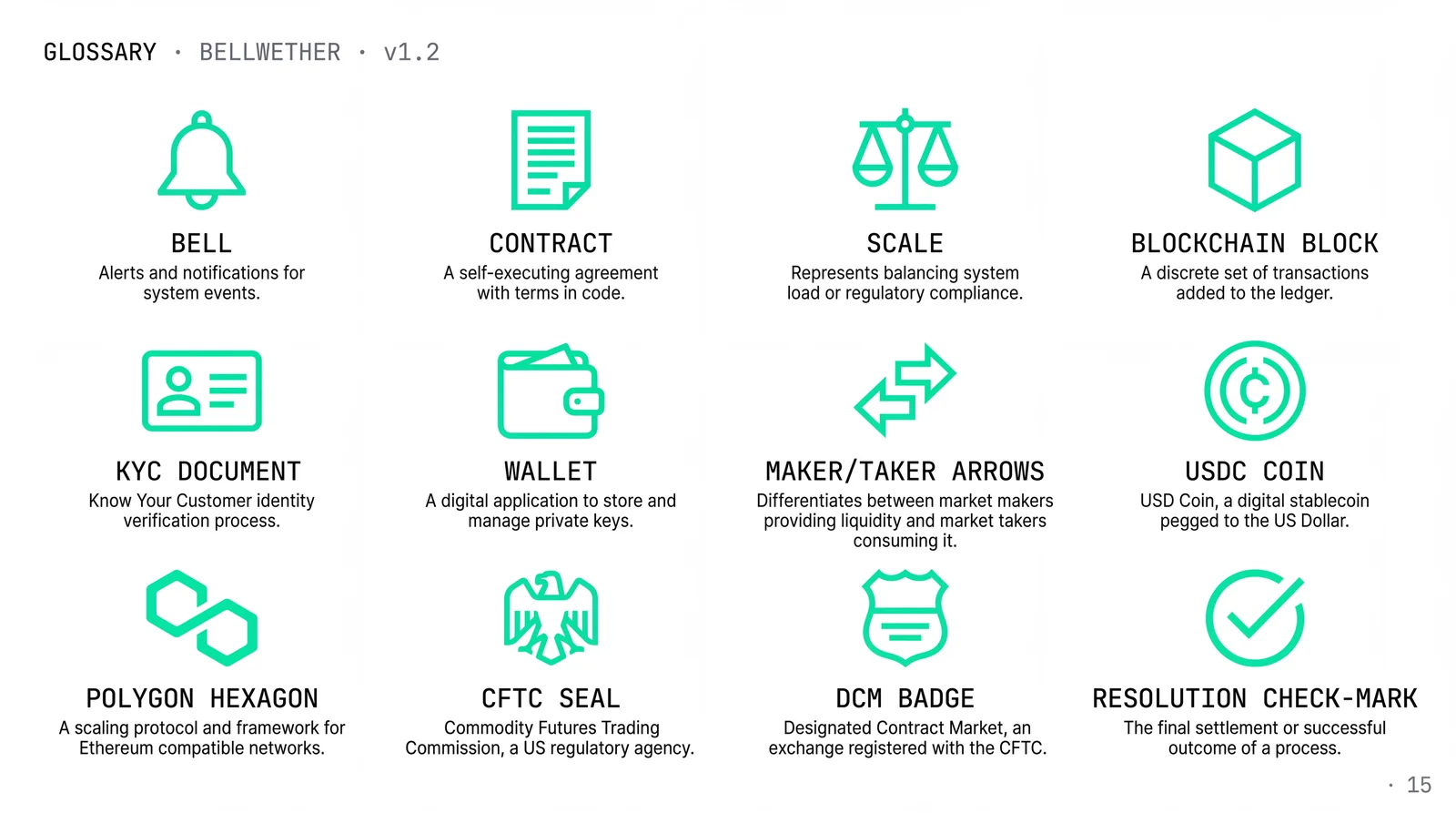
Bellwether glossary: contract, scale, blockchain block, KYC, wallet, maker and taker arrows, USDC, Polygon, CFTC seal, DCM badge
What is a prediction market?
A prediction market is a marketplace for contracts whose value depends on whether a specific future event happens. Most contracts are binary. They pay $1 if the event happens and $0 if it does not.
Think of a coupon that says: "Worth $1 if the Federal Reserve cuts rates at its December 2026 meeting. Otherwise worth nothing." What would you pay for it today?
If you think a cut is nearly certain, perhaps 90 cents. A coin flip, about 50 cents. Nearly impossible, perhaps 5 cents. Now picture thousands of people answering the same question with their own money, on an exchange where they can buy and sell the coupon whenever they like. The price they settle on is the market's implied probability.
That is a prediction market. The coupon is called an event contract. Everything else (platforms, fees, regulators, lawsuits) is built around that one idea.
How prediction markets work
There are four parts: the contract, the price, the order book and the resolution.
1. The contract
Every contract is tied to a precisely worded yes-or-no question. The wording decides what counts as "yes." A market on "Will the Fed cut rates in December 2026?" has to say:
- which decision (the FOMC meeting ending December 9, 2026, for example)
- what counts as a cut (a lower federal funds target range than after the previous meeting)
- what source settles it (the FOMC statement on federalreserve.gov)
You can buy either side. Buy YES if you think the Fed will cut, NO if you think it will not. Every YES contract bought is matched by a NO on the other side.
2. The price
Prices run from $0.00 to $1.00. A YES contract at $0.65 means:
- you pay $0.65 now
- if the event happens, you get $1.00 (a $0.35 profit)
- if it does not, you get nothing (a $0.65 loss)
YES and NO prices add up to about $1.00. If YES is $0.65, NO is about $0.35, because exactly one of them will pay. When the two drift apart, traders buy the cheap side and close the gap.
That is why the price is read as a probability. At $0.65, the market is saying there is roughly a 65% chance.
3. The order book
You do not buy from the platform. You buy from another trader. Every market has an order book: a live list of bids (offers to buy at a price) and asks (offers to sell). When a bid meets an ask, a trade happens.
There are two roles:
- Makers post limit orders that wait on the book. They add liquidity, and some exchanges pay them a rebate.
- Takers fill orders already on the book. They remove liquidity and usually pay the fee.
The deeper the book, the narrower the gap between the best bid and best ask, and the easier it is to trade without moving the price. Liquidity is the main difference between a serious market and a thin one.
4. Resolution
When the event happens or the deadline passes, the contract resolves. Holders of the winning side get $1.00 per contract; holders of the losing side get nothing.
Most resolutions are automatic. When the facts are unclear, the contract's rulebook decides. On Kalshi, each contract's terms are self-certified with the CFTC and name the source that settles it. Polymarket's international exchange uses the UMA oracle, where token holders vote on disputed outcomes. Read the rules before you trade.
A trade, step by step
Say it is October 2026 and the Fed's December meeting is two months away. A Kalshi market on "Will the Fed cut rates in December 2026?" shows:
- YES = $0.45
- NO = $0.55
The market implies a 45% chance of a cut.
You think it is closer to 60%, so YES looks cheap. You buy 100 YES contracts at $0.45:
100 × $0.45 = $45
If the Fed cuts, you receive:
100 × $1.00 = $100
Your possible profit is $55 before fees. If the Fed holds, you lose the $45. You cannot lose more than you paid on a binary contract, which is different from shorting a stock or selling an uncovered option.
Kalshi's taker fee on that order would be about 0.07 × 100 × 0.45 × 0.55, or $1.74 (DeFi Rate fee guide).
Now the November jobs report comes in weak. Traders price in a higher chance of a cut, and YES rises to $0.62. You can:
-
Hold to resolution. Collect $100 if the Fed cuts, lose $45 if it holds.
-
Sell now. Sell 100 YES at $0.62:
100 × $0.62 = $62 Profit before fees: $62 − $45 = $17
You never have to wait for the result, as long as someone is willing to trade. That ability to exit is also what keeps the price current: it moves every time new information arrives.
Why prices track probabilities
The case that market prices are good probability estimates draws on Friedrich Hayek's work on prices as information, and on later research by Robin Hanson and Justin Wolfers, among others. The argument:
- Information is spread across many people. No one knows everything about the Fed's next move, but traders together hold a lot of relevant knowledge.
- Traders act on what they know. Someone who thinks a cut is 70% likely buys YES below $0.70 and sells above it.
- The price combines those views. Trading continues until no one expects to profit from moving the price further.
- Money corrects mistakes. A trader who spots a wrong price has a direct reason to fix it. A pundit does not.
The evidence mostly supports this. The Iowa Electronic Markets, running since 1988, has often beaten polls on US presidential elections. A 2004 paper by Wolfers and Eric Zitzewitz in the Journal of Economic Perspectives reviewed accuracy across political and economic events. Markets fail too: thin markets can be pushed around, and traders who share the same blind spot can all be wrong together (see Brexit, below). On liquid questions with clear resolution rules, the price is usually as good an estimate as you will find. For more, read how to read prediction-market prices.
How prediction markets make money
These are exchanges. They earn from the trades that happen on them, not from your losses.
1. Trading fees
The largest source. Fee formulas differ:
- Kalshi charges takers 0.07 × contracts × price × (1 − price), rounded up to the cent. The fee is highest at 50 cents: about $1.75 per 100 contracts, which is roughly $3.50 for every $100 you put in. It falls toward zero near 1 or 99 cents. Some markets use a lower multiplier (DeFi Rate).
- Polymarket US has charged takers since July 1, 2026. The multiplier started at 0.06 and is now 0.0695, so the fee is 0.0695 × contracts × price × (1 − price). That peaks at about $1.74 per 100 contracts at 50 cents (about $3.48 per $100 put in). Makers earn a rebate of up to 0.0125 × contracts × price × (1 − price), moving to volume tiers from October 19, 2026 (Polymarket US fee schedule). Polymarket's international exchange has its own schedule.
- Robinhood charges a commission of 10% × price × (1 − price) per contract (5% with Gold), capped at $0.01, plus exchange fees of up to $0.01 (Robinhood).
- DraftKings Predictions charges $0.01 per contract at 1–19 cents and 97–99 cents, and $0.02 at 20–96 cents (SI).
- Novig charges nothing on pregame straight trades and a taker fee with a 0.03 multiplier on live trades: $0.75 on 100 contracts at 50 cents (Action Network).
2. Maker rebates
Some exchanges pay market makers to post orders. That costs the exchange money, but every resting order eventually meets a taker who pays a fee, and tighter prices attract more takers. Active market makers can end up paying little or nothing net.
3. Payment fees
A smaller source. ACH deposits are usually free. Third-party guides put Kalshi's debit-card deposit fee at about 2% (next.io). Check the deposit screen before you pay.
4. Interest on customer cash
Exchanges hold large customer balances and earn interest on them. Kalshi passes some back: a variable 3.50% APY on balances of $250 or more, with an SSN required for interest above $10 a year (Kalshi help center, October 2026). Robinhood also pays interest on brokerage cash. Most others keep the spread.
5. Liquidity programs
Several platforms pay market makers who keep tight quotes for set hours. The aim is deeper order books, which draw more traders, who pay more fees.
These are exchange businesses: small fees on large volume, plus interest. (See our Kalshi review for the fee math in more detail.)
A brief history
The idea is old. Lloyd's of London wrote policies on uncertain events in the 1700s, Britons bet on elections in the 1800s, and American "bucket shops" sold bets on price moves in the late 1800s. The modern era starts in 1988.
1988: the Iowa Electronic Markets
The University of Iowa's business school launched the Iowa Electronic Markets as a research project, with a $500 limit per trader. It let people trade contracts on the presidential election and often beat the polls. It still runs. Its value was credibility: it showed in academic settings that these markets work.
2000s: Intrade
Intrade, based in Ireland, brought the idea to a global retail audience. It had real liquidity on US elections and world events, and 2008 was its peak. In 2012 the CFTC sued it for offering unregistered options to Americans. In March 2013 it halted trading after finding "financial irregularities," and never reopened. Every later platform shaped its regulatory strategy around that failure.
2014: PredictIt
PredictIt launched in 2014, run by Victoria University of Wellington under a CFTC no-action letter. Tight limits ($850 per market at the time), high fees (10% of profits and 5% on withdrawals) and a small menu kept it niche, but it was the main US home for political markets for years. The CFTC tried to withdraw its letter in 2022, PredictIt sued, and the two settled in 2025. A July 2025 letter moved operations to a US nonprofit, raised the limit to $3,500 and removed the 5,000-trader cap (CFTC Letter 25-20).
2018: Augur
Augur was the first serious decentralized prediction market, on Ethereum. The code worked. The product did not: high gas fees, slow resolution and thin books kept it small.
2020: Polymarket
Polymarket launched in 2020 on Polygon, a cheaper network than Ethereum, with a clean web interface and fast market listing. It became the leading venue for political and world-event markets. In January 2022 the CFTC fined it $1.4 million and ordered it to stop serving Americans. In 2024 its presidential-winner market passed $3 billion in volume before the vote (The Block), on an exchange US users were not allowed to use.
Its route back was QCX, a small CFTC-licensed exchange and clearinghouse it bought for $112 million in July 2025. The CFTC's amended order, announced November 25, 2025, allowed it to serve US customers directly (Covers). The US app requires identity checks and takes dollar deposits.
2021: Kalshi
Kalshi was founded in 2018 by two MIT graduates and took the opposite path. It worked with the CFTC before launching, became the first designated contract market built for event contracts in November 2020, and went live in 2021. Early contracts were deliberately dry: CPI, jobless claims, Fed decisions. It won its election-contract case against the CFTC in district court in September 2024, and the CFTC dropped its appeal in May 2025. Sports contracts followed from January 2025, and with them the state lawsuits. By October 2026, 21 states were contesting Kalshi (OddsShopper).
2024 to 2026: brokers and sportsbooks
Robinhood began offering event contracts in late 2024 and built a prediction-markets hub in 2025. Since June 2026 it also routes contracts to Rothera, its joint-venture exchange with Susquehanna (Robinhood).
The sportsbooks followed. DraftKings bought Railbird and its exchange licence in October 2025, launched DraftKings Predictions in December 2025 and its own exchange, DKeX, on June 24, 2026. FanDuel Predicts lists contracts from CME Group and, since June 2026, Crypto.com. Crypto.com launched its own app, OG, on February 3, 2026. Novig became a designated contract market on June 16, 2026.
The line runs from the IEM to Intrade, PredictIt, Augur, Polymarket and Kalshi, and on to brokers and sportsbooks. Each learned from the failures before it. The idea, that prices reveal probabilities, has not changed since 1988.
The main US platforms in 2026
Shares below are of tracked contract volume from September 16 to October 15, 2026 (DeFi Rate).
Kalshi (about 76% of volume)
CFTC designated contract market since 2020. Dollar funding by ACH, debit card or wire. Markets in economics, politics, sports, weather, culture and crypto. Pays a variable 3.50% APY on balances of $250 or more. Sports and some other contracts are restricted in several states. Our score: 4.6/5 (methodology).
Polymarket US (about 12%) and Polymarket international (about 5%)
The US app runs on QCX and takes dollar deposits. Polymarket's international exchange, which settles in USDC on Polygon, is closed to US users. The international side did $4.7 billion in September 2026. Polymarket US is not available in eight states. Our score: 4.5/5.
Robinhood
Prediction markets inside the Robinhood brokerage app, routed to KalshiEX, ForecastEx, Rothera or Crypto.com's exchange. Rothera alone had about 1% of tracked volume. Easiest for existing Robinhood users. Our score: 4.0/5.
DraftKings Predictions (about 3%) and FanDuel Predicts
The sportsbook brands' prediction apps. Both list sports contracts in 18 states and non-sports contracts more widely. Not yet scored.
Novig (about 2%)
Sports-focused exchange, CFTC-designated since June 16, 2026, 21+. Not yet scored.
OG
Crypto.com's prediction app on its CFTC-registered exchange, with sports, economic, political and entertainment markets. Not yet scored.
PredictIt
The original US academic market, now with a $3,500 per-market limit. Mostly US politics.
ProphetX and others
ProphetX, Underdog's exchange and Gemini each had about 1% or less of tracked volume.
If you are choosing one to start with, Kalshi has the widest menu, Polymarket US has the deepest political catalog among the alternatives, and Robinhood is simplest if you already use it.
Read more: Kalshi vs Polymarket on fees, liquidity and state availability, our Kalshi review, our Polymarket review and our Robinhood review.
What you can trade
Almost anything with a verifiable outcome and a set resolution date. Common categories on US platforms in 2026:
- Politics. Elections, primaries, control of Congress, cabinet appointments, Supreme Court confirmations, foreign leadership changes.
- Economics. Fed decisions, CPI, PCE, jobless claims, GDP, payrolls, unemployment.
- Sports. Game winners, and on some platforms point spreads, totals, player props and parlays. Futures on championships, MVPs and the World Cup.
- Crypto. Bitcoin and Ether price ranges, ETF flows, regulatory decisions.
- Weather and climate. Daily high temperatures, hurricane counts, snowfall.
- Culture. Oscars, Grammys, box office, music charts, Super Bowl halftime.
- World events. Ceasefires, treaties, sanctions, leadership changes.
- Tech and science. Product launches, AI benchmarks, space missions, FDA approvals.
What limits the menu is resolution clarity. "Will the Fed cut in December 2026?" is easy: one statement, one date. "Will the economy be strong in 2027?" is not, because no single source defines "strong." Good contracts name the source in the rules.
Examples that mattered
2008 US election. Intrade priced an Obama win well before election day, and the price moved sharply toward him during the September 2008 financial crisis.
2016 Brexit vote. Markets got it wrong on the day, pricing Remain as likely. The lesson: a market reflects the people trading it. If they share a bias, the market can be wrong in the same direction.
2024 US election. Polymarket's presidential-winner market passed $3 billion in volume before the vote (The Block) and priced the result before the networks called it. It was also the first cycle with CFTC-regulated election contracts on Kalshi.
Fed decisions, 2022 to 2026. CME fed funds futures and prediction markets both price every FOMC meeting, and financial reporters now quote both.
Super Bowl LX, February 2026. DeFi Rate tracked $833.2 million of Super Bowl-related volume on Kalshi and $795.3 million on Polymarket (DeFi Rate). Kalshi's own count, which includes more markets, was over $1 billion.
Russia-Ukraine, 2022 to 2026. Polymarket has run markets on ceasefire timing and negotiations throughout the war.
When a question has a clear resolution date and real liquidity, prices tend to move before the news coverage does.
How prediction markets differ from sportsbooks
Legally, the federal government treats CFTC-regulated event contracts as swaps, not bets. That is the basis for the exchanges' claim that federal law displaces state gambling law. Courts have split on it for sports: the Third Circuit agreed with Kalshi in April 2026, and the Ninth and Sixth Circuits disagreed in August and September.
In practice, prediction markets share features with both betting and trading. They carry risk of loss on uncertain outcomes, like betting. They run as two-sided exchanges with public prices, like financial markets.
The structural differences from a sportsbook:
- No house line. A sportsbook sets odds with a margin built in (about 4.5% on standard -110 lines) and takes the other side. An exchange matches you with another trader and charges a fee.
- Two sides. You can buy YES or NO on every contract.
- Exit any time. You can sell back into the market whenever there is a buyer. Sportsbook cash-out offers are usually priced below fair value.
- Visible order book. You can see bids and asks. A sportsbook shows only its own price.
These differences are real, and they are why the CFTC classifies event contracts as it does. But paying money now for a payout that depends on a game is close enough to a bet that the courts are divided. State regulators and tribes in Nevada, Massachusetts, Michigan, Ohio, New York, California and elsewhere argue that the substance is sports betting whatever the label.
For you as a trader, the label does not change the exposure. Treat the money as risk capital. (For the Kalshi-specific version, read is Kalshi gambling?.)
Are prediction markets gambling?
Under federal law, no. CFTC-regulated event contracts are swaps, and the exchanges listing them are designated contract markets. The same category covers commodity futures and interest-rate swaps.
Under state law, it depends on the state and the contract. Sports contracts are where states have won. The Ninth Circuit wrote in August 2026 that Kalshi's sports contracts are "sports gambling, regardless of whether Kalshi calls them swaps." Election and economic contracts have faced far fewer challenges.
A one-line version for a friend: "Federally regulated as a financial product. Several states and courts call the sports contracts gambling. Either way, you are trading against other people and you can lose what you put in."
Most platforms say "trading" rather than "betting." That reflects the exchange structure, and it is also legal positioning. Treat the activity as financially risky regardless.
Are prediction markets legal?
On CFTC-regulated platforms, yes at the federal level. The full state picture is in are prediction markets legal in the US?. The short version as of mid-October 2026:
- Kalshi accepts users in all states, but sports contracts are off in Nevada and Michigan, election contracts are off in Nevada and Washington, and Ohio, Utah and other states may now enforce (OddsShopper).
- Polymarket US does not serve Arizona, Illinois, Massachusetts, Maryland, Michigan, Montana, Nevada or Ohio.
- Robinhood blocks sports contracts for Maryland and Nevada residents and new sports positions for Michigan residents.
- FanDuel Predicts and DraftKings Predictions list sports in 18 states.
- PredictIt runs under amended CFTC no-action relief.
- Non-US residents generally cannot use the US platforms. US residents cannot use Polymarket's international exchange, and a VPN breaks its terms.
Check the platform's state screen before you deposit. This page can go out of date within weeks.
State guides: California, Texas, Florida, New York, Illinois, Massachusetts, Nevada, New Jersey.
Who uses prediction markets
Retail traders. The largest group by headcount. They trade for interest, to hedge an outcome they care about, or for entertainment.
Professional traders and market makers. Fewer people, much of the volume. They quote prices, run arbitrage between platforms and hedge other positions. Susquehanna's stake in Rothera shows how far trading firms have moved in.
Journalists and analysts. Dow Jones agreed in January 2026 to put Polymarket data across the Wall Street Journal, Barron's and MarketWatch (Business Wire). Reporters now quote market odds on elections and Fed decisions.
Funds. Some use prediction-market prices as one input for macro views. Position sizes are still small by fund standards.
Academics. The longest-standing group, using the IEM, PredictIt and now the large exchanges to study forecasting.
Sports fans. The fastest-growing group since Kalshi added sports in 2025, and the reason sportsbook companies launched their own apps.
How the news media uses them
The largest change since 2024 is that market prices now appear in mainstream coverage.
- Dow Jones and Polymarket announced an exclusive data partnership on January 7, 2026. Polymarket odds appear on WSJ, Barron's, MarketWatch and Investor's Business Daily pages, and Dow Jones planned an earnings calendar showing market-implied expectations (Business Wire).
- Financial reporters routinely quote Kalshi and CME prices before Fed meetings.
- Election coverage in 2024 and the 2026 midterms regularly cites market odds alongside polls.
This creates a loop. Coverage brings readers to the markets; some become traders; more traders mean deeper books and better prices; better prices get quoted more.
The risks
1. Losing your money. Any contract can go to zero, and there is no FDIC-style insurance on positions. If you buy YES at $0.45 and the event does not happen, you lose $0.45 per contract.
2. Thin markets. Headline markets (presidential races, NFL games, Fed decisions) are deep. Obscure ones can have spreads so wide that a small order moves the price. Check the order book first.
3. Manipulation. Thin markets can be pushed by one determined trader. Regulated exchanges run surveillance, which helps but does not remove the risk. A Columbia University study cited by DeFi Rate estimated that roughly 25% of Polymarket's historical volume reflected wash trading (DeFi Rate).
4. Legal risk. State courts can switch off whole categories with little notice. Kalshi's Michigan sports markets went dark under a September 1, 2026 injunction, and New York is seeking at least $36 billion from Kalshi. A ruling can freeze or close positions.
5. Resolution disputes. Most settle cleanly. Some do not, usually when the facts are messy ("Did the candidate concede by date X?" when the concession came a day later). Read the rules and know the source.
None of these should stop you if the subject interests you. They should stop you from putting in money you cannot afford to lose.
How to start
1. Pick a platform. Kalshi has the widest menu and most volume. Polymarket US has a deep political catalog if your state allows it. Robinhood is simplest if you already have an account.
2. Check your state. Use our state guides and the platform's own sign-up screen.
3. Complete identity checks. Name, date of birth, address and Social Security number, plus a photo ID. It usually takes minutes.
4. Fund the account. ACH is the cheapest method on Kalshi. Polymarket US takes cards, bank transfers and Apple Pay. Start small; $50 to $200 is enough to learn.
5. Make a small first trade. Pick a topic you know. Buy 5 to 20 contracts. Watch the price. Sell or hold to resolution to see how both feel.
6. Read the rules. Before every trade, know what counts as YES and what source decides it.
7. Size positions to your balance. Putting half your balance into one trade is a common early mistake. A 70% event still fails 30% of the time.
The first month is mostly learning: what a tight market looks like, where fees bite, which categories have thoughtful traders. People who trade well have usually been at it for years.
Frequently asked questions
Are prediction markets legal in the United States?
Yes, on CFTC-regulated exchanges. Kalshi has been a designated contract market since November 2020. Polymarket US runs on QCX, bought in July 2025. Robinhood is a CFTC-registered broker. What you can trade depends on your state, especially for sports.
Are prediction markets gambling?
Federal regulators treat them as swaps. Several courts, including the Ninth and Sixth Circuits in 2026, have ruled that states may treat sports contracts as gambling. Either way, you can lose what you put in.
How are they different from sportsbooks?
Your counterparty is another trader, not the house. You can buy YES or NO. You can sell before the event ends. You can see the order book. Sportsbooks set their own odds and take the other side.
What is the difference between Kalshi and Polymarket?
Kalshi is a CFTC-regulated exchange since 2020, funded in dollars, paying a variable 3.50% APY on balances of $250 or more, and it handles most US volume. Polymarket runs a separate US app on its QCX exchange plus an international crypto exchange closed to US users. Polymarket US is unavailable in eight states. See Kalshi vs Polymarket.
Is there a minimum trade size?
Usually just the price of one contract, which can be as low as 1 cent. Most new traders start with $20 to $100 positions. Payment methods can have their own minimums.
Can I lose more than I put in?
Not on a standard binary contract. The most you can lose is what you paid.
Are winnings taxable?
Yes. How they are taxed is not settled. Kalshi issues 1099 forms; some traders report gains as ordinary income, others as capital gains, and some argue for Section 1256 treatment. See are Kalshi event contracts taxable? and talk to a tax professional.
How do the exchanges make money if they do not take the other side?
Trading fees, interest on customer cash and some payment fees. Kalshi's taker fee peaks at about $1.75 per 100 contracts at 50 cents. Polymarket US peaks at about $1.74.
How accurate are prediction-market prices?
Often very accurate on liquid markets with clear rules. The IEM has often beaten polls since 1988, and Polymarket priced the 2024 result before the networks called it. Accuracy falls on thin markets, vague questions and markets where traders share a bias, as with Brexit.
Can I trade without crypto?
Yes. Kalshi, Polymarket US, Robinhood, DraftKings Predictions, FanDuel Predicts and Novig all take dollars. Crypto is only needed for Polymarket's international exchange, which US users cannot use.
What happens if a resolution is disputed?
The contract rules decide. On Kalshi and Polymarket US, the exchange applies its rulebook. On Polymarket's international exchange, UMA token holders vote. Read the rules first.
How do I start if I have never traded?
Pick one platform, pass the identity check, deposit a small amount and make a small trade on a topic you know. Read the rules before each trade. Do not put in money you cannot afford to lose.
Where to go next
- Compare platforms: Kalshi vs Polymarket
- Kalshi in depth: our Kalshi review
- Polymarket in depth: our Polymarket review
- Polymarket as a US user: how to use Polymarket in the US
- The gambling question for Kalshi: is Kalshi gambling?
- Robinhood: our Robinhood review
- Your state: all state guides
We update this guide when platforms, fees or the law change. If you spot something out of date, write to us. We would rather fix it than be wrong.
Next: How to use Polymarket in the US
Following the 2026 midterms? Our live midterm prediction market tracker shows current Senate and House pricing, updated automatically, with the closest races sorted to the top.
Weekly roundup · Free
Get the Bellwether weekly market roundup
One short email each Sunday: what moved on Kalshi and Polymarket, the regulation news that mattered, and the markets worth watching.
One email per week · Unsubscribe anytime · We don't share your email