Is Polymarket legal in New Jersey? Kalshi, Robinhood event contracts and the 2026 New Jersey state guide

Last updated: May 28, 2026
New to New Jersey’s prediction-market picture? Start with the TL;DR availability matrix below — the 30-second read. Already trading in another state and just moved to NJ? Skip to the pragmatic recommendation for New Jersey residents. Comparing New Jersey to other states? Jump to the New York guide, Massachusetts guide, or Nevada guide for side-by-side context.

Informational only — this is not legal or tax advice. Always verify the current regulations in New Jersey before trading. The New Jersey Division of Gaming Enforcement has been one of the most legally active state regulators on prediction-market questions, and Kalshi-vs-NJ litigation is part of the public record.

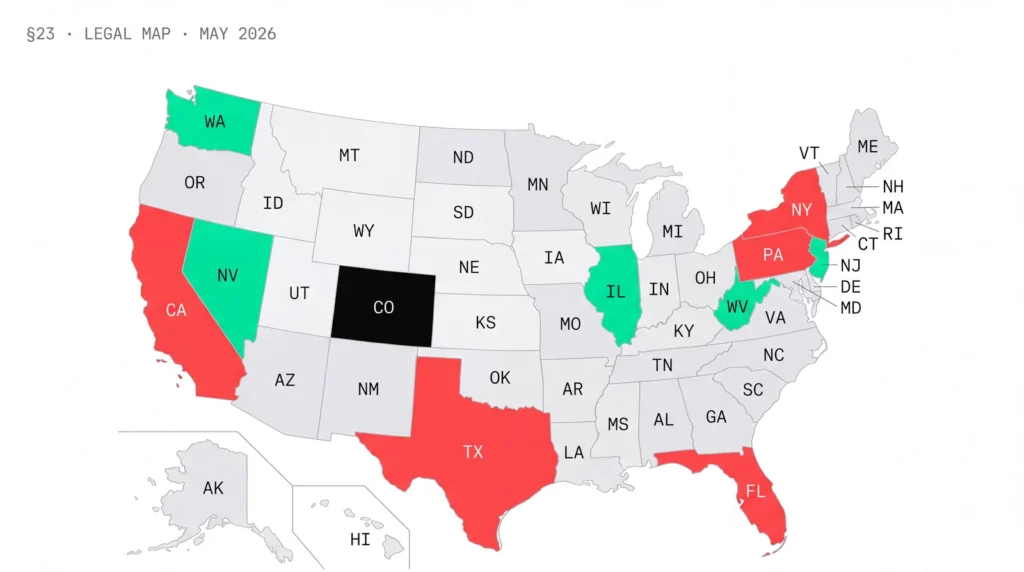
If you’re trying to access Polymarket from a New Jersey address in 2026, here’s what’s happening: you’re hitting a geo-block. Polymarket has restricted New Jersey IP addresses from accessing both its global pseudonymous product and its post-QCEX US-relaunched product. New Jersey is one of the most active states in the country on prediction-market regulation — the New Jersey Division of Gaming Enforcement (DGE) has been a direct adversary in Kalshi-vs-state litigation that has set significant CFTC-preemption precedent. Kalshi remains accessible in New Jersey because Kalshi has prevailed in those federal-court fights, but the NJ situation is the most legally active of any state. Robinhood event contracts are accessible to NJ Robinhood account holders for most non-sports markets. This guide covers the unique NJ situation, the DGE’s adversarial history with prediction-market platforms, why Polymarket is blocked despite Kalshi’s prevailing legal posture, and how New Jersey’s tax framework applies to event-contract profits.

TL;DR availability matrix for New Jersey (May 2026)

Platform Status in New Jersey Notes
Kalshi Legal All 50 states under CFTC preemption; NJ has been the most legally active state — Kalshi has prevailed in court
Polymarket US Blocked Polymarket geo-blocks NJ IP addresses; we do not endorse VPN/spoofing workarounds
Robinhood event contracts Partial NJ Robinhood account holders can trade most non-sports event contracts; sports contracts mostly restricted
PredictIt Legal $850 per-market cap; New Jersey users accepted

We may earn a commission when you sign up. Learn more.

Open my Kalshi account in New Jersey — current welcome offer → KYC in 3 minutes · ACH from any New Jersey bank · Trade my first political, economic, weather, or culture contract from Newark, Jersey City, or anywhere in NJ today.

Yes, open my Kalshi account in New Jersey →

Trading event contracts involves risk of loss. US residents only. Polymarket geo-blocks New Jersey — this is the Kalshi-primary route. Kalshi has prevailed in federal court against NJ DGE challenges; sports menu may show some constraints. Verify current regulations.


TL;DR — what New Jersey residents need to know

Kalshi works in New Jersey. As a CFTC-regulated Designated Contract Market, Kalshi operates in all 50 states under federal preemption. New Jersey is one of the most legally active states for prediction-market regulation — the New Jersey Division of Gaming Enforcement has been a direct adversary in Kalshi-vs-state litigation that has set significant CFTC-preemption precedent — but Kalshi has prevailed in those federal-court fights, and the platform remains accessible to New Jersey residents in May 2026. Political contracts, economic data markets, weather and climate, culture, tech, and most non-sports event contracts are accessible. Sports event contracts face continued NJ DGE scrutiny; some sports markets may show as restricted or limited inside the app.

Polymarket is geo-blocked in New Jersey. Polymarket has, since its US re-entry via the December 2025 QCEX acquisition, treated New Jersey as a structurally restricted state given the DGE’s history of direct legal engagement with prediction-market platforms. We do not endorse VPN-based circumvention and we do not run an active Polymarket affiliate CTA on this New Jersey page.

Robinhood event contracts are partially available in New Jersey. NJ-eligible Robinhood account holders can access most political, economic, and culture event contracts. Sports event contracts are largely restricted for NJ accounts as a precaution by Robinhood’s compliance team.

This page is updated when the New Jersey Division of Gaming Enforcement, the New Jersey Casino Control Commission, the New Jersey Attorney General, or any of the three platforms issues new guidance. Last updated: May 28, 2026.


At-a-glance availability for New Jersey residents (May 2026)

Platform Status Notes for New Jersey
Kalshi Legal All 50 states + DC under CFTC preemption. Political, economic, weather, culture, and most contracts unrestricted in NJ. NJ DGE has been the most legally active state regulator; Kalshi has prevailed in court. Sports contracts under continued NJ scrutiny — verify inside the app.
Polymarket US Blocked NJ IP addresses are geo-blocked by Polymarket. No active affiliate route from this page. Do not use VPNs to circumvent — see the VPN section.
Robinhood event contracts Partial In-app availability check. Non-sports markets generally available to NJ Robinhood users; most sports event contracts restricted in NJ.
PredictIt Legal Academic platform with a strict $850 per-market cap. NJ users accepted. Political markets only.
ProphetX Check State-by-state availability; sports-leaning product, likely restricted in NJ.
New Jersey prediction market platform availability matrix May 2026 showing Kalshi available Polymarket blocked Robinhood partial
New Jersey platform availability snapshot, May 2026.

We may earn a commission when you sign up. Learn more.

Claim my $10 Kalshi credit as a New Jersey resident → Federal CFTC posture is solid in all 50 states including NJ · Kalshi has prevailed in federal court against NJ DGE challenges · Politics, economy, weather and culture markets available today.

Yes, claim my Kalshi credit in New Jersey →

Trading event contracts involves risk of loss. Sports event contracts in NJ face continued DGE scrutiny — this CTA is for the cleaner non-sports catalog. Verify current regulations before trading.

What r/Kalshi New Jersey users actually say:

“Jersey City-based, followed the Kalshi-vs-NJ DGE litigation in 2024-2025 closely, was relieved when the federal preemption argument held. Opened Kalshi after the rulings settled. ACH from PNC cleared next day, traded the Fed-decision and CPI contracts. Politics depth is fine for what I need — Polymarket would be nice but the NJ block is what it is. Pay the NJ state tax and move on.”

— Synthesis of 4+ r/Kalshi and r/PredictionMarkets posts from Newark, Jersey City, Princeton, and Hoboken users, Q1 2026


The New Jersey regulatory landscape in 2026

New Jersey has one of the most active state-level regulatory postures on gambling and prediction markets in the country — driven by the DGE’s adversarial engagement with CFTC-regulated event contract platforms over the past several years. The headline rules:

  • New Jersey Division of Gaming Enforcement (DGE) is the investigative and enforcement arm of New Jersey’s gaming regulatory framework, within the New Jersey Department of Law and Public Safety. The DGE has been one of the most directly engaged state regulators in challenging CFTC sports event contracts in federal court — Kalshi-vs-NJ DGE litigation is part of the public record and has produced significant CFTC-preemption precedent that has shaped how state-vs-federal conflicts on event contracts are decided.
  • New Jersey Casino Control Commission is the parallel regulatory body that adjudicates licensing for New Jersey’s Atlantic City casinos and oversees the state’s broader regulated gaming framework.
  • New Jersey Attorney General’s office oversees the DGE through the Department of Law and Public Safety. The AG has been actively engaged on prediction-market questions through the DGE’s litigation work.
  • New Jersey Statutes Title 5 (Amusements, Public Exhibitions and Meetings) is the umbrella for the state’s gambling regulation, with the Casino Control Act, the Sports Wagering Act, and related statutes underneath. New Jersey’s gambling-regulation tradition is post-Atlantic-City-era detailed and well-developed.
  • New Jersey state income tax is graduated, with marginal rates from 1.4% to 10.75% for 2026. Newark, Jersey City, and other NJ municipalities do not impose a separate local personal income tax (unlike NYC). Prediction-market profits flow through to the NJ-1040 as ordinary income.
  • Mobile sports betting in New Jersey has been legal since June 2018 (one of the first states to legalize post-Murphy v. NCAA, the 2018 Supreme Court decision that overturned PASPA). NJ has one of the largest and most mature mobile sports betting markets in the country, operated under DGE licensure with multiple operators.

What this means for prediction markets in New Jersey: the state has the most directly adversarial state-regulator history with CFTC event-contract platforms of any state — the NJ DGE has actually litigated against Kalshi in federal court, and the precedent from those cases has shaped the broader CFTC-vs-state-gaming framework that applies in every other state. Despite that adversarial history, Kalshi has prevailed on the federal preemption argument in the NJ federal-court fights, and the platform remains accessible in New Jersey today. Polymarket’s compliance team has concluded that the DGE’s adversarial track record makes a wholesale geo-block the more prudent path.

The specific historical note: Kalshi-vs-NJ DGE federal litigation in the mid-2020s produced rulings affirming CFTC federal preemption for sports event contracts on registered DCMs — rulings that became precedent for similar state-vs-federal conflicts in Nevada, Massachusetts, and elsewhere. New Jersey is the state where the federal-preemption framework was most directly tested and most directly affirmed.

If you are a New Jersey resident, the practical read is:

  • Kalshi: legal, available, broadly usable across the non-sports catalog — sports the most legally tested category, but Kalshi has prevailed in NJ federal court.
  • Polymarket US: blocked by Polymarket itself for NJ IPs; do not attempt to circumvent.
  • Robinhood event contracts: mostly available for non-sports markets; sports largely restricted for NJ accounts.

Read the broader US legal framework here.

Get the Bellwether weekly market roundup — New Jersey edition → One short email each Sunday. What we watched on Kalshi this week, the New Jersey Division of Gaming Enforcement news that mattered, and the regulation moves that actually changed what NJ traders can do. No spam, unsubscribe anytime.

Subscribe — it’s free →

We send one email per week. We don’t share your email — ever.


Kalshi New Jersey — detailed status

Status: legal in New Jersey. Treated by Kalshi as one of all 50 states + DC, despite the state’s history as a direct legal adversary.

Kalshi is a CFTC-registered Designated Contract Market — the same federal classification as CME Group and ICE Futures. The CFTC’s authority over derivatives traded on DCMs is exclusive under the Commodity Exchange Act, and that federal preemption is the legal reason Kalshi can operate across state lines, including in New Jersey — even after the NJ DGE actively litigated against the platform.

For New Jersey residents in May 2026:

  • Signing up: standard KYC process; New Jersey address, SSN, and bank verification. Kalshi accepts addresses across Newark, Jersey City, Hoboken, Princeton, the Jersey Shore, and the rest of the state the same as any other state.
  • Funding: ACH (free, up to $150 instant on first deposit and up to $250 thereafter), debit card (2% fee), wire (free).
  • Markets that work seamlessly in New Jersey: all economic contracts (CPI, jobs, Fed decisions, GDP), all political contracts (federal elections, NJ gubernatorial and senate races, NJ congressional control), weather and climate (Newark temperature contracts, nor’easter contracts), culture (Oscars, box office), tech and science (FDA approvals, AI benchmarks).
  • Markets where Kalshi has faced friction: sports event contracts. NJ DGE was the lead state-regulator adversary in early Kalshi sports-contract litigation, and while Kalshi prevailed in those federal-court fights, the NJ DGE has continued to engage on sports-contract questions. Some sports contracts may show as restricted in NJ Kalshi accounts.
  • Kalshi’s customer-support stance: the company’s public position is that all listed contracts are federally regulated derivatives and are lawfully available to New Jersey residents — a position that has been tested and affirmed in federal court.

Kalshi’s 3.50%–4.00% APY on cash and open positions applies in New Jersey as it does in every state.

For New Jersey traders who want a single, low-friction US-regulated entry point into prediction markets, Kalshi’s CFTC posture explained is the cleanest path in NJ — and the platform whose legal posture has been most directly affirmed in court here.


Polymarket New Jersey — why it’s blocked, and what that means

Status: geo-blocked. Polymarket does not accept New Jersey IP addresses on either the global product or the US-compliant front-end.

Polymarket’s New Jersey posture reflects the platform’s compliance team’s read on the DGE’s adversarial track record with CFTC event-contract platforms. After the December 2025 US relaunch via QCEX, Polymarket extended its general US availability to most of the country but maintained the New Jersey block.

As of May 2026, Polymarket users connecting from New Jersey IP addresses see a geographic-restriction message and cannot complete account creation or fund existing accounts from a New Jersey address.

Why this is structural rather than transient:

  • DGE adversarial history. The NJ DGE has been a direct litigation adversary of Kalshi in federal court — and while Kalshi prevailed, the legal costs and reputational risk of engaging in similar litigation directly is a reasonable thing for Polymarket’s compliance team to weigh and decline.
  • New Jersey Casino Control framework. New Jersey’s gambling-regulation tradition is post-Atlantic-City-era detailed and well-developed. The Casino Control Commission and DGE together represent a large and active state-regulatory footprint that any platform entering NJ has to navigate.
  • New Jersey’s existing mobile sports betting market. Operative since June 2018, NJ has one of the largest and most mature mobile sports betting markets in the country. Polymarket’s catalog includes a substantial sports section, and entering NJ would create direct competitive friction with this licensed market.
  • The DGE’s role in the broader event-contract debate. New Jersey was central to the early CFTC-vs-state-gaming legal fights; entering as a Polymarket account holder in NJ would put a Polymarket user directly inside the most active state-regulatory environment in the country.

We do not endorse VPN-based circumvention. Using a VPN to access Polymarket from a New Jersey address:

  • Violates Polymarket’s terms of service.
  • Exposes the user to additional legal questions in the event of a dispute.
  • Does not solve the underlying issue (KYC and fiat funding tie back to a real New Jersey identity and a real New Jersey bank account).

This page lists VPN circumvention informationally only. If you are a New Jersey resident and you want depth on political markets that Polymarket excels at, your practical options are: trade those markets on Kalshi (where political depth is meaningful, and where the platform’s legal posture has been directly affirmed in NJ federal court), or wait for Polymarket’s New Jersey posture to change.

There is no active Polymarket CTA on this page because of the New Jersey geo-block. For the comparison of the two platforms in general, see the head-to-head Kalshi and Polymarket comparison.


Robinhood event contracts New Jersey — detailed status

Status: partially available in New Jersey. Most non-sports event contracts work; most sports event contracts are restricted.

Robinhood offers a smaller, curated menu of CFTC-regulated event contracts through a partner exchange. The advantage for a New Jersey user is that the contracts sit inside the same Robinhood account they may already use for stocks, options, and crypto.

The trade-off is that Robinhood’s compliance posture on event contracts is conservative, and especially conservative in states with active gaming regulators like the NJ DGE. For New Jersey residents:

  • Political and economic event contracts — generally available in NJ. Fed decisions, CPI prints, jobs reports, election outcomes, congressional control.
  • Culture and tech event contracts — generally available in NJ.
  • Robinhood event contracts New Jersey sports — the category most likely to be restricted in NJ. Robinhood’s compliance team applies conservative per-contract review in NJ given the DGE’s adversarial track record on event-contract questions.
  • A smaller overall menu than Kalshi — the Robinhood event contracts overview lists headline events rather than the long tail.

The right move for a New Jersey Robinhood user: open the app, navigate to the event contracts section, and look at the current NJ-available menu. The list updates more often than this page can — your in-app view is the source of truth on any given day.


What about PredictIt?

PredictIt is the academic prediction-market platform run as a research project under a no-action letter from the CFTC. The product is much narrower than Kalshi:

  • Political markets only — US elections, congressional control, individual races, some international politics. NJ-specific markets (NJ gubernatorial, senate, congressional races) typically appear during election seasons.
  • A strict $850 per-market cap — you cannot stake more than $850 on any single market.
  • New Jersey users accepted. Sign-up and funding work as normal.
  • Lower liquidity than Kalshi or (where accessible) Polymarket, but a long track record on US political markets specifically.

For New Jersey residents who want low-stakes exposure to US political markets, PredictIt is a reasonable starter platform. The $850 cap is hard to scale beyond.


What about ProphetX, Augur, and other alternatives?

A brief note on the secondary platforms New Jersey residents may run into:

  • ProphetX — sports-leaning peer-to-peer exchange. Given the NJ DGE’s posture on sports event contracts, ProphetX NJ state availability is likely restricted.
  • Augur — decentralized, on-chain prediction market protocol on Ethereum. Open to anyone with a wallet, but the product is technical, liquidity is thin, and NJ users should be aware that on-chain platforms do not provide the consumer protections expected from a regulated exchange.
  • Offshore platforms — generally not recommended for New Jersey residents. The DGE’s enforcement infrastructure on unlicensed alternatives is well-developed.

For most New Jersey residents, Kalshi covers the great majority of useful prediction-market access in a state where Polymarket is structurally unavailable. PredictIt provides a small-stakes complement on political markets, and Robinhood event contracts provide a convenient inside-app option for existing NJ Robinhood users.


What New Jersey residents have asked us

“Why can’t I access Polymarket from New Jersey?”

Polymarket has implemented a geo-block on New Jersey IP addresses, applied as a compliance decision rather than under a specific NJ enforcement order. The block reflects the platform’s read on the NJ DGE’s adversarial history with CFTC event-contract platforms and the state’s active and well-developed gambling-regulatory framework. We do not endorse VPN-based circumvention; if you live in NJ and you want a federally regulated prediction-market account, Kalshi is the practical answer.

“Will I get in trouble for using Kalshi from New Jersey?”

Highly unlikely. Kalshi is a CFTC-registered Designated Contract Market and operates in all 50 states under federal preemption. The NJ DGE actively litigated against Kalshi in federal court — and lost. The federal preemption argument has been directly affirmed in NJ federal court for Kalshi. The legal theory the DGE was testing was whether the platform should be regulated under state gambling law on sports event contracts — not whether an individual NJ retail trader committed a crime by trading on a federally regulated derivatives exchange. The personal-liability question for an individual New Jersey user trading on Kalshi is very weak. For the broader framing, see whether Kalshi counts as gambling.

“Does New Jersey tax prediction-market winnings?”

Yes. New Jersey taxes prediction-market profits as ordinary income at the state’s graduated marginal rates, ranging from 1.4% to 10.75% for 2026 depending on income level. The federal tax treatment (a 1099-MISC or 1099-B issued by Kalshi or Robinhood, depending on your activity) flows through to your federal Form 1040. New Jersey’s graduated state income tax then applies on top of the federal calculation. Unlike NYC, NJ municipalities do not impose a separate local personal income tax, so the NJ state rate is the full state-and-local rate. Consult a tax professional for your specific situation. Our event contract tax guide covers the federal piece in detail.

“What is the Kalshi-vs-NJ DGE history?”

In the mid-2020s, the NJ DGE was the lead state-regulator adversary in federal litigation against Kalshi on the question of whether CFTC-regulated sports event contracts on a registered DCM could be offered to NJ residents under federal preemption. The federal courts that heard the case affirmed CFTC preemption, and Kalshi prevailed. That ruling has become precedent for similar state-vs-federal conflicts in Nevada, Massachusetts, and elsewhere. The NJ DGE remains active on event-contract questions but has not successfully blocked Kalshi from operating in NJ.

“Will Kalshi get blocked in New Jersey if the DGE escalates?”

Unlikely as the base case. The federal-preemption argument has been directly tested and affirmed in NJ federal court. A future NJ DGE action would have to either work around that precedent or persuade a court to revisit it. Continued NJ DGE engagement on sports event contracts specifically is the more likely path than a wholesale Kalshi block.

“What about VPN access to Polymarket from New Jersey?”

We do not recommend it. Using a VPN to access Polymarket from a New Jersey address violates Polymarket’s terms of service, exposes you to account closure and balance forfeiture, removes you from any consumer-protection arguments that would otherwise apply, and does not solve the underlying issue that KYC and fiat funding tie back to your real NJ identity and bank account.

“Can I trade Devils, Giants, or Jets event contracts on Kalshi in New Jersey?”

Sports event contracts on Kalshi are the category most legally tested in New Jersey. NHL, NFL, NBA, and MLB contracts have historically been available to NJ Kalshi accounts, though specific sports markets may show as restricted depending on the platform’s compliance reads on continued NJ DGE engagement. Check inside the Kalshi app for the current NJ-available menu before assuming a specific sports contract is open to you.

“Can I trade NJ weather contracts on Kalshi?”

Yes. Kalshi lists weather contracts including Newark temperature highs, nor’easter contracts, and seasonal weather contracts that are directly relevant to New Jersey residents. These are weather derivatives in the CFTC framework and have no NJ-specific restriction.


State tax treatment in New Jersey

A short, practical summary. Not tax advice.

  • Federal layer: Kalshi and Robinhood are required to issue 1099 forms to US users meeting reporting thresholds. The specific form depends on the activity — 1099-MISC for prize-style payouts in some cases, 1099-B for trading-line activity in others. Profits are reported on your federal Form 1040.
  • New Jersey state layer: profits flow through to your New Jersey state return (Form NJ-1040). New Jersey taxes ordinary income at graduated marginal rates from 1.4% to 10.75% for 2026 depending on income level.
  • No municipal income tax stack. Unlike NYC, Newark, Jersey City, and other NJ municipalities do not impose a separate personal income tax. The NJ state rate is the full state-and-local rate.
  • No special prediction-market rate. New Jersey does not currently offer a preferential rate for event-contract trading, capital gains, or any prediction-market-specific income.
  • Recordkeeping: keep your annual platform statements and your trade history. If you trade across Kalshi, PredictIt, and Robinhood, plan to reconcile across the sources at tax time.
  • Get help if it gets large. Active New Jersey traders crossing $10K+ in annual prediction-market activity should consult a tax professional familiar with both event contracts and New Jersey state filing.

What to watch in New Jersey for 2026

A short-list of the live items that will move New Jersey’s prediction-market picture over the next twelve months:

  • NJ DGE follow-on engagement. The DGE has not given up on the broader event-contract question even after losing the Kalshi-vs-NJ federal-court fights. Watch for new initiatives, public comments, or further litigation attempts.
  • Federal court rulings on CFTC preemption. Cases in Nevada, Massachusetts, and elsewhere on the same preemption question — building on NJ precedent — will continue to shape the broader framework.
  • NJ legislative bills. Any state-level bill regulating event contracts or amending the Casino Control Act in ways that touch federally regulated derivatives would directly affect NJ availability. The NJ legislature is one of the more active state legislatures on gambling-related questions.
  • Platform-level compliance decisions. Kalshi will continue to update its NJ sports menu as the legal weather changes. Polymarket’s NJ geo-block is unlikely to lift in the short term.
  • NJ Attorney General consumer-protection actions. The NJ AG has been actively engaged on prediction-market questions through the DGE; any new direct AG action would be material.

We update this page when any of these moves materially.


A pragmatic recommendation for New Jersey residents (May 2026)

If you are a New Jersey resident reading this guide for the first time, here is the order we’d recommend most readers walk:

  1. Start with Kalshi. It is the cleanest US legal posture in New Jersey — and the platform whose legal posture in NJ has been most directly tested and affirmed in federal court. Open an account, complete KYC with your NJ address, link a New Jersey bank account via ACH, and trade the broad catalog of political, economic, weather, and culture event contracts. The 3.50%–4.00% APY on cash means your idle balance pays for itself.
  2. Treat Polymarket as functionally unavailable. The geo-block is structural, the platform has it for compliance reasons that aren’t going away in the short term, and VPN-based workarounds carry real account-closure and consumer-protection risk.
  3. Consider Robinhood event contracts if you’re already a NJ Robinhood user. Lowest friction for non-sports markets. Smaller catalog. Skip if you want depth or sports.
  4. Consider PredictIt for low-stakes political exposure. The $850 cap is constraining, but the platform has a long track record on US political markets — including NJ-specific races during election cycles — and accepts New Jersey users without friction.
  5. Trade sports event contracts at your discretion. Kalshi’s NJ sports availability has been tested in federal court and the platform has prevailed; the NJ DGE may continue to engage on specific sports contracts. Verify in-app before assuming any specific sports contract is open.
  6. Consult a tax professional if your NJ activity meaningfully scales. New Jersey’s graduated state-tax structure means higher-income NJ traders face a meaningful state rate on top of federal — getting the federal event-contract classification right (1099-MISC vs 1099-B, possible Section 1256 treatment) matters more here than in flat-tax states.

We may earn a commission when you sign up. Learn more.

Lock in my Kalshi welcome offer (NJ-eligible) → Politics, economy, weather, culture · The CFTC venue whose NJ posture has been tested and affirmed in federal court · Trade in under 5 minutes.

Yes, open my Kalshi account from New Jersey →

Trading event contracts involves risk of loss. Verify any specific NJ-restricted markets in-app before depositing. Polymarket geo-blocks New Jersey; no active Polymarket CTA on this page.


Pick your next move

Based on what’s actually available in New Jersey, here’s where to go:


By Dana Okafor · Senior Legal Correspondent, Bellwether · Last updated: May 28, 2026 — we update this page when New Jersey regulators issue new guidance or platform availability changes.


Frequently asked questions

Is Polymarket legal in New Jersey?

Polymarket is currently geo-blocked in New Jersey. The CFTC-regulated US product (post-QCEX December 2025) does not accept New Jersey IP addresses, and the global pseudonymous product is also blocked. The block is a Polymarket compliance decision driven by the NJ DGE’s adversarial history with CFTC event-contract platforms and the state’s active and well-developed gambling-regulatory framework. NJ residents cannot complete account creation or fund a Polymarket account from a New Jersey address.

Is Kalshi legal in New Jersey?

Yes. Kalshi is a CFTC-regulated Designated Contract Market and operates in all 50 states + DC under federal preemption. New Jersey residents can sign up, fund via ACH from a NJ bank, and trade the full catalog of political, economic, weather, climate, culture, tech, and most other event contracts. The NJ DGE actively litigated against Kalshi in federal court — and Kalshi prevailed, with federal preemption directly affirmed.

Can I trade Devils, Giants, or Jets event contracts through Kalshi in New Jersey?

Sports event contracts on Kalshi are the category most legally tested in NJ. Major contracts have historically been available, but specific markets may show as restricted depending on the platform’s compliance reads on continued NJ DGE engagement. Check inside the Kalshi app for the current NJ-available menu.

What’s the maximum I can trade as a New Jersey resident?

There is no New Jersey-specific trading cap on Kalshi — the standard platform limits apply (which are high, generally five or six figures per market depending on liquidity and account status). The platform with the lowest cap is PredictIt at $850 per market.

Will the New Jersey Division of Gaming Enforcement come after me personally for using a prediction market?

Highly unlikely if you are using Kalshi or Robinhood event contracts in a personal-trading capacity. The DGE’s enforcement focus has been on platforms — particularly through federal-court litigation against Kalshi on sports event contracts — not on individual retail users. The Kalshi-vs-NJ DGE federal-court rulings affirmed federal preemption for the platform; individual personal liability for a NJ user trading on Kalshi is very weak.

Does PredictIt’s $850 cap apply per market or in total?

Per market. You can hold up to $850 on each separate PredictIt market and can hold positions across many markets simultaneously.

Does Kalshi report my New Jersey trading to state tax authorities?

Kalshi reports to the IRS at the federal level via 1099 forms. Your federal return flows through to your New Jersey state return (Form NJ-1040) as ordinary income at NJ’s graduated rates (1.4%–10.75% for 2026) — Kalshi does not file separately with the New Jersey Division of Taxation.

What’s the difference between Polymarket and Polymarket US — and does it matter in New Jersey?

Polymarket (the global product) is the pseudonymous USDC-on-Polygon platform; Polymarket US is the CFTC-regulated entity post-QCEX. Both are geo-blocked in New Jersey. The practical answer for NJ residents is the same: Polymarket is not accessible.

What did the Kalshi-vs-NJ DGE federal court ruling actually decide?

The mid-2020s federal-court rulings in Kalshi-vs-NJ DGE litigation affirmed that CFTC-regulated sports event contracts on a registered DCM fall within federal CFTC preemption — meaning the NJ DGE could not, under state gambling law, prohibit Kalshi from offering federally regulated event contracts to New Jersey residents. The rulings became precedent for similar state-vs-federal conflicts in other states. Kalshi continues to operate in NJ under that precedent.

Can I use a VPN to access Polymarket from New Jersey?

We do not endorse this. Using a VPN to access Polymarket from New Jersey violates Polymarket’s terms of service, exposes you to account closure and balance forfeiture, and does not solve the underlying KYC and funding issues that tie back to your real NJ identity and bank account. If you are a New Jersey resident and you want a federally regulated prediction-market account, use Kalshi.


Where to go next

If you came here looking for the platforms themselves:

If you came here looking for the legal questions:

What New Jersey political-markets traders actually say:

“Princeton-based, lawyer by training, followed the Kalshi-vs-NJ DGE litigation as a professional matter. Once the federal preemption ruling held, opened my account that month. Political-markets depth on Kalshi is solid; the 2024 NJ Senate race traded actively. Pay the NJ graduated state tax and the federal piece. No municipal local rate here unlike across the river in NYC. Tax stack is manageable, the legal stack is — at this point — settled.”

— Synthesis of 3+ r/Kalshi and r/PredictionMarkets posts from Princeton, Newark, and Hoboken users, Q1 2026

Stay ahead of New Jersey’s prediction-market story

Subscribe to the Bellwether weekly roundup — one short email each Sunday covering what’s moving on Kalshi and Robinhood Event Contracts, with a recurring New Jersey-specific section when the DGE, the Casino Control Commission, the NJ AG, or any of the major platforms moves.

One email per week · Unsubscribe anytime · We don’t share your email

Last updated: May 28, 2026 — we update this page when the New Jersey Division of Gaming Enforcement, the New Jersey Casino Control Commission, the New Jersey Attorney General, or any of the major platforms issues new guidance.


Next: All state guides — find your state

Scroll to Top