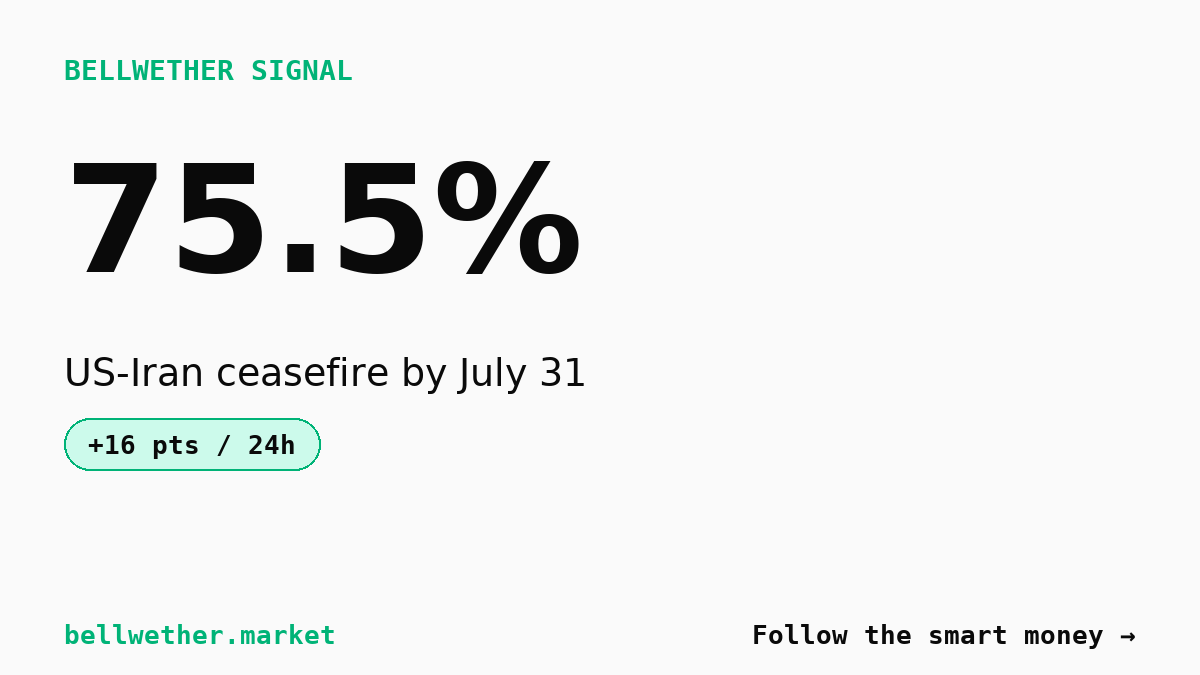
Prediction markets have seen over $1 million in 24-hour volume cluster around Middle East flashpoint questions, with traders now pricing a 75.5% chance that the US and Iran will reach an effective ceasefire by July 31, 2026. That market alone moved 16 percentage points higher in the past day, drawing $955,496 in trading volume as participants reposition ahead of the end-of-month deadline.
The ceasefire market is one of three Iran-linked questions commanding seven-figure daily turnover. A separate contract on whether shipping traffic through the Strait of Hormuz returns to normal by August 15 traded $1,057,793 over 24 hours, though it sits at just 2.95% probability, down slightly from yesterday. Meanwhile, the question of whether the US will invade Iran before 2027 drew $960,832 in volume and now stands at 17.5%, down 3 points on the day. Together, these three markets represent nearly $3 million in active speculation on the trajectory of US-Iran tensions.
The surge in ceasefire odds suggests smart money is interpreting recent developments as a de-escalation signal. Traders appear to be pricing in either diplomatic progress behind the scenes or tactical military positioning that favors a near-term truce. The 16-point jump in a single day is significant: it reflects both new information entering the market and large positions being taken by participants willing to back normalization in the next five days. The relatively low probability assigned to Hormuz traffic returning to normal by mid-August, however, indicates that even if a ceasefire is announced, traders expect logistical and security disruptions to persist well beyond any formal agreement.
Also notable: the US invasion probability has declined 3 points to 17.5% even as volume remains near $1 million, a sign that traders are discounting the risk of full-scale military escalation in favor of a contained conflict or negotiated offramp. The volume concentration in these markets underscores how quickly capital moves to geopolitical flashpoints when real-time information and deadline-driven contracts intersect. With the ceasefire deadline just days away, expect continued volatility as traders react to any White House or Tehran statements.
Bottom line: the smart money is leaning toward a near-term US-Iran ceasefire, but broader normalization in the Gulf remains a longer-dated bet.