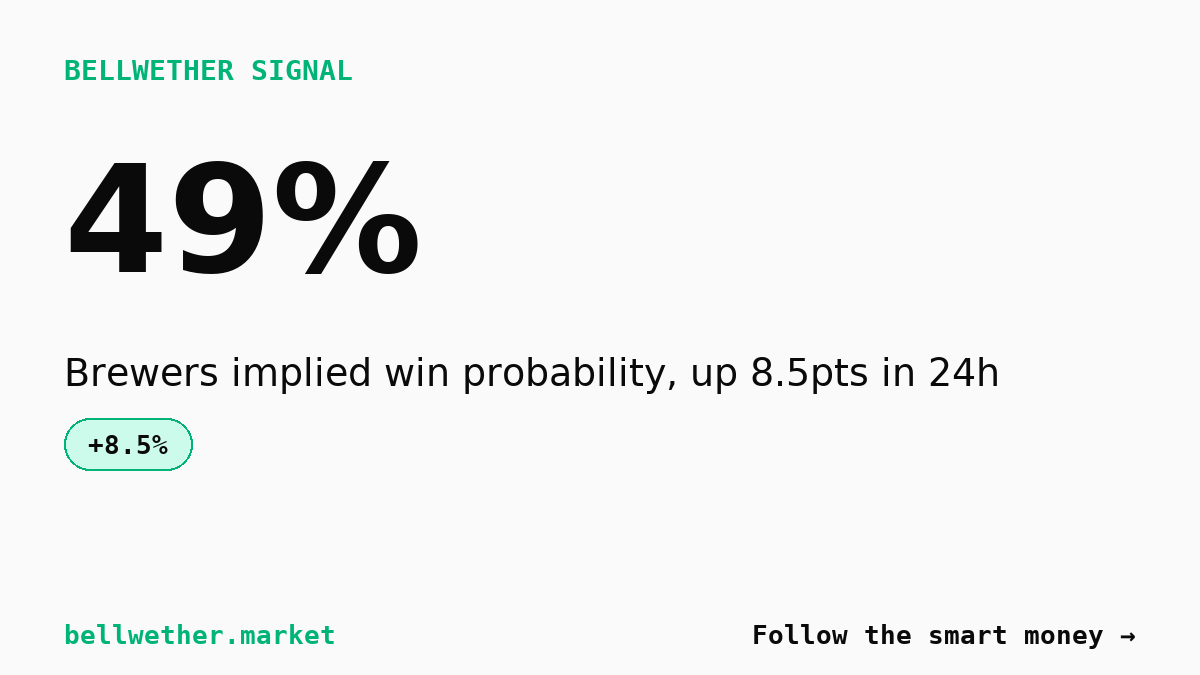
The Brewers opened this game priced under 42% and climbed eight and a half points in 24 hours, closing at 49% on Polymarket against the Dodgers. That is not a rebalancing after an injury report or a rotation change. That is real money rerating the matchup, and $702,253 of volume in a single day says the move is genuine.
This is not a market waiting for news. It is a market absorbing it. The price tells you that Milwaukee, despite playing in Los Angeles, is now effectively a coin flip. That is a sharp repricing of what looked like a road underdog spot 48 hours ago.
What moved
The implied probability for the Brewers rose from 40.5% to 49% over 24 hours, an 8.5 point climb that moved them from clear underdog to dead even. Volume over the same window was $702,253, which is real liquidity for a single MLB game market on Polymarket. The market is not thin. The move is not one trader. This is flow.
Context matters. Other overnight Polymarket sports markets show comparable volume but vastly different dynamics. The Cincinnati Open match between Rinderknech and Cerundolo traded $1,181,495 but settled at 0.1%, a post-resolution formality. The G2 Esports versus Fnatic League of Legends market saw $833,491 but also landed at 0.1%, another settled event. The Brewers-Dodgers market is live, uncertain, and pulling capital in real time.
What is driving it
The headlines retrieved for this market cluster around logistical coverage: how to watch, what channel, which streaming service. They do not explain the repricing. There is no late scratch announcement, no bullpen implosion disclosed in the last 24 hours, no sudden weather event that would tilt probabilities eight points toward the road team.
What does appear is a reference to another Edwin Díaz meltdown in a prior game against the Brewers, published three days ago by the Los Angeles Times. That headline notes a loss to the first-place Brewers and attributes it to a bullpen failure. If that game is recent enough to still shape market perception, it offers a plausible catalyst: bettors and traders updating their priors on late-inning Dodgers reliability and on Milwaukee’s ability to win close games in this matchup.
The other detail is the Sports Illustrated headline from two days ago noting Kyle Tucker out and Alex Call starting for the Dodgers. Tucker is a meaningful bat. His absence removes run production and alters the lineup balance. If that news broke 48 hours ago and the market took 24 hours to digest it, the repricing makes sense. The move does not require a breaking scandal. It requires a rotation shift and a bullpen question mark, both present in the headlines, plus enough participants willing to back Milwaukee at the new number.
This is not a headline-driven spike. It is a flow-driven climb informed by public information that became consensus over a day. The market did not wait for a press conference. It repriced as participants read the lineup card and remembered the bullpen.
How strong is this signal
The Bellwether Signal Score is 94 out of 100, which is a strong reading. That score derives from three components: liquidity, move magnitude, and genuine uncertainty. Liquidity scores 40 out of 40, meaning the market is deep enough that the move reflects broad participation, not a single large order. Move magnitude scores 30 out of 35, recognizing an 8.5 point swing as material but not extreme. Genuine uncertainty scores 25 out of 25 because the market is live, unresolved, and the probability sits near 50%, the zone of maximum disagreement.
What the score does not capture is why the move happened or whether it will persist. A 94 does not mean the Brewers will win. It means the market moved with conviction, in size, and landed in a spot where participants genuinely disagree about the outcome. The score measures signal quality, not outcome probability.
Limits matter. The score does not adjust for resolution risk, for the time left before first pitch, or for the possibility that the next headline reverses the move. It tells you the market is alive and the move is real. It does not tell you the move is correct.
How to read a price like this
An implied probability of 49% means that if you buy the Brewers at that price, you pay 49 cents for a contract that settles at one dollar if Milwaukee wins and zero if they lose. Your breakeven is 49%. If you believe Milwaukee wins more than 49 times out of 100 in this exact scenario, the contract offers value. If you believe they win less, it does not.
The move matters more than the level. A market sitting at 49% all week says participants were always split. A market climbing from 40.5% to 49% in 24 hours says something changed: information arrived, or positioning shifted, or a consensus formed that was not there yesterday. The move is the signal. The level is the snapshot.
Thin books amplify moves. Deep books dampen them. This market traded $702,253 in a day, which is enough liquidity to smooth out individual orders and reflect aggregate belief. The price is not a single trader’s opinion. It is the clearing level for everyone willing to trade at that moment.
Reading a prediction market price means distinguishing between where the market sits and where it has been. A static 49% tells you the crowd is split. A rising 49% tells you the crowd is repricing in one direction, and that direction is toward Milwaukee.
What would change the picture
A lineup change would move this market immediately. If Tucker returns to the Dodgers lineup before first pitch, or if Milwaukee scratches a starting pitcher, the probability will reprice within minutes. The market is live and responsive. New information does not wait for the next trading session.
A weather update could matter. If the forecast shifts to heavy wind favoring one team’s ballpark tendencies, or if rain delays the game and forces a bullpen-heavy contest, probabilities will adjust. Weather is public information, but its incorporation into prices is not instantaneous. The first participant to connect forecast to outcome can move the line.
Volume drying up would change the reliability of the signal. If the next 24 hours show $50,000 of turnover instead of $700,000, the current price becomes less anchored. Low liquidity means higher slippage and less confidence that the price reflects consensus. Watch the volume as much as the probability.
A reversal in the broader Dodgers bullpen narrative would matter. If the team announces a closer change, or if Díaz posts a clean inning in a prior game, the market will reconsider the late-inning edge that currently favors Milwaukee. The repricing was partly a memory of a bullpen failure. A new performance erases that memory.
The caveats
Resolution on Polymarket sports markets follows the official result as recorded by the league. If the game goes to extra innings, the market resolves on the final score, not the score at nine innings. If the game is postponed, the market typically resolves on the makeup game, not the originally scheduled date. Read the rules. The price you see reflects the contract you are actually buying, and the contract may not resolve the way you expect.
Thin books create false precision. This market is not thin, but many sports markets are. A price of 49% on $10,000 of volume is not the same as 49% on $700,000 of volume. The first is two traders disagreeing. The second is a crowd converging. Always check the volume before trusting the number.
Single large orders can move prices in illiquid markets, and even in moderately liquid ones. A $50,000 bet on the Brewers in this market would not move the line eight points, but it would move it some. If the next few hours show a sudden two-point jump on low volume, treat it as a single participant, not a consensus shift.
Time to resolution compresses risk. This market resolves within hours of this analysis. Prediction markets for events weeks or months away face different dynamics: participants can wait, probabilities can drift, and late information dominates early positioning. A market resolving in hours reflects what participants believe right now, not what they expect to believe tomorrow. The price is current. It is not durable.
Bellwether.market earns referral commission from Polymarket and from KalshiSpy, a paid analytics tool for traders. This analysis is financial journalism, not trading advice. Prediction markets carry risk of loss. Nothing here is an invitation to deposit funds, to buy cryptocurrency, or to take a position. Read the price for the information it contains, not for the trade it suggests.