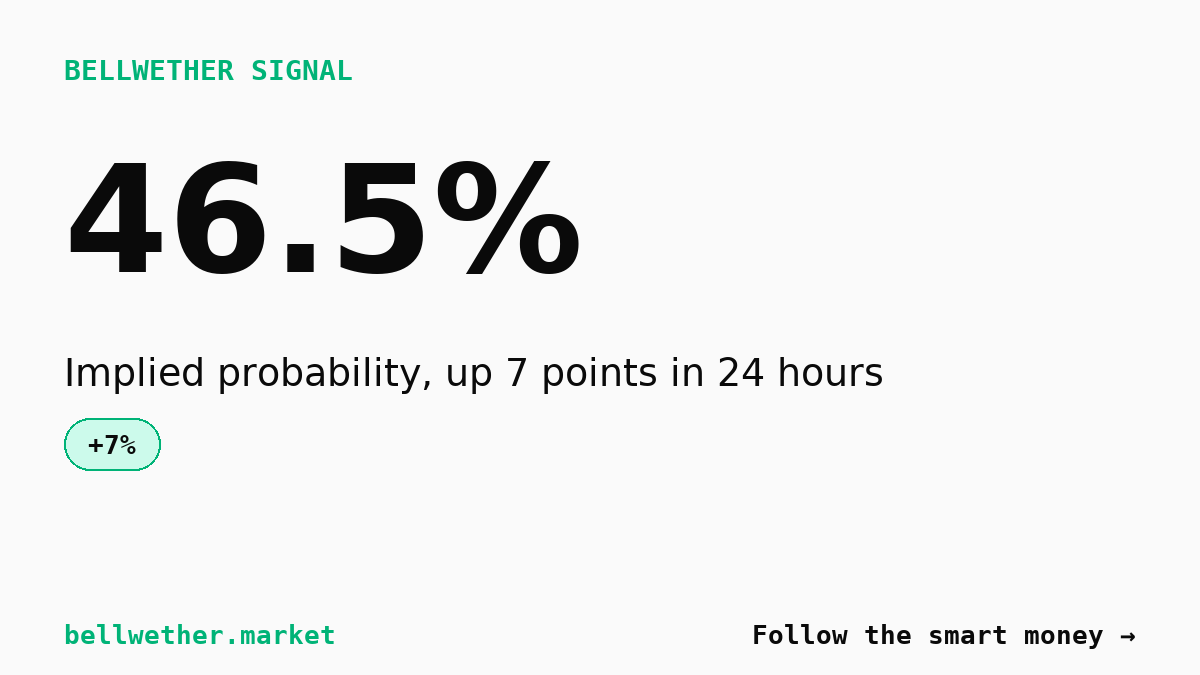
A Polymarket contract on a Brentford FC fixture eighteen months away is trading at 46.5 cents, up 7 points in 24 hours, on three-quarters of a million dollars in volume. That tells you two things: someone wants exposure to this specific outcome badly enough to lock capital for a year and a half, and the market is genuinely uncertain about the result. The Bellwether Signal Score of 88 reflects deep liquidity and a meaningful repricing, but the real story is what the price does NOT tell you: why anyone is trading a mid-table Premier League side’s prospects for August 2026 when the current season is still unfolding.
What moved
The contract settled at 46.5 cents, implying a 46.5 percent chance Brentford wins on August 22, 2026. That probability rose 7 percentage points in 24 hours, a substantial single-day shift for a market this far from resolution. Volume hit $749,394, making this one of the most liquid football prediction markets on Polymarket and exceeding many near-term fixtures. For context, the platform’s top esports markets—League of Legends best-of-three series resolving within days—are posting similar volume figures in the $500k to $800k range. A football match 560 days out is trading with the intensity of a live tournament bracket.
The 24-hour move from 39.5 cents to 46.5 cents represents a 17.7 percent increase in implied probability. In prediction market terms, that is a repricing, not noise. The order flow suggests conviction: either a large position or a cluster of smaller bets all leaning the same direction. The liquidity component of the signal score maxed out at 40 of 40 points, confirming the book is deep enough to absorb this activity without collapsing the spread. The move magnitude component scored 25 of 35, recognizing a 7-point swing as meaningful but not extreme. The genuine uncertainty component came in at 23 of 25, reflecting a price near the middle of the probability range where information can shift outcomes materially.
What is driving it
The headlines retrieved for this market all concern Brentford’s match against Tottenham Hotspur scheduled for the current weekend, not the August 2026 fixture. Yahoo Sports, ESPN, NBC Sports and the club’s own site published preview coverage between one and two days ago, coinciding with the 24-hour price move. The stories focus on team news—Mamadou Sangaré set for a Premier League debut, according to Brentford FC’s site on the date marked 1 day ago—and predicted lineups for the imminent fixture. None of the headlines reference a match 18 months in the future or provide a reason to reprice Brentford’s chances in mid-2026.
That disconnect is the central fact here. The market moved 7 points and cleared three-quarters of a million in volume without any public news specific to the resolution date. The headlines confirm ordinary preview activity for a current-season game, not a development that would alter long-term projections. The most plausible explanation is that the order flow reflects positioning rather than information: a trader or group of traders building exposure to a distant outcome, possibly as part of a portfolio of related bets, or a whale testing liquidity in a less-watched contract. The timing coincidence with near-term match coverage suggests the current fixture may have drawn attention to Brentford markets generally, but the news itself does not explain why someone would pay 46.5 cents for a binary result 560 days away.
Another possibility is that the contract resolves on a specific opponent already known to traders but not yet announced publicly, and recent form or scheduling rumors have shifted the perceived matchup difficulty. Premier League fixtures for 2026-27 would not be released until June 2026 at the earliest, but if the market resolves on a pre-scheduled event—a cup tie, a friendly, or a rescheduled fixture—that information could be driving the repricing. The headlines do not support this interpretation, so absent additional context, the move reads as flow-driven rather than news-driven.
How strong is this signal
The Bellwether Signal Score of 88 out of 100 marks this as a strong indicator, but the score measures market structure, not predictive accuracy. The three components break down as follows: liquidity at 40 of 40 points confirms the market can handle large orders without extreme slippage, meaning the price reflects genuine supply and demand rather than a thin book where a single bet moves the number 10 points. Move magnitude at 25 of 35 points recognizes the 7-point swing as significant but not off the charts; a 20-point move would score higher, a 2-point drift would score lower. Genuine uncertainty at 23 of 25 points reflects the mid-range probability, where small new information can shift the price materially because the outcome is not foregone.
What the score does NOT capture: whether the price is accurate, whether the order flow reflects smart money or dumb money, or whether the 18-month time horizon introduces tail risks the current price ignores. A high signal score means the market is liquid, the move is real, and the uncertainty is genuine. It does not mean the 46.5 cent price is correct. Understanding how to read prediction market prices requires separating the signal from the substance: a strong signal tells you the market is active and the move is meaningful, but you still have to decide if the price makes sense.
How to read a price like this
The 46.5 cent price translates directly to a 46.5 percent implied probability that Brentford wins on August 22, 2026. If you bought the Yes contract at 46.5 cents and Brentford wins, you collect $1.00, netting 53.5 cents profit per share. If Brentford draws or loses, the contract pays zero. The price reflects the collective judgment of everyone willing to put capital at risk, weighted by the size of their bets. A single large order can move the price substantially if the book is thin, but $749k in volume suggests enough participants to absorb individual positions without distortion.
The 7-point move in 24 hours matters more than the absolute level. A market sitting at 45 cents for weeks is one thing; a market that jumped from 39.5 to 46.5 in a day is another. The move signals new information or new capital, even if the headlines do not explain which. For traders, the question is whether the repricing is justified or whether it creates an opportunity on the other side. For observers trying to understand what prediction markets reveal, the move itself is the data point: someone with $749k to deploy thinks Brentford’s chances improved, or at least thinks other participants will reprice it higher still.
Time to resolution introduces a risk premium. Locking capital for 18 months carries opportunity cost: those dollars could trade dozens of near-term contracts and compound returns before August 2026 arrives. The 46.5 cent price must therefore offer enough edge to justify the wait, or the participant must have strategic reasons—hedging related positions, signaling conviction, or simply finding this the best available use of capital. If you are evaluating whether to fade the move, that time-value calculation matters. How prediction markets work in theory assumes instant resolution; in practice, long-dated contracts trade at a discount to their true probability unless the edge is large enough to overcome the delay.
What would change the picture
The price would reprice sharply if the opponent for the August 22, 2026 fixture were announced and turned out to be significantly stronger or weaker than expected. If Brentford draws Manchester City or Liverpool, the probability would fall; if they draw a newly promoted side, it would rise. The fixture list for the 2026-27 Premier League season will be released in mid-2026, at which point the market will reprice based on actual matchup difficulty rather than speculation.
Managerial changes, ownership shifts, or player transfers between now and mid-2026 could all move the needle. If Brentford secures a top-tier manager or loses key players, the market will adjust. Relegation would collapse the price to near zero if the contract specifies a Premier League fixture and Brentford are playing in the Championship. Conversely, sustained strong form over the next 12 months could push the price higher as confidence in the squad’s quality grows.
Volume patterns will signal whether this was a one-off positioning move or the start of sustained interest. If volume dries up and the price drifts, the 7-point move was likely an isolated event. If volume remains elevated and the price continues climbing, that suggests ongoing accumulation. Watch for Polymarket to list related contracts—Brentford top-half finish, Brentford relegation odds, individual player performance markets—that could provide triangulation. If those markets move in tandem, the repricing reflects a broader reassessment of the club’s prospects; if they do not, the August 2026 contract is trading on its own dynamics.
The caveats
Resolution rules determine everything. The contract must specify whether it resolves on a Brentford win in any competition, a Premier League win, a specific opponent, or a particular tournament. If the match is postponed, rescheduled, or canceled, the resolution terms dictate what happens to the contract. Polymarket typically voids contracts if the event does not occur as specified, but traders should verify the exact language before taking a position.
Thin books in long-dated contracts mean a single large order can move the price disproportionately. While $749k in volume is substantial, if 80 percent of that came from one participant, the price reflects their view more than a broad consensus. The liquidity component of the signal score suggests the book is deep, but order-level data would confirm whether this was distributed flow or concentrated conviction.
The 18-month time horizon introduces tail risks the price may not fully capture. Brentford could be sold to new ownership, suffer a financial crisis, lose their stadium, or face any number of low-probability, high-impact events that would invalidate current assumptions. The further out the resolution date, the wider the confidence interval around any probability estimate. A 46.5 cent price in a market resolving next week is easier to evaluate than the same price 560 days out.
Referral disclosure: Bellwether earns commission from Polymarket and from KalshiSpy, a paid analytics tool for prediction market traders. This analysis is financial journalism, not investment advice. Prediction markets carry risk of total loss, and long-dated contracts lock capital for extended periods with no guarantee of profit.