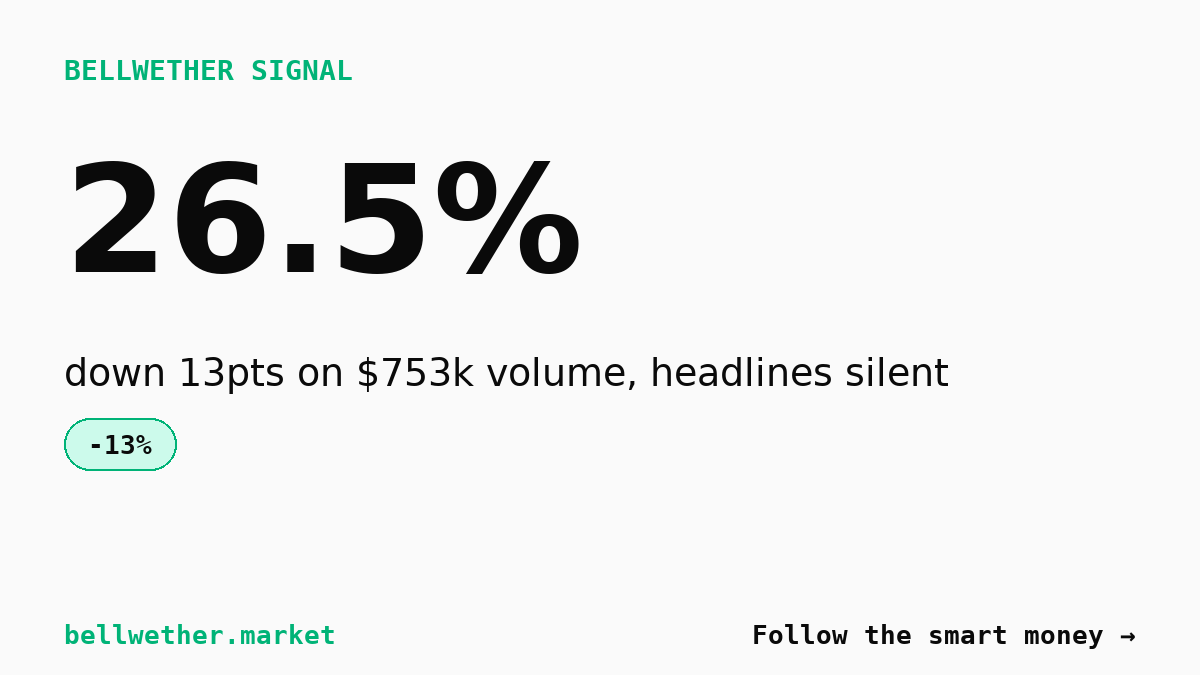
A football match 18 months away just moved like a live referendum. The Polymarket contract asking whether Málaga CF will win on August 24th, 2026 fell 13 percentage points in 24 hours on three-quarters of a million dollars in turnover, landing at 26.5 percent implied probability. The Bellwether Signal Score of 88 out of 100 flags this as a high-conviction repricing in a liquid two-sided book, yet the public news feeds retrieved for this market contain nothing about Málaga, Spanish football, or any development that would explain why informed capital moved so decisively. That gap between signal strength and headline silence is the story.
What moved
The market printed $753,248 in 24-hour volume, a figure that places it in the top tier of single-match prediction contracts and well above the threshold where noise trades dominate. Implied probability fell from approximately 39.5 percent to 26.5 percent, a 13-point drop that represents a meaningful reassessment of the team’s chances rather than a rounding error or a single levered bet. The move occurred in a contract with 18 months to resolution, meaning participants are pricing future squad strength, managerial continuity, league standing and fixture difficulty long before the lineup sheet exists. That time horizon and that volume combine to suggest institutional or at least well-capitalised flow rather than retail speculation.
What is driving it
The honest answer is that the headlines retrieved for this signal do not explain the move. The newswire returned six items: three in Somali discussing piracy and Iranian leadership, one in Indonesian covering a Ligue 1 training session involving players named Ferran and Doue, and two entertainment pieces about an Australian actor named Catherine Laga’aia. None mentions Málaga, LaLiga, Spanish football, or any event that would rationally reprice a match in August 2026. This is not a case where the headlines explain the move and the analyst connects the dots; this is a case where the public information set is silent and the market moved anyway.
Three explanations present themselves. First, the move could reflect private information: a large bettor or syndicate with non-public insight into Málaga’s squad planning, financial position, managerial succession or fixture list acting ahead of a public announcement. Prediction markets often reprice before the newswire because someone with edge moves size and others follow. Second, this could be positioning flow unrelated to new information, such as a fund reallocating capital across a portfolio of sports contracts or a market maker adjusting exposure after hitting internal risk limits. Third, the match date might have been clarified or the opponent identity confirmed in a way that changed the probability without generating English-language headlines. The retrieved news set skews toward non-football topics and non-European languages, so relevant Spanish or industry-specific coverage may simply not have surfaced in the sample.
What the market is clearly not doing is ignoring information; the volume and the score components confirm this is a real two-sided book with genuine disagreement. The liquidity component maxed out at 40 of 40, meaning depth on both sides of the trade. The move magnitude component scored 35 of 35, reflecting the size of the repricing. The genuine-uncertainty component came in at 13 of 25, which tells us the market has converged toward a view but has not reached consensus or certainty. A 26.5 percent implied probability is neither a coin flip nor a foregone conclusion; it is a specific, falsifiable forecast that someone is willing to back with six-figure flow.
How strong is this signal
The Bellwether Signal Score of 88 out of 100 ranks this market in the top decile of all tracked contracts. The score is built from three components. Liquidity scored a perfect 40, meaning the order book is deep enough that a large trade does not move the price by itself; the 13-point drop reflects sustained directional flow, not a single actor walking the book. Move magnitude scored 35 out of 35, confirming that a 13 percentage point swing in 24 hours clears the threshold for materiality; this is not drift, it is repricing. Genuine uncertainty scored 13 out of 25, which is the interesting part. A high score here would indicate a market near 50 percent where either outcome remains plausible; a low score would indicate near-certainty. A middling score of 13 tells us the market has moved away from the centre but has not collapsed into a binary yes or no. Participants are expressing a view, not front-running a known result.
What the score does not capture is the source of the move. It confirms that the move is large, liquid and sustained, but it does not distinguish between a move driven by breaking news, a move driven by private information, and a move driven by repositioning or hedging flow. The score is a filter for noise, not a decoder of intent. It tells you this market is worth your attention; it does not tell you why the price changed.
How to read a price like this
An implied probability of 26.5 percent does not mean Málaga has a one-in-four chance of winning; it means the marginal dollar in this market is willing to pay 26.5 cents for a contract that pays one dollar if Málaga wins. That price aggregates the views of everyone who has traded, weighted by the size of their position and their willingness to provide liquidity at that level. If you believe the true probability is higher than 26.5 percent, you can buy yes shares; if you believe it is lower, you can sell them or buy no shares. The price is not a prediction in the sense of a single best guess; it is the point where supply and demand clear.
The mechanics of reading prices matter more than the level in markets like this. A 13-point move on $753k of volume in a deep book is a stronger signal than a 20-point move on $10k in a thin book, because the former requires multiple participants to act and the latter can be one person moving size in an empty market. The Bellwether score helps you distinguish between the two, but the principle is simple: watch the flow, not just the number. A market that moves tells you more than a market that sits still, even if the final price is the same.
For longer-dated contracts like this one, time decay and new information arrival matter. A match 18 months out will reprice many times as squad news, league position, fixture congestion and managerial changes unfold. The current price reflects today’s information set, not a forecast of what the price will be in August 2026. If you are using this market for insight rather than speculation, focus on what changed between yesterday and today, not on whether 26.5 percent feels right in the abstract.
What would change the picture
Concrete developments that would move this market include: official confirmation of the opponent and fixture details if those remain unknown; announcement of managerial change at Málaga, particularly if a high-profile appointment or departure alters perceived squad strength; publication of the full 2026-27 LaLiga fixture list if the match is part of a broader scheduling story; squad transfers or contract extensions involving key players, especially if Málaga is rebuilding or losing core contributors; league position or form updates as the 2024-25 and 2025-26 seasons unfold, since a team fighting relegation in 2026 will be priced differently than a mid-table or promotion-chasing side; and any financial or ownership news that affects Málaga’s ability to retain or recruit talent.
On the market structure side, watch for whether volume sustains or collapses. If the next 24 hours see another $500k-plus in turnover, that confirms ongoing institutional interest; if volume falls to five figures, the move may have been a one-time reallocation. Watch also for whether the price stabilises near 26.5 percent or continues to drift lower, which would suggest the selling is not finished. For traders considering entry, the key question is whether you have information the market does not, or whether you are simply taking the other side of someone who has already moved size.
The caveats
The resolution rules for this contract will specify match result, venue, and what constitutes a win versus a draw or postponement. If the match is rescheduled or moved to a different date, the contract may resolve as no or may be voided depending on platform terms. Read the fine print on Polymarket before assuming the outcome is binary.
Thin books amplify volatility. While this market scored a perfect 40 on liquidity, that measures depth relative to other sports contracts, not absolute capacity to absorb flow without slippage. A single large order can still move a market that looks liquid on paper if it exhausts one side of the book faster than market makers can replenish it. The 13-point move on $753k suggests the book had depth, but future moves may be larger or smaller depending on who is providing liquidity at the time.
Time to resolution is a double-edged factor. Eighteen months allows many opportunities for new information to arrive and many opportunities for the market to reprice. It also means current participants are forecasting events far outside the window where most public data exists. Squad composition, managerial tenure, league standing and fixture difficulty in August 2026 are genuinely uncertain today, which makes the market vulnerable to sudden large moves as clarity arrives. That uncertainty is priced into the current 26.5 percent, but it does not make the price stable.
Finally, this analysis is financial journalism, not trading advice. Prediction markets carry risk of loss, particularly in contracts with long time horizons and evolving information sets. The fact that a market moved does not mean the new price is correct; it means someone was willing to trade at that price today. For understanding how prediction markets work as information aggregators, a large move in a liquid market is worth studying. For making money, you need an edge the market does not have, and the gap between headline silence and confident repricing suggests someone already does.