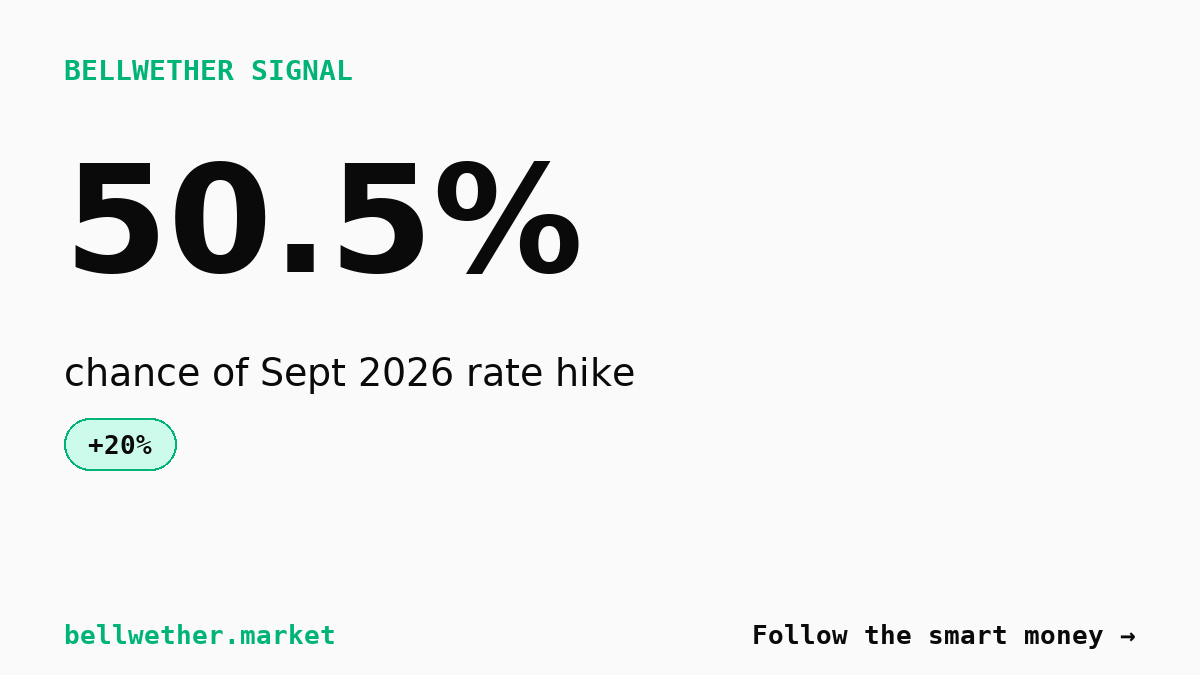
A Federal Reserve decision 18 months away is trading like a referendum on monetary policy this week. The market now assigns a 50.5 percent chance that the Fed will raise interest rates by 25 basis points following its September 2026 meeting, up from roughly 42 percent 24 hours earlier. Over $2 million changed hands on Polymarket in a single day as traders repositioned around remarks by Fed chair Kevin Warsh, who said the central bank may still have work to do on inflation.
The move is clean and the explanation is public. Warsh spoke to reporters one day ago and flagged ongoing inflation concerns, and the market repriced the probability of a September 2026 hike by 20 percent within hours. The timing and the scale of the shift line up with the newswire coverage, which ran under headlines such as ‘September Fed decision is now a coin flip’ and quoted Warsh directly on the possibility of further tightening. This is not a gap begging for interpretation; it is a straightforward response to fresh guidance from the person who sets the policy.
What makes this signal notable is not the probability level itself but the convergence of volume, genuine disagreement and a discrete catalyst. The Bellwether Signal Score of 100 out of 100 reflects all three firing at once: deep two-way flow, a meaningful one-day move and a market that remains split down the middle even after the repricing. That combination is rare and worth dissecting.
What moved
Polymarket recorded $2,050,515 in 24-hour volume on the question of whether the Fed will raise rates by 25 basis points after the September 2026 meeting. The implied probability closed at 50.5 percent, up 20 percent from the prior session. A companion market asking whether there will be no change in rates at that meeting traded $2,208,479 over the same period and priced the status quo at 48.5 percent. The two probabilities do not sum to 100 because the contracts resolve independently and the market allows for the possibility of a cut or a larger hike, though those outcomes are priced in the low single digits.
The 24-hour move of 20 percent is substantial for a monetary policy market with this much liquidity. It implies that new information entered the system and a critical mass of participants concluded that the baseline scenario had shifted. The fact that volume spiked in tandem with the move suggests genuine reassessment rather than a single large order walking through a thin book.
What is driving it
The repricing coincides with comments from Fed chair Kevin Warsh published one day ago in The Washington Post and covered by CNBC under the headline ‘September Fed decision is now a coin flip as rate hike odds increase post Warsh.’ Warsh told reporters that the central bank may have further work to do if inflation remains elevated, a statement that contrasts with earlier market expectations of a prolonged pause or outright cuts by mid-2026. The timing is exact: Warsh spoke, the wires moved the story, and the market gapped higher within the same news cycle.
This is not the only data point in circulation. PBS reported ten days ago that many Fed officials believe higher rates will be necessary if inflation stays sticky, a theme that has been building in the background for weeks. But the Warsh remarks appear to have been the proximate trigger for this particular move, given the tight correlation between the headline timestamp and the volume surge on Polymarket.
It is worth noting that the European Central Bank is also moving toward a September rate hike, according to Reuters reporting from four days ago. While the ECB and the Fed operate in different jurisdictions with different mandates, the fact that both are signaling tightening in the same month may be reinforcing a broader narrative about persistent inflation and the limits of the current policy stance. Traders pricing the Fed decision may be anchoring to the ECB timeline as a reference point, though the headlines do not make that link explicit.
How strong is this signal
The Bellwether Signal Score of 100 out of 100 is the highest rating the system can assign. It reflects maximum scores across all three components: 40 out of 40 for liquidity, 35 out of 35 for move magnitude and 25 out of 25 for genuine uncertainty. Each component measures a distinct aspect of signal quality.
The liquidity score of 40 means the market is trading with sufficient depth that the price is unlikely to be the artifact of a single participant or a handful of large orders. Over $2 million in 24-hour volume on a binary outcome is well above the threshold for noise, and the presence of a nearly equal volume on the companion no-change contract suggests that capital is flowing into the question from multiple directions.
The move magnitude score of 35 captures the size of the 24-hour shift relative to the market’s historical behavior. A 20 percent increase in implied probability is not a trivial wiggle; it represents a material reassessment of the baseline scenario. The score does not measure whether the move is justified, only whether it is large enough to be informative.
The genuine uncertainty score of 25 reflects the fact that the market remains split after the move. A 50.5 percent probability is as close to a coin flip as a market can get, which means participants with access to the same public information are drawing opposite conclusions about the likely outcome. That level of disagreement is itself a signal: it tells you that the question is genuinely difficult and that the answer depends on variables that have not yet resolved.
What the score does not capture is the quality of the information driving the move or the possibility that the market is wrong. A perfect signal score means the price change is well-supported by liquidity and genuine disagreement, not that the price itself is correct. The market could be overreacting to Warsh’s comments, underestimating the Fed’s tolerance for inflation or mispricing the time value of a decision still 18 months away. The score measures the strength of the signal, not its accuracy.
How to read a price like this
An implied probability of 50.5 percent means that if you could run this scenario 1,000 times under identical conditions, the market expects the Fed to raise rates roughly 505 times and hold or cut roughly 495 times. It does not mean the market is uncertain about what will happen; it means the market believes the evidence currently available is consistent with both outcomes in roughly equal measure.
The distinction matters because reading prices as uncertainty rather than forecast can lead to misinterpretation. A market at 50 percent is not shrugging; it is pricing a genuine fork in the road where the next piece of information could tip the balance either way. That makes the price highly sensitive to new data, which is exactly what happened when Warsh spoke.
It is also worth distinguishing between the level of a price and the direction of a move. The fact that the market moved 20 percent in a day is more informative than the fact that it closed at 50.5 percent. The move tells you that something changed, that participants revised their views in response to new information and that the revision was large enough to overcome transaction costs and the inertia of existing positions. The level tells you where the market settled after that revision, but the move tells you that the revision happened at all.
Thin versus deep books also matter here. Polymarket uses an order book model, which means the price reflects the marginal clearing level between buyers and sellers rather than an automated market maker’s inventory risk. With over $2 million in daily volume, this market is deep enough that the price is unlikely to be an artifact of a single large order. That gives you more confidence that the 50.5 percent figure represents a genuine consensus rather than the opinion of one well-capitalised participant.
What would change the picture
The most direct catalyst would be further commentary from Warsh or other voting members of the Federal Open Market Committee. If Warsh walks back his remarks or if other officials push back on the idea of a September 2026 hike, the market would likely retrace some or all of the recent move. Conversely, if additional officials echo Warsh’s concerns or if the Fed’s next Summary of Economic Projections shows a higher terminal rate, the probability of a hike could push above 60 percent.
Incoming inflation data will also matter, though the effect may be delayed given the long time horizon. If core PCE or CPI prints come in consistently above the Fed’s 2 percent target over the next several months, that would reinforce the case for further tightening and likely push the market higher. If inflation falls faster than expected, the probability of a September 2026 hike would decline, possibly sharply.
The path of the ECB could also influence this market indirectly. If the ECB follows through with a September rate hike as Reuters sources suggest, and if that decision is accompanied by language about ongoing inflation risks, it may lend credibility to the idea that central banks globally are not done tightening. That narrative could spill over into Fed pricing, even if the economic conditions in the eurozone and the United States are not identical.
Finally, any significant change in the economic outlook between now and September 2026, such as a recession, a sharp uptick in unemployment or a financial stability event, would likely move this market substantially. The question is not just what the Fed wants to do but what the Fed is able to do given the state of the economy at that point in time.
The caveats
The market resolves based on the official Federal Reserve announcement following the September 2026 FOMC meeting. It is a binary question: did the Fed raise the target range for the federal funds rate by 25 basis points, yes or no. A 50 basis point hike would resolve this market as no, as would a cut or no change. The contract does not pay out based on forward guidance, dot plots or market expectations; it pays out based on the actual decision.
Eighteen months is a long time in monetary policy. The market is pricing probabilities today based on information available today, but the Fed’s decision in September 2026 will be based on the data available at that time, much of which has not yet been generated. Inflation could accelerate or decelerate, the labour market could tighten or soften, and financial conditions could ease or tighten. Any of those variables could change the calculus entirely.
The order book on Polymarket, while deep by the standards of prediction markets, is still thin compared to traditional financial markets. A large institutional order or a coordinated set of trades could move the price by several percentage points even in the absence of new information. The volume spike over the past 24 hours suggests that did not happen here, but it remains a structural risk any time you are trading a market with less than $10 million in daily turnover.
Resolution risk is minimal for a market tied to an official Fed announcement, but operational risk is not zero. If the FOMC meeting is postponed, if the announcement is ambiguous or if the size of the rate change is outside the binary parameters of the contract, the market could take days to resolve or require arbitration. Those are low-probability scenarios, but they are not impossible, and they matter more the closer you get to the event date.