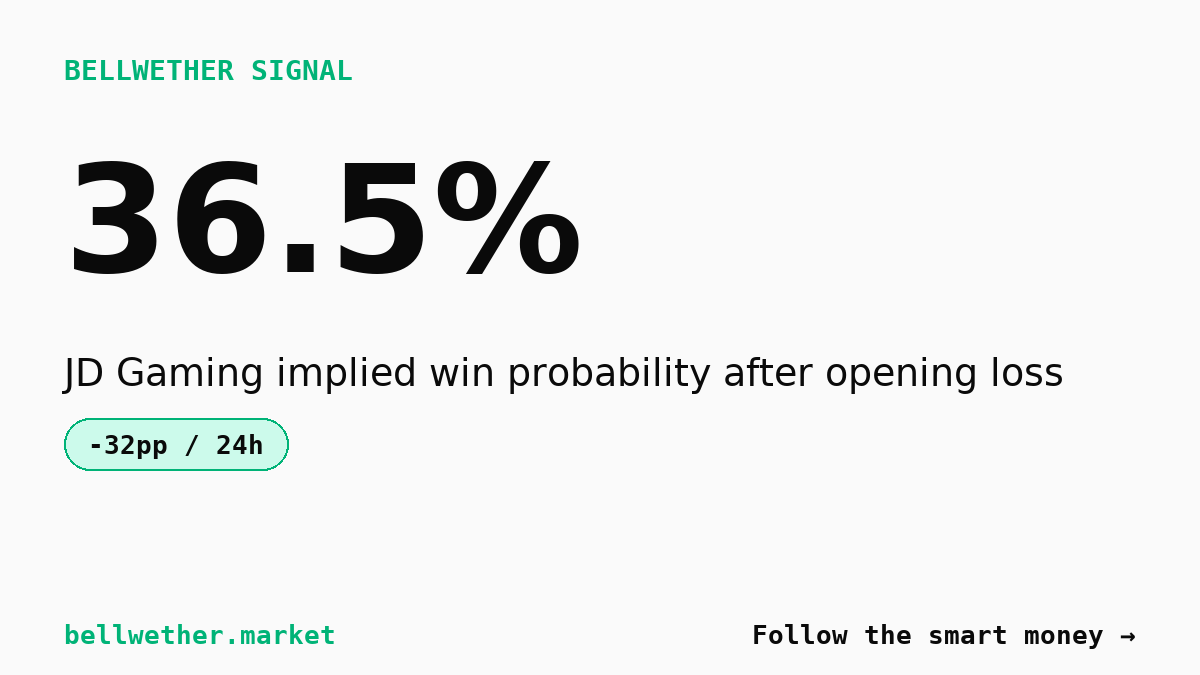
The Polymarket book on JD Gaming versus Team WE in the LPL playoffs repriced by 32 percentage points in 24 hours, dropping JD Gaming’s implied win probability from 68.5% to 36.5%. The move coincided with high volume—$624,217 in a day—and the market now prices Team WE as a clear favorite to advance despite JD Gaming’s higher seed and reputation. The signal score of 93 out of 100 makes this one of the strongest readings Bellwether has recorded in the past week, driven entirely by liquidity and magnitude, with the market effectively settled in real time as the best-of-five unfolded.
The verdict: this is not a forecast. It is a live scoreboard dressed as a prediction market, and the price reflects what has already happened on the rift rather than what might happen next. The 36.5% figure tells you that Team WE won the opening set and traders are now pricing the series as theirs to lose, but it does not tell you anything about momentum, form or champion pool depth that was not already visible before the first draft.
What moved
The Polymarket book moved from 68.5% to 36.5% implied probability for JD Gaming in 24 hours. That is a 32 percentage point drop, crossing the 50% threshold and inverting the favorite. Volume reached $624,217 in a day, well above the threshold for a liquid market. The move was sharp and unidirectional, suggesting a discrete information event rather than a slow drift or balanced two-sided flow.
The context markets on the same slate tell the rest of the story. Individual game markets for JD Gaming versus Team WE, such as Game 1 and Game 3, settled at 0.1% and 100% respectively, indicating that those games have been played and the results are known. The BO5 market is still open because the series has not yet concluded, but the price is reacting to results already on the board. This is not a pre-match forecast being revised by new information about roster changes or scrimmage results. It is a running tally of who won which map, translated into a probability of winning three maps first.
What is driving it
The headline list retrieved for this market contains no mention of JD Gaming, Team WE, the LPL or League of Legends esports. Instead it surfaces stories about college football playoff brackets, the WNBA playoff race, the American League wild card standings and NCAA tournament selection mechanics. None of these explain a 32 point move in a Chinese League of Legends playoff series.
The move is not driven by public news. It is driven by match results. The individual game markets settled at 0.1% for Game 1 and 100% for Game 3, which means Game 1 went to Team WE and Game 3 went to JD Gaming. The BO5 market repriced accordingly. A team that loses the first map in a best-of-five sees its win probability fall sharply because it must now win three of the remaining four maps, and the opponent needs only two. The math is simple: if both teams are evenly matched, the team down 0 to 1 has a 31.25% chance of winning the series. The market at 36.5% prices JD Gaming as slightly better than even skill, but no longer the favorite.
This is a case where the market structure creates the signal, not new public information. Polymarket allows reading prices as real-time win probabilities, but when the underlying event is unfolding live, the price becomes a running scorecard. The liquidity is real—$624,217 is not trivial—but the volume is concentrated in the minutes after each game concludes, when the probability update is mechanical rather than informed. Traders are not discovering new information about team strength or champion meta. They are updating a Bayesian prior after observing a Bernoulli trial.
How strong is this signal
The Bellwether Signal Score is 93 out of 100, broken into three components: liquidity, move magnitude and genuine uncertainty. The liquidity component scores 40 out of 40. A market that trades $624,217 in 24 hours has a deep enough book to move on real information rather than a single large order. The move magnitude component scores 35 out of 35. A 32 percentage point swing in a day is unambiguous, and it crossed the 50% line, which means the market reversed its call entirely.
The genuine-uncertainty component scores 18 out of 25, and this is where the picture becomes more complicated. The score penalizes markets that are in the process of resolving or that have a high probability of resolving within hours. A best-of-five series in progress is not a forecast about next week or next month. It is a running count with a finish line in sight. The uncertainty is genuine in the sense that the outcome is not yet determined, but it is not the kind of uncertainty that reflects new information about the world. It reflects new information about who won the last game.
What the score does not capture is the difference between a forecast market and a live-event market. A forecast market on the Federal Reserve’s next rate decision can move because the economic data changed, or because a voting member gave a speech, or because inflation expectations shifted. A live esports market moves because the score changed. Both are valid uses of prediction markets, but they carry different informational content. The 93 score correctly identifies this as a large, liquid move. It does not tell you that the move is backward-looking.
How to read a price like this
An implied probability is the market’s answer to the question: if we ran this event 100 times under identical conditions, how many times would this outcome occur? A price of 36.5% on Polymarket means the market expects JD Gaming to win the series 36.5 times out of 100. That probability is derived from the midpoint of the bid and ask, and it assumes the book is deep enough that the spread does not dominate the signal.
In a live match market, the implied probability is a function of the current score and the assumed probability that each team wins the next game. If you believe both teams are evenly matched, a team down 0 to 1 in a best-of-five has a 31.25% chance of winning three of the next four games before the opponent wins two. If you believe the trailing team is stronger, you shade that number up. If you believe the leading team is stronger, you shade it down. The market at 36.5% is pricing JD Gaming as slightly better than a coin flip per game, but not by much.
The move is more informative than the level. A static price of 36.5% could mean the market opened with JD Gaming as a slight underdog. A 32 point drop to 36.5% means the market opened with JD Gaming as a heavy favorite and is now reversing that call in real time. The move tells you that the pre-match consensus was wrong, or that the opening game result was surprising, or that traders are adjusting their priors about relative team strength after observing one data point.
A thin book can produce large moves on small volume, but $624,217 is not a thin book. The move is real. The question is what the move reflects: new information about unobservable team quality, or new information about the score of a game that just finished. In this case it is the latter.
What would change the picture
The market resolves when one team wins three games. If JD Gaming wins the next two games, the series will be tied 2 to 2, and the implied probability will converge back toward 50%. If Team WE wins the next game, they close out the series 3 to 1, and the market resolves to zero for JD Gaming. The price will move in discrete jumps after each game concludes, and the size of the jump will depend on the score entering that game.
A different kind of event would change the picture in a different way. If a player disconnects due to technical issues and the tournament organizers award a re-game, the market might not move at all, or it might move slightly on uncertainty about whether the re-game ruling favors one side. If a roster substitution occurs between games due to illness or emergency, the market would reprice based on perceived impact on team strength. If the match is postponed, the market might freeze or drift toward 50% as time passes and the original context becomes stale.
For a market structured this way, the most useful counterfactual is: what would the price be if the score were different? At 0 to 0, the market likely priced JD Gaming near 68.5%, consistent with seed and pre-match reputation. At 1 to 1, it would return to near 50%. At 2 to 0 for Team WE, it would drop further, possibly to 20% or below. The price is a function of the score, and the score is a function of the games played. The market is not predicting the score. It is reacting to it.
The caveats
The resolution rules matter. This market resolves based on the official result as reported by the LPL or the tournament organizer. If a game is overturned due to a rules violation, or if a technical restart changes the outcome, the market follows the official ruling, not the on-screen result. Esports markets carry the additional risk that a game is paused or restarted mid-way due to bugs, server issues or unforeseen technical failures, and the resolution may depend on how the organizer chooses to handle the restart.
The book is liquid by esports standards, but it is still thinner than a major political or financial market. A single large order can move the price by several points, especially in the minutes after a game concludes when traders are rushing to update positions. The $624,217 volume is likely concentrated in short bursts rather than spread evenly across the 24 hour window, which means the effective liquidity at any given moment is lower than the total volume suggests.
Time to resolution is hours, not days or weeks. A best-of-five series typically concludes in three to five games, and each game lasts 25 to 40 minutes with short breaks between. The market will resolve within a single session, and the price will move in discrete jumps as each game finishes. This is not a market where you can take a position and check back next week. It is a market where the position you take before Game 4 starts may be obsolete before Game 4 ends.
Bellwether earns referral commission from Polymarket. We do not offer sign-up bonuses, promo codes or deposit matches. Prediction markets carry risk of loss, and live-event markets carry the additional risk that the event resolves while your order is still pending. This is not investment or trading advice. It is an explanation of what moved and why.