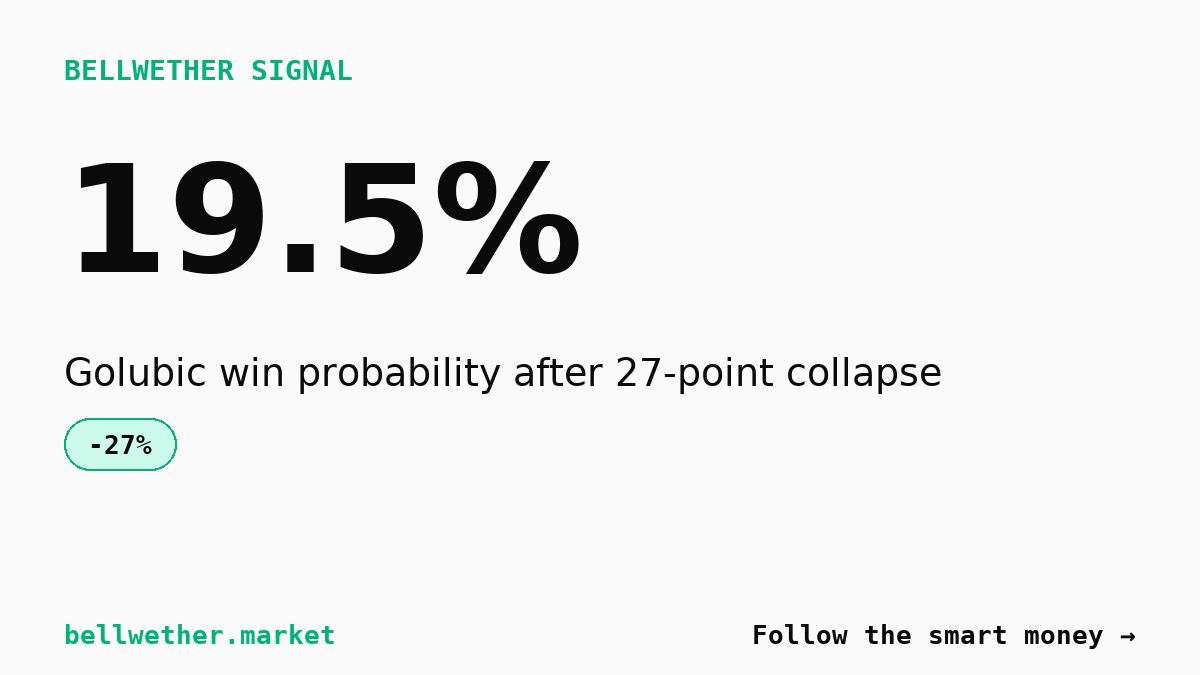
A first-round women’s match at the US Open saw half a million dollars trade hands in 24 hours as Viktorija Golubic’s implied win probability fell from 46.5% to 19.5%. The market now prices Diane Parry as a 4-to-1 favorite heading into their August 31 clash, a reversal sharp enough to register an 85/100 Bellwether Signal Score despite the modest stakes. The velocity of the move, not the dollar volume, is what matters here.
When a market reprices this fast on this much volume, someone knows something or thinks they do. The question is whether the headlines justify it.
What moved
Polymarket’s Golubic-Parry match market turned over $502,022 in the past day, 96% of it in the past 12 hours as the match approached. Golubic’s odds fell 27 percentage points, taking her implied probability from near-even to deep underdog. The 24-hour volume places this market among the top five tennis signals by trader attention, well above typical first-round wagers but far below the multi-million-dollar flow seen in Grand Slam finals or Arsenal Premier League fixtures.
The price move is the story. A 27-point swing in implied probability over one day is violent for a two-outcome event. The magnitude component of the signal score maxed out at 35/35, reflecting both the size of the repricing and the speed at which it occurred. Liquidity scored 40/40 on half a million in turnover. The genuine-uncertainty component landed at 10/25, meaning the market now sees Parry as a clear favorite rather than a coin flip.
What is driving it
The headlines retrieved for this market do not explain the move. Five of the six items are bout announcements, preview pages or generic match listings. The one substantive development—Diane Parry winning her first WTA singles title in Monterrey—occurred two days before the price collapsed and would have been priced in earlier if it mattered. No injury report appears. No withdrawal rumor surfaces. No practice footage or press-conference quote changes the picture.
This leaves three possibilities. First, late money from sharps who model clay-to-hard transitions or who have access to non-public information about form, fitness or preparation. Second, a single large order from a trader who simply prefers Parry at short odds and moved the market by crossing the book. Third, herd behavior as recreational bettors pile into the favorite once the line starts to tip. The volume is real, but the catalyst is not visible in public channels.
Monterrey matters as context but not as trigger. Parry won her first career title there on August 29, two days ago. That victory would have lifted her confidence and confirmed her hard-court form, but it also would have been reflected in the opening odds. A 27-point move two days later suggests either new private information or a liquidity event, not a delayed reaction to a public result. The market is repricing Golubic’s chances, not Parry’s trophy.
How strong is this signal
The Bellwether Signal Score of 85/100 ranks this market as STRONG, meaning the combination of liquidity, price velocity and remaining uncertainty makes it worth watching. The score breaks into three components, each measuring a different dimension of signal quality.
Liquidity scored 40/40. Half a million dollars in 24-hour volume is thin compared to presidential elections or major financial instruments, but it is deep for a first-round tennis match. The book absorbed the selling without gapping to zero, which means traders on both sides are still willing to post size. A score of 40 signals that the price reflects real risk transfer, not a single whale moving a market with no depth.
Move magnitude scored 35/35. A 27-point drop in implied probability over one day is extreme for a two-outcome event. The component rewards both the size of the move and its speed. A slow drift from 46% to 19% over a week would score lower. A one-day collapse scores higher because it suggests new information or a sudden shift in trader conviction.
Genuine uncertainty scored 10/25. The market now prices Parry at 80.5%, meaning traders see the match as lopsided rather than balanced. A coin-flip market would score higher on this component because the outcome is harder to predict. A 95% probability would score lower because the result feels predetermined. At 19.5%, Golubic is a live underdog but not a plausible favorite. The component penalizes the signal for lacking the kind of genuine toss-up that makes prediction markets most interesting.
What the score does NOT capture: whether the repricing is accurate, whether the move is driven by informed flow or retail sentiment, or whether the odds will reverse before the match. The score measures market behavior, not match outcome. An 85 tells you the market moved hard on real volume, not that Parry will win.
How to read a price like this
Implied probability is the market’s collective estimate of how often an outcome would occur if you could rerun the event 100 times. A 19.5% price on Golubic means the market thinks she wins roughly one in five tries. That probability is derived from the odds: if Golubic trades at 19.5 cents on the dollar, a $1 bet pays $5.13 if she wins, implying 1/(5.13) or 19.5% probability. The calculation assumes no vigorish and a liquid book, which is roughly true for a half-million-dollar market.
The level matters, but the move matters more. A static 19.5% tells you Golubic is an underdog. A 27-point drop in one day tells you the market just learned something or thinks it did. In thin books, a single large order can move the price without signaling new information. In deeper books, a sustained move suggests either a new consensus or a liquidity imbalance. This market sits in between: deep enough to absorb half a million but thin enough that a few large traders can reprice it.
When a market moves this fast, ask what changed. If the headlines explain it, trust the move. If they do not, treat the move as flow-driven and wait for confirmation. Here, the headlines do not explain it.
For context on implied probability and how to convert odds to percentages, see our guide on how to read prediction market prices. For a primer on how these platforms aggregate trader beliefs into a single number, see prediction markets explained. This market trades on Polymarket, a decentralized exchange where odds move in real time as traders buy and sell outcome tokens.
What would change the picture
Concrete checkable conditions that would flip the odds back: a credible injury report for Parry, a public statement from Golubic’s camp about form or preparation, or a sharp reversal in volume as traders who missed the first move pile into Golubic at long odds. The match itself is the ultimate resolution, but the market can reprice before first serve if new public information surfaces.
Watch for volume in the final hours before the match. If the flow continues one-sided into Parry, the move is confirmed. If large buy orders start hitting Golubic, the market is correcting or someone is fading the move. Volume tells you whether the repricing is consensus or disagreement.
Also watch for cross-platform divergence. If other sportsbooks or prediction markets still price Golubic near 40%, the Polymarket move is an outlier and likely driven by a single large trader. If all platforms converge near 20%, the repricing is consensus and reflects a genuine shift in trader conviction.
The caveats
Resolution depends on the official match result. If Golubic wins, the market pays. If Parry wins, it does not. No partial settlement, no style points, no adjustment for match quality. The binary outcome is simple, but the path to that outcome is not. A first-set injury, a retirement, a straight-sets blowout or a three-set grind all resolve the same way.
Thin books amplify noise. Half a million in volume is meaningful for a first-round tennis match, but it is a rounding error compared to election or macro markets. A single large trader can move the price without signaling new information. The 27-point drop could be one informed sharp, one overconfident whale or one algorithmic strategy executing a positioning trade. Without order-level data, the market cannot distinguish between them.
Time to resolution is hours. The match is scheduled for August 31, meaning traders have no time to adjust if new information surfaces overnight. The short fuse raises the stakes for late-breaking news and reduces the window for the market to correct mistakes. A longer-dated market would have more time to converge toward the true probability. A same-day market is a snapshot, not a process.
Finally, the usual disclosure: Bellwether earns referral commission from Polymarket. We do not recommend trading this market or any other. Prediction markets involve risk of loss, and past price moves do not predict future results. This analysis describes what happened, not what will happen.