Iran ceasefire odds slip to 77% with no fresh news behind it
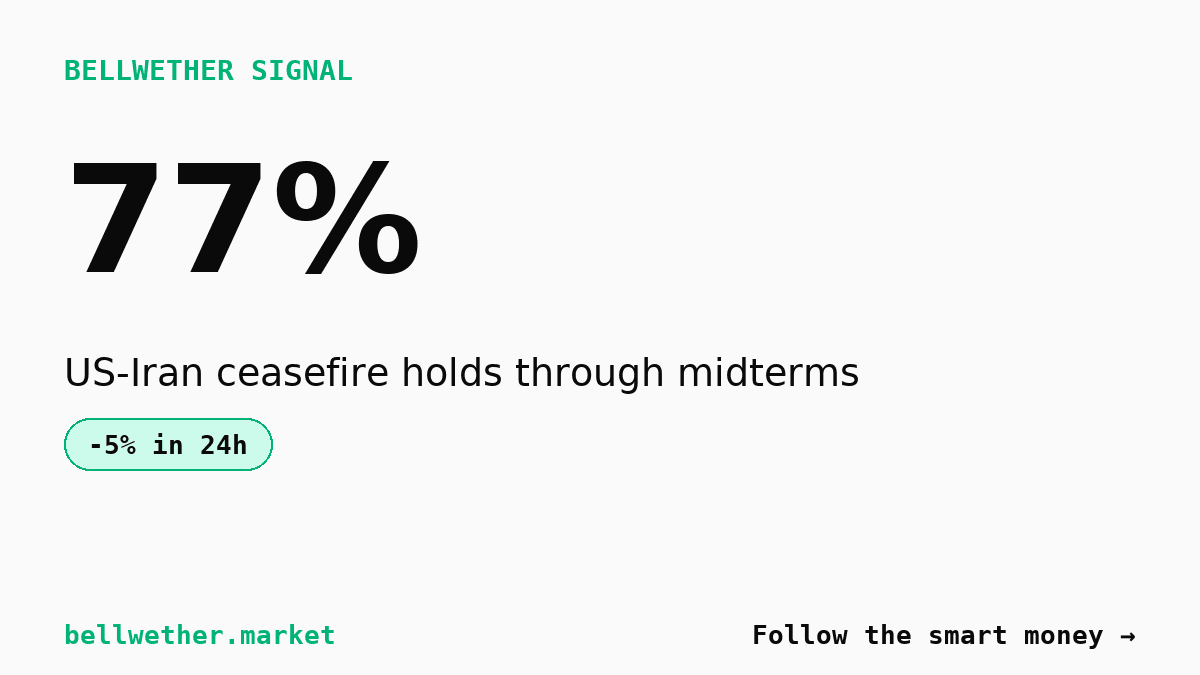
Polymarket traders still expect the US-Iran ceasefire to hold through the midterm elections, though a little less firmly than a day ago. The market prices the chance at 77%, after a 5% drop over 24 hours. No headline from the past few days explains the dip, so it reads as flow or positioning rather than a reaction to news.
A dip with no fresh headline
The news tied to this market is not new. The two reports that matter most are about 12 and 13 days old. CBS News reported that Trump promised not to resume strikes before the midterm elections. WPDE reported the same pledge and noted that the blockade continues. Those reports explain why the market sits so far above even odds.
Most coverage since then has been commentary and roundups. About 12 days ago, Al Jazeera asked whether Trump is signalling a return to war with Iran after the midterms. Benzinga ran a piece 9 days ago on what the prediction market shows. The Conference Board published a policy backgrounder on the war in the Gulf and the midterms 6 days ago. RG.org listed Polymarket odds on several topics 4 days ago. None of these reports a strike, a breach or a change in US policy. None falls inside the 24-hour window of the move.
So the 5% slide coincides with no known event. It may reflect a few traders trimming positions, taking profit after the pledge, or adding doubt about the blockade. The headlines do not let us say which.
What the 77% rests on
The price leans on a public promise from the president. That is a firm anchor for a market like this. A promise is not a treaty, though. The WPDE report notes the blockade is still in place, and the Al Jazeera piece points to the period after the vote. A market that runs only to the midterms does not have to price what happens after them, and that may help hold the number up.
A price of 77% is the crowd's rough estimate. It is not a forecast with authority. Our guide on how to read prediction market prices covers what a number like this does and does not tell you.
Thin book, modest swing
The market traded $126,408 in the past 24 hours. That is real money, but it is a small market for a question of war and peace. On a day this light, a handful of orders can move the price by several points. A 5% drop here deserves less weight than the same move in a deep market.
Bellwether's Signal Score rates the market 81 out of 100, which we class as strong. Liquidity provides the largest share, at 38 of 40. The move itself scores 18 of 35, a middling reading. Genuine uncertainty scores 12 of 25, which fits a price that leans well to one side. Put plainly, the market is active enough to watch, but the move is not large and the outcome is not finely balanced.
For comparison, the Polymarket market on a Democratic win in the Texas Senate race traded $139,027 in the same window at 62.5%. The 2026 balance of power market for a Democratic Senate and House traded $87,311, also at 62.5%. Interest in the ceasefire question sits in the same range as the bigger midterm races. All of these books are small.
The rules decide the outcome
Before you read much into 77%, check how the market resolves. The resolution text on the market page defines what counts as the ceasefire ending, which sources settle it and when the market closes. A narrow definition of a breach can keep yes priced high even as tensions rise. A broad one can flip the market on a single incident. Our explainer on how prediction markets work covers the basics, and our Polymarket overview describes how the platform handles resolution.
What would change the picture
The clearest trigger would be any sign that the strike pledge is weakening. That could be a new White House statement, a reported strike or an incident tied to the blockade. Any of these would likely move this market far more than 5%. In the other direction, a formal step toward a lasting deal could push yes higher. Without news like that, expect drift on thin volume, with moves that say more about who is trading than about Iran.
Prices in markets like this can swing hard on one headline, and traders can lose what they stake. This report describes the market. It is not advice to buy or sell.
Weekly roundup · Free
Get the Bellwether weekly market roundup
One short email each Sunday: what moved on Kalshi and Polymarket, the regulation news that mattered, and the markets worth watching.
One email per week · Unsubscribe anytime · We don't share your email