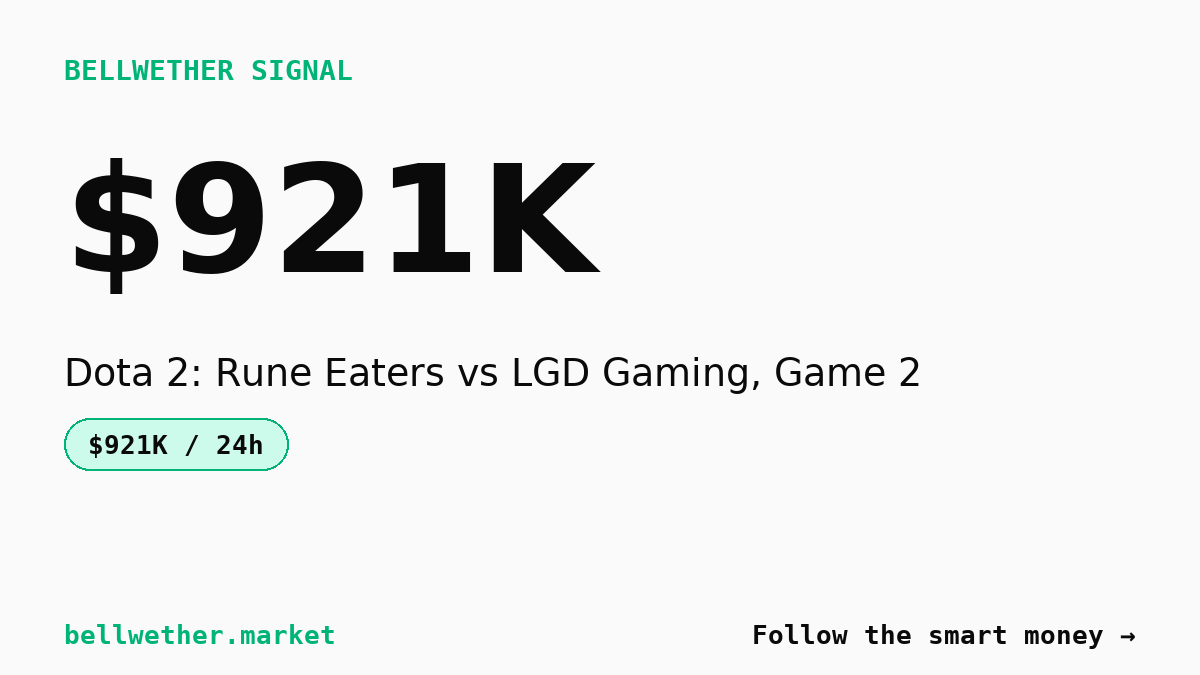
Prediction markets processed $921,443 in 24-hour volume on a single Dota 2 esports match, with smart money pricing Rune Eaters at 99.95% to defeat LGD Gaming in Game 2. The massive overnight volume marks one of the largest single-market esports bets tracked across decentralized prediction platforms.
The Rune Eaters vs. LGD Gaming Game 2 market absorbed more trading activity than geopolitical flashpoints, with traders staking nearly a million dollars on the outcome. Current pricing sits at 99.95% for Rune Eaters and 0.05% for LGD, a near-certain outcome in the eyes of the market. For context, a parallel match between Team Liquid and Vici Gaming saw $718,176 in volume on Game 1 and $617,735 on Game 2, with similarly lopsided pricing favoring Liquid at 99.95% and Vici at 0.5% in the second game.
The concentration of capital in esports markets reflects institutional-grade liquidity migrating to niche event outcomes, where information asymmetry and real-time data give sharp bettors an edge. When a market prices an outcome at 99.95%, it suggests either overwhelming favorite status or that the event has effectively concluded and traders are closing positions. The volume confirms conviction: participants are willing to lock capital at razor-thin returns rather than sit on the sidelines.
Geopolitical markets, by comparison, saw significant but smaller flows. U.S. invasion of Iran before 2027 drew $881,095 in volume at 20.5% probability, while Strait of Hormuz normalization by August 15 pulled $635,330 at just 3.1%. The contrast underscores how quickly liquidity shifts between event types based on information clarity and timing. Esports markets resolve in hours; geopolitical bets can take years.
The takeaway: when a Dota 2 match commands nearly a million dollars in 24-hour volume and trades at 99.95%, the smart money has already moved. The only question left is settlement.