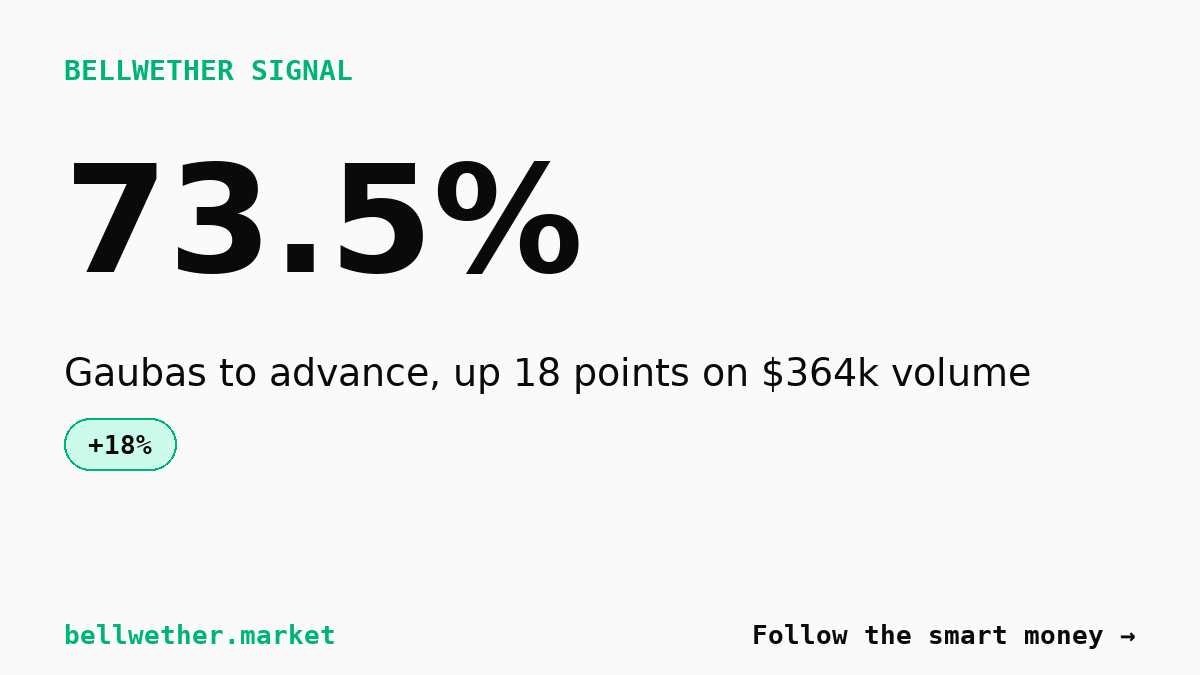
A $364,535 market on US Open qualifying now prices Lithuanian player Vilius Gaubas at 73.5 percent to advance past Harry Wendelken, up 18 percentage points in 24 hours. The repricing follows rain delays that pushed qualifying matches to a revised Friday schedule, announced by tournament officials on August 27. No match result or injury report explains the shift; the headlines confirm schedule disruption but no change in player status or form.
What moved
Polymarket logged $364,535 in 24-hour volume on the Gaubas-Wendelken qualifying match, concentrated enough to rank among the platform’s top sports signals. The implied probability for Gaubas rose from 55.5 percent to 73.5 percent, an 18-point climb that repositions the Lithuanian as a strong favourite. For context, a move of that size in a thin two-outcome market often reflects a handful of large orders rather than distributed conviction. Volume here sits well below the million-dollar game-by-game League of Legends markets that dominated the same signal window, but it remains the largest flow in tennis qualifying by a wide margin.
The 24-hour window captures trading through the rain-delay announcement and the publication of the revised schedule. Order flow tightened the spread and lifted the bid consistently, a pattern more typical of conviction than hedging. The market has not yet resolved; the match itself remains suspended as of this writing, pending court availability and weather clearance.
Bellwether Signal Score: 88 out of 100
The strong score reflects deep liquidity (40 of 40 points) and sharp movement (35 of 35), offset by low genuine-uncertainty (13 of 25). Translation: the market is liquid and moved decisively, but the outcome itself may not hinge on information traders can process in real time. A qualifying match between two players outside the top 200 typically offers limited public data on form, fitness or conditions. The score tells you the market repriced; it does not tell you the repricing was rational or that the new level is more accurate than the old one.
What is driving it
The repricing coincides with the US Open’s announcement of a revised Friday schedule after rain suspended qualifying matches. Heavy.com reported the schedule change on August 27, confirming that play was halted and matches pushed to the following day. No headline reports a Gaubas win, a Wendelken withdrawal, or any development in the match itself. The market moved before the match resumed.
That timing matters. When a sports market reprices sharply without a result, three explanations are common: new information on player condition, a large bet from a trader with an edge, or positioning ahead of a liquidity event. The headlines provide no evidence of the first. Sky Sports and olympics.com published standard US Open coverage with no mention of either player. Tennishead covered British players at the tournament but said nothing about Gaubas or Wendelken. The Robinhood headline from two days prior advertised a set-winner market, confirming the match was scheduled but offering no analysis or forecast.
The most plausible driver is flow. A trader or small group of traders bet Gaubas heavily, and the thin order book repriced. Qualifying matches between unranked players do not attract the depth of ATP main-draw markets; a few tens of thousands of dollars can move the line. The rain delay may have presented an opportunity to reposition without moving the market intraday, then lift offers once the schedule was confirmed. Alternatively, a trader may have accessed non-public information, local weather forecasts, or player-specific data that the broader market has not yet processed. We have no evidence of the latter, but we cannot rule it out.
What we can say: the headlines do not explain the move. The match has not been played. No credible tennis analyst published a Gaubas forecast in the past 48 hours. The repricing is flow-driven until proven otherwise.
How strong is this signal
The 88-point Bellwether Signal Score breaks into three components. The liquidity score, a perfect 40, reflects $364,535 in 24-hour volume, enough to trade size without slippage under normal conditions. The move-magnitude score, 35 out of 35, rewards the 18-point climb in implied probability, a clean and sustained repricing. The genuine-uncertainty score, 13 out of 25, penalises the lack of resolution ambiguity or real-time information flow. A US Open qualifying match resolves cleanly when one player wins; there is no hung jury, no recount, no interpretation required. The low uncertainty score is not a flaw in the signal; it is a feature. It tells you this is a straightforward binary event with a fast, verifiable outcome.
The score does not capture several things. It does not tell you whether the new price is correct. It does not measure the quality of the order flow or whether the traders moving the line have an edge. It does not adjust for the possibility that a single whale moved the entire market. And it does not account for time to resolution; a market that resolves in hours trades differently than one that resolves in months. Use the score to identify repricing events, not to validate the repricing itself.
How to read a price like this
Implied probability is the market’s current best guess, expressed as a percentage. A 73.5 percent price for Gaubas means the market assigns him a 73.5 percent chance of advancing, leaving 26.5 percent for Wendelken. To convert price to probability, divide the price by 100. To convert probability to odds, divide 1 by the probability: 1 divided by 0.735 equals 1.36, or 1.36-to-1 in decimal odds. If you believe Gaubas has a better than 73.5 percent chance, the market is offering value; if you believe he has less, the market is overpricing him.
The 18-point move is more informative than the 73.5 percent level. A static price tells you where the market is; a move tells you the market is revising its view. In thin markets, moves often reflect the beliefs of a small number of traders rather than aggregated wisdom. A $364,535 volume total is large for a qualifying match but modest compared to ATP main-draw markets, where daily volume can reach seven figures. Lower liquidity means higher volatility; a single large order can swing the line.
Order-book depth matters. A market with $50,000 on each side at narrow spreads is harder to move than one with $5,000 on each side at wide spreads. Polymarket does not publish full depth, so retail traders see price and volume but not the distribution of resting orders. That opacity makes it harder to distinguish between a genuine repricing and a temporary dislocation. If you are reading this price as a forecast, treat it as a signal that some traders now favour Gaubas, not as proof that Gaubas is the better player. For more on how prediction markets aggregate information, see our guide on how prediction markets work.
What would change the picture
The match itself is the only event that resolves the market. If Gaubas wins, the market settles at 100 percent. If Wendelken wins, it settles at zero. Between now and first serve, the price will move on order flow, weather updates, and any leaked information about player readiness. Check the US Open’s official schedule for the confirmed start time; if play is delayed again, expect the market to chop as traders reposition.
A sharp reversal in the other direction, back toward 55 percent or lower, would suggest the initial repricing was speculative and that informed flow is now fading it. A continued grind higher, toward 80 percent or beyond, would suggest the large buyers have conviction and are willing to defend the level. Volume alone will not clarify which scenario is playing out; you need to watch the price path and the timing of moves relative to public information.
New headlines about either player, official scratches, or weather updates that further delay play could all move the line. As of now, none of those have materialised. The market is pricing in the dark, using whatever private signals the largest traders believe they have.
The caveats
Resolution is straightforward: the player who wins the match wins the market. Polymarket’s rules tie the outcome to the official tournament result, so retirements, walkovers and disqualifications all count as losses for the retiring player. No ambiguity there, but thin liquidity and low public information create other risks.
Single large orders can dominate price discovery in markets this size. If one trader moved the line from 55.5 percent to 73.5 percent, the price reflects that trader’s view, not the crowd’s. You are not trading against aggregated information; you are trading against whoever has the most size. That introduces adverse selection risk: the trader moving the line may know something you do not, or they may simply be wrong with more capital than you.
Time to resolution is short, likely within 24 to 48 hours depending on weather. Short resolution windows reduce fundamental risk but amplify execution risk; if the match starts and the price moves against you, there may not be liquidity to exit cleanly. Prediction markets require understanding both the event and the mechanics of price formation.
Finally, this is a qualifying match. The winner advances to another round; the loser goes home. Neither player is a household name, and neither has a deep public track record on hard courts in late August. The market is pricing an outcome with limited data, which makes the 73.5 percent level less robust than a comparable price on a top-20 ATP player. Treat this as a flow signal, not a forecast. The market moved; the reason why remains unclear.