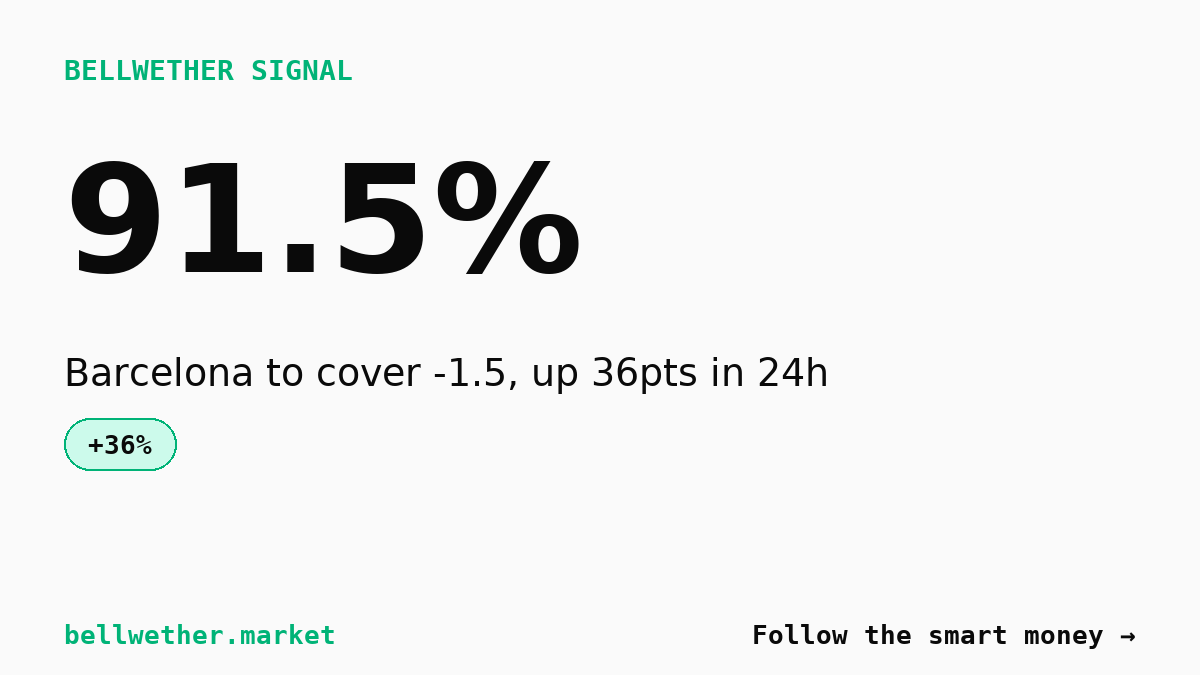
A prediction market on FC Barcelona covering -1.5 goals shows implied probability at 91.5%, up 36 percentage points in 24 hours on $643,261 of trading volume. The move earns a Bellwether Signal Score of 79/100, driven entirely by liquidity and magnitude; genuine uncertainty scores just 4/25, indicating this is a positioning event rather than new information changing the underlying contest.
When a sports spread market moves this far this fast, you look for breaking news. Here, there is none. The market concerns a Barcelona match scheduled for August 27, 2026, against Athletic Club. The only recent headlines reference the same fixture with generic match previews published over the past five days by PrizePicks, FanDuel, OddsShopper and ESPN. None report injuries, lineup changes, or any material development dated within the 24-hour window of the price move. This is a repricing without a catalyst visible in public reporting.
What moved
The market now prices Barcelona at 91.5% to cover a -1.5 goal spread, meaning they must win by at least two goals for the contract to resolve yes. Twenty-four hours ago, the same market sat near 55%. That 36-point climb happened on $643,261 of volume, a figure well above background noise but not exceptional for a major football fixture on Polymarket. For context, a separate market asking simply whether Barcelona will win the same match on the same date shows 99.7% probability on $2.9 million of volume, earning a similar signal score of 75. The gap between those two numbers tells you the entire question here is margin, not outcome.
The 24-hour move is large in percentage terms but occurred from a starting point that already reflected Barcelona as favorite. A jump from 55% to 91.5% is not the same as a jump from 10% to 46%; the latter would indicate a fundamental reassessment, while the former suggests participants converging on a view that was already the base case. Still, 36 points in a day is material, and the volume confirms this was not a single whale pushing an empty book.
What is driving it
The headlines do not explain the move. PrizePicks published a prediction piece on August 26, one day ago, covering Barcelona vs. Athletic Club and offering picks and expected lineups. That coincides with the timing of the repricing, but the article contains no breaking news, no injury update, no tactical revelation. It is a standard pre-match preview of the type published for every fixture in La Liga. FanDuel published odds for Barcelona in unrelated exhibition matches against Liverpool under various labels (MADNESS, SPARTAN, FRANCHISE, ZT, BOUNTY, STORM) over the past three days; these are simulated or branded betting markets with no connection to the August 27 Athletic Club fixture. OddsShopper ran a piece three days ago noting Kalshi odds on Barcelona vs. Bilbao, a different opponent, with a headline reading “One Win In Twenty.” ESPN posted spread and odds for Barcelona vs. Athletic on August 22, five days ago, before the move began.
None of these headlines contain information that would logically cause a 36-point repricing in a 24-hour window. The move is therefore best understood as driven by order flow and positioning rather than by news. Possible explanations include a large participant or group of participants taking a strong view on Barcelona’s form or Athletic’s weakness, arbitrage activity between this spread market and the outright win market, or a liquidity event where a seller stepped away and the book repriced to reflect the remaining bids. Prediction markets on sports often move when sophisticated participants disagree with traditional sportsbook lines and push the price until the gap closes or the book thins out. Without access to order-level data, we cannot confirm which dynamic occurred here, but the absence of public news makes it clear this is a market-structure story, not an information story.
How strong is this signal
The Bellwether Signal Score of 79/100 ranks this market as a strong signal, but the composition of that score matters more than the headline number. The score combines three components: liquidity (40/40), move magnitude (35/35), and genuine uncertainty (4/25). The first two are maxed out or near-maxed, reflecting deep volume and a large percentage move. The third is near zero, indicating the market sees the outcome as close to certain.
What the score captures: this is a liquid market where a large move happened quickly, meaning participants with real capital changed their view or their position in a short window. That makes it worth watching. What the score does not capture: whether that move was driven by information, by positioning, or by a handful of large orders. A high signal score tells you the market moved in a way that stands out statistically; it does not tell you the move was correct or that it reflects widely distributed information. In this case, the low genuine-uncertainty component confirms that participants are not pricing a close contest. They are pricing a Barcelona win by two or more goals as nearly inevitable. The question is why they repriced that view so sharply in 24 hours when no new information entered the public record.
How to read a price like this
An implied probability of 91.5% means the market assigns roughly 11-to-1 odds that Barcelona will cover the -1.5 spread. In traditional terms, that is a heavy favorite. But reading prediction market prices requires looking beyond the percentage to the conditions that produced it. A price of 91.5% on $643,261 of volume in 24 hours is different from a price of 91.5% on $50,000 of volume or on $5 million. The former might reflect a single large order moving a thin book; the latter would indicate broad consensus. Here, the volume is solid but not exceptional, and the move is sharp, which suggests either a small number of large orders or a cluster of medium-sized orders all pushing the same direction.
The relationship between this spread market and the outright win market is also instructive. The outright win market prices Barcelona at 99.7% to win, meaning the market sees almost no chance of Athletic avoiding defeat. The spread market at 91.5% prices an 8.2 percentage-point gap between Barcelona winning and Barcelona winning by two or more. That gap is where the action is. Participants are debating margin, not outcome, and the repricing suggests they now see a multi-goal victory as significantly more likely than they did yesterday. Whether that view is correct depends on factors the headlines do not address: fitness, tactical matchups, recent form in training, or proprietary models that participants trust more than public odds.
What would change the picture
Concrete checkable conditions that would shift this market include any Athletic Club lineup announcement showing key defenders unavailable, any Barcelona lineup announcement confirming full strength in attack, any pre-match press conference where the Athletic manager signals a defensive or rotated approach, or any late injury news on either side. If Athletic rests starters or Barcelona fields a weakened side, the spread market would reprice immediately. If the match starts and Barcelona takes an early lead, live markets would move further in their favor; if Athletic scores first or holds Barcelona level through the first half, the spread market would collapse back toward even.
On the structural side, watch whether volume continues at this level or drops off. If volume falls below $200,000 in the next 24 hours, the current price may reflect a temporary imbalance rather than sustained conviction. If volume rises above $1 million and the price holds or moves further, that would indicate broader participation and stronger consensus. Also watch whether the gap between the spread market and the outright win market widens or narrows. If the outright win market ticks down from 99.7% toward 95%, that would signal participants pricing in more Athletic resistance, and the spread market would likely follow. Conversely, if the outright win market stays near certainty and the spread market moves toward 95% or higher, that would confirm participants see a rout as the modal outcome.
The caveats
Resolution depends on the final score meeting the -1.5 condition, meaning Barcelona must win by at least two goals. A 1-0 or 2-1 result resolves no; a 2-0, 3-0, 3-1 or wider result resolves yes. Prediction markets on sports spreads are binary and do not pay partial credit for close margins. This market resolves on August 27, 2026, roughly two years from now, which introduces significant calendar risk. Rosters will change, managers may turn over, form will fluctuate, and the context surrounding this fixture may look entirely different by the time it occurs. The current price reflects expectations based on present information, but two years is long enough for those expectations to become irrelevant.
Thin books remain a risk even at $643,261 of volume. If the majority of that volume came from a small number of participants, the price may not represent a broad market view. Single large orders can move a book sharply, especially in spread markets where liquidity is often thinner than in outright win markets. The absence of explanatory headlines suggests this move may have been driven by exactly that kind of concentrated activity. Finally, Polymarket remains the only platform where this specific spread market trades, so cross-platform comparison is not possible here. For broader context on how prediction markets work, including liquidity dynamics and order flow, see the linked explainer. This is a strong signal by the numbers, but the story it tells is about market structure and positioning, not about new information changing the game.