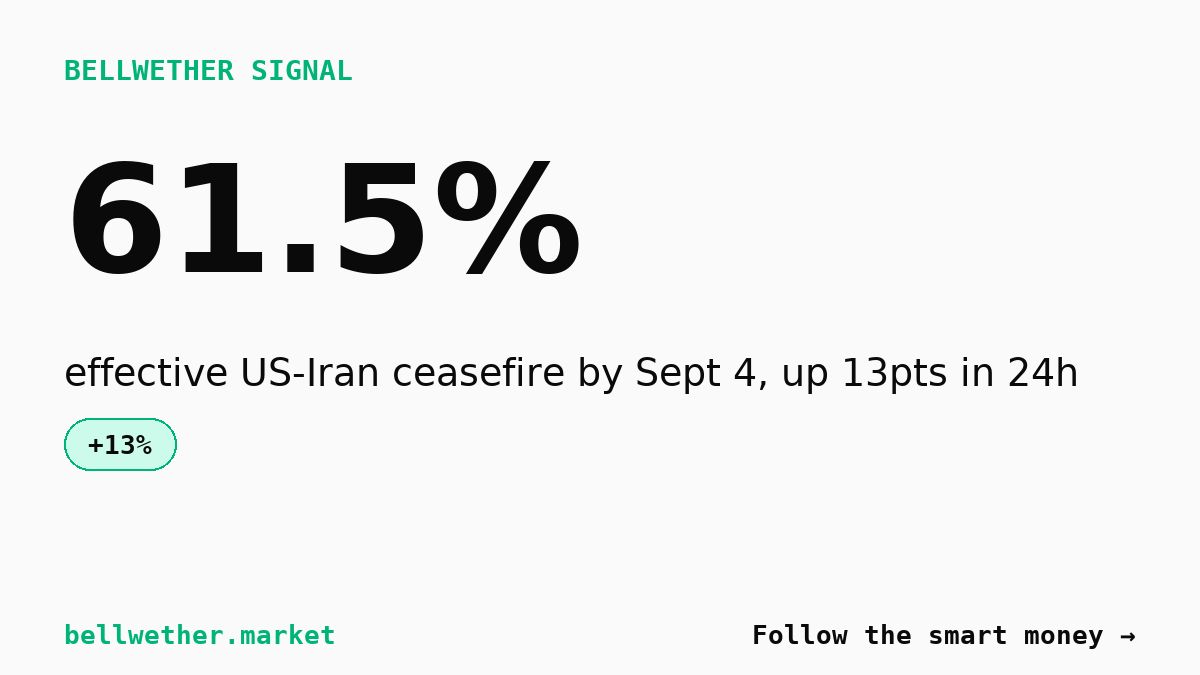
Polymarket traders have repriced the chance of an effective US-Iran ceasefire by September 4 to 61.5%, a 13-point climb in 24 hours. Half a million dollars changed hands in that window. The market now sees this outcome as more likely than not, a sharp reversal from where it stood a week ago when US and Iranian forces traded direct strikes.
The move tells us that someone with capital believes the tit-for-tat phase has ended. Whether they are right depends on events that have not yet occurred, but the price itself is a real-time estimate of how traders with money at risk are weighing the evidence.
What moved
The market saw $505,014 in 24-hour volume, enough to qualify as deep liquidity by Polymarket standards. Implied probability rose from 48.5% to 61.5% in that period. That is not a marginal drift; it is a deliberate repricing. The yes side pulled ahead decisively, flipping the market from a near coin toss to a probable outcome in a single day.
Volume of this size means the move was not driven by a single whale. Multiple participants pushed the price higher, suggesting convergent information or shared interpretation of recent developments.
What is driving it
The headlines retrieved for this market do not contain a ceasefire announcement, a diplomatic breakthrough or a formal agreement. The most recent development is a brief mention in a piece dated four days ago titled ‘Diplomacy on the Side’ which references a new peace push in Ukraine but does not detail any US-Iran negotiation. Earlier items describe the strike exchange nine days ago and rising oil prices three days ago following those air strikes.
What the headlines do show is a timeline. The US military struck Iran eight to nine days ago. Iran retaliated. Oil prices rose in response three days ago. Since then, no further escalation has been reported. The absence of new strikes coincides with this repricing.
The simplest explanation is that traders are interpreting the lack of follow-on attacks as a signal that both sides have chosen restraint. The market is not reacting to a press release; it is reacting to what has not happened. When combatants trade blows and then go quiet, prediction markets often price in de-escalation before official announcements arrive.
That said, the headlines do not confirm this interpretation. No diplomat is quoted saying the worst is over. No backchannels are described. The repricing could equally reflect position-taking by traders who believe September 4 is far enough away that any current tension will fade, or it could be driven by information not yet public. Without a concrete news hook, this is a flow-driven move until proven otherwise.
How strong is this signal
The Bellwether Signal Score of 94 out of 100 marks this as a strong indicator. The score breaks into three components: liquidity, move magnitude and genuine uncertainty. Liquidity scores 40 out of 40, meaning the market is deep enough that the price reflects aggregated conviction rather than a single large order. Move magnitude scores 35 out of 35, recognising that a 13-point jump in 24 hours is material and deliberate. Genuine uncertainty scores 19 out of 25, reflecting the fact that the outcome is still contested but not a pure toss-up.
What the score does not capture is whether the traders who moved the price have access to better information than the public. A high score tells you the market is liquid, the move is real and the outcome is uncertain. It does not tell you the market is correct. Reading prices requires distinguishing between a strong signal and a correct forecast.
In this case, the signal is strong because half a million dollars moved in one direction in a short window on a geopolitically sensitive question. The forecast is less certain because the headlines do not explain the move.
How to read a price like this
An implied probability of 61.5% does not mean ceasefire is guaranteed. It means that if you could run this scenario 100 times, traders expect an effective ceasefire to occur in roughly 62 of them. It is the modal outcome, but not the only outcome.
The 13-point move matters more than the 61.5% level. A market that has been drifting at 60% for weeks is less informative than a market that jumped from 48% to 61% in a day. The latter tells you new information arrived or new capital committed. The former tells you nothing changed.
Thin order books amplify moves. A market with $10,000 in volume can swing 20 points on a single $2,000 order. This market crossed half a million in 24 hours, so the book is not thin. The move required multiple participants to agree on direction. That makes it more credible as a signal, though not immune to reversal if the next headline contradicts the calm.
Traders on Polymarket are pricing this based on a resolution date of September 4, 2026, which gives the scenario four months to play out. A ceasefire that lasts a week does not resolve this market yes. The outcome depends on sustained restraint, not a temporary pause. Markets with longer time horizons are harder to price because more variables can intervene.
What would change the picture
A new round of strikes by either side would reverse this repricing immediately. If Iran launches another wave of attacks on US assets or US forces hit additional Iranian targets, the yes price would collapse. The current price assumes the cycle of retaliation has stopped.
A formal diplomatic announcement would lock in the move. If the US and Iran agree to terms brokered by a third party, or if either side publicly commits to restraint, the market would drift higher toward 70% or 80%. The absence of such an announcement keeps the price below certainty.
Oil price movements could serve as a leading indicator. If crude climbs further, it may signal that energy markets expect renewed disruption in the Gulf. If oil stabilises or falls, it suggests traders in commodity markets agree that the worst is over. The headline from three days ago noted oil prices rising; a reversal would support the ceasefire thesis.
Events in related theatres matter. The headline referencing Yemen’s Houthis is relevant because the group is backed by Iran. If Houthi attacks on shipping intensify, it would imply Iranian proxies remain active, which would weaken the case for a broader ceasefire. If Houthi activity declines, it would support the repricing.
The caveats
Resolution depends on the precise definition of ‘effective ceasefire’ in the market’s rules. If the criteria require a formal agreement, a de facto pause may not count. If the criteria allow for an informal halt to hostilities, the current quiet could be enough. Traders should verify the resolution source before interpreting the price.
The order book on this market may still be thinner than the volume suggests. High 24-hour volume does not always mean deep resting liquidity. If the bids and offers are sparse beyond the inside spread, a single large order in the opposite direction could push the price back down quickly. Knowing the depth of the book matters when assessing how much force would be required to reverse the move.
This market has four months to resolution. Geopolitical events rarely follow smooth paths over that time frame. A price of 61.5% today reflects the information set available now, not the events that will occur between now and September. The market can be right about the current trajectory and still wrong about the outcome if conditions change.
Polymarket operates on blockchain infrastructure and settles in USDC. Traders should understand the mechanics of the platform and the legal status of prediction markets in their jurisdiction before participating. All prediction markets carry risk of loss. No price, no matter how confident, guarantees a result.