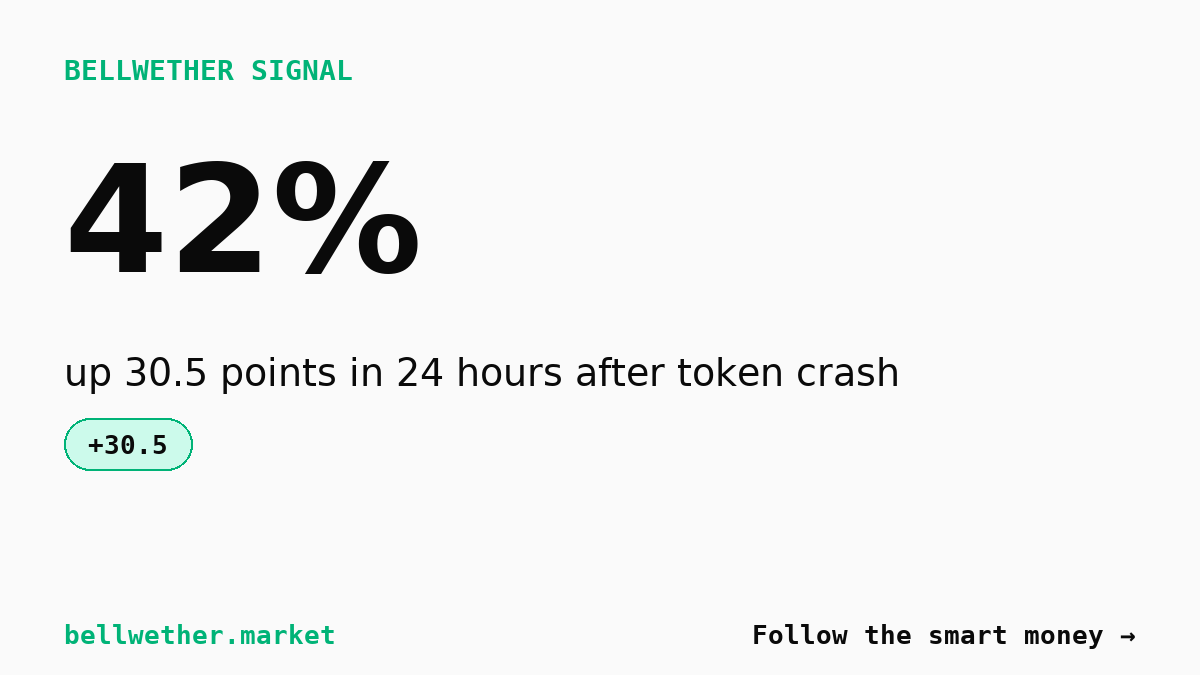
The question is whether a token that briefly touched a $200 billion fully diluted valuation before erasing 99% of that figure in hours can still close its first trading day above $1 billion. As of this writing, traders on Polymarket give that outcome a 42% chance, up from 11.5% yesterday.
That 30-point climb coincides with the actual launch and subsequent collapse of the LAPTOP token on January 19, 2025. Hunter Biden announced the memecoin three days earlier via an exclusive Wall Street Journal interview on January 16. The token went live, saw violent price action, and by the time the dust settled, most of the paper valuation had evaporated. The market is now digesting what the wreckage looks like and whether enough residual demand exists to hold a ten-figure valuation through the end of the first trading day.
What moved
Volume over the last 24 hours reached $927,163, enough to rank this market in the top tier of active event contracts on Polymarket. The implied probability rose from 11.5% to 42%, a 30.5-point swing. That is a repricing, not a drift. A market that started the day pricing the outcome as unlikely now treats it as plausible.
The 24-hour move of 30.5 points is large in absolute terms and decisive in context. A contract that spent time below 15 cents is now trading above 40 cents. That kind of velocity requires either concentrated buying or a fundamental reassessment of the distribution of possible outcomes. The volume figure tells us liquidity is present; the move tells us conviction shifted.
What is driving it
The headlines explain the move. On January 19, multiple outlets reported that the LAPTOP token crashed over 99% shortly after launch, erasing most of a fully diluted valuation that had briefly exceeded $200 billion. The Financial Times, Yellow.com, and tech-insider.org all covered the collapse within hours of the event. The token went live, spiked, and then fell apart.
The market is binary: does the FDV stay above $1 billion one day after launch, or does it fall below that threshold? The launch happened. The crash happened. What remains is whether enough buying support exists in the aftermath to keep the valuation above $1 billion when the measurement window closes. The repricing from 11.5% to 42% reflects traders updating their view of that residual demand.
Before the launch, this was speculative pricing based on announcement buzz and the novelty of a Biden family member entering the memecoin space. The Wall Street Journal broke the story on January 16, and two days later, multiple local and national outlets covered the impending launch. That early coverage created anticipation. The actual launch on January 19 converted anticipation into data. The data showed extreme volatility, a massive initial valuation, and then a collapse. The market is now pricing the aftermath, not the hypothesis.
One detail worth noting: there are three related markets on Polymarket, each with a different FDV threshold. The $250 million threshold market sits at 92.5% and logged $294,203 in volume. The $500 million threshold market sits at 72% with $504,470 in volume. The $1 billion threshold market sits at 42% with $927,163 in volume. The progression is coherent. Traders are assigning high confidence to the token holding a quarter-billion-dollar valuation, moderate confidence to half a billion, and lower confidence to a full billion. The volume concentrates at the $1 billion level because that is where the uncertainty is sharpest.
The 30-point move coincides with the crash, but the move is not merely a reaction to the crash. It is a reaction to what the crash revealed about the token’s ability to retain value. The headlines describe a token that briefly commanded a $200 billion FDV. If it crashed 99%, that implies it fell to roughly $2 billion, give or take. The question is whether it holds above $1 billion through the close of the first trading day. A market that opened the day pricing that outcome at 11.5% now prices it at 42%. That suggests traders believe the token stabilized somewhere in the range where $1 billion is a real possibility, even if not the most likely outcome.
How strong is this signal
The Bellwether Signal Score is 96 out of 100, which puts this in the top tier of active markets. The score breaks into three components: liquidity, move magnitude, and genuine uncertainty. The liquidity component is 40 out of 40, meaning volume is deep enough to reflect a wide base of opinion rather than a handful of large orders. The move magnitude component is 35 out of 35, meaning the 24-hour change is large enough to represent a material shift in probability rather than noise. The genuine-uncertainty component is 21 out of 25, meaning the market is not trading near the extremes; there is real disagreement about the outcome.
That combination is unusual. High liquidity and high move magnitude often coincide with markets that are resolving toward certainty, but this market remains at 42%, which is close to maximum uncertainty. Traders are transacting in size, the price is moving decisively, and yet the outcome remains genuinely in doubt. That is what a 96 score captures.
What the score does not capture is the specific risk that a memecoin market introduces. The FDV depends on the token price, the circulating supply, and the total supply. Those figures are volatile and subject to manipulation. A single large transaction can move the price by double digits in seconds. The resolution of this market hinges on a snapshot at a specific time, and that snapshot could be influenced by coordinated buying or selling in the minutes before the measurement. The score tells you the market is liquid and the move is large. It does not tell you whether the underlying asset is stable or manipulable.
How to read a price like this
An implied probability of 42% means the market is pricing the outcome as slightly less likely than a coin flip. If you believe the true probability is higher, you would buy the Yes contract at 42 cents and collect a dollar if the outcome occurs. If you believe the true probability is lower, you would buy the No contract at 58 cents and collect a dollar if the outcome does not occur.
The 24-hour move from 11.5% to 42% is more informative than the current level. A static price of 42% could mean the market has been there for days and nothing has changed. A move from 11.5% to 42% in 24 hours means the market was surprised. Traders who priced the outcome as unlikely yesterday are now pricing it as plausible today. That shift coincides with the token going live and crashing, which means the market learned something from observing the actual price action.
Volume of $927,163 over 24 hours is substantial for a niche memecoin market. For context, the related $500 million threshold market logged $504,470, and the $250 million threshold market logged $294,203. The liquidity concentrates at the $1 billion level because that is where the disagreement is sharpest. A deep book means the price reflects a wide distribution of opinion. A thin book means a single large order can move the price by ten points. This book is deep.
When reading a market like this, focus on the move, not the level. A market that sits at 42% for a week is telling you one thing. A market that moves from 11.5% to 42% in a day is telling you something else. The move is the signal. The level is the snapshot.
What would change the picture
The market resolves based on the FDV one day after launch. One day after January 19 is January 20. The resolution will depend on the token price and the total supply at the measurement time specified in the market rules. If the token price holds above a certain threshold, the FDV stays above $1 billion and the Yes contract pays out. If the price falls below that threshold, the No contract pays out.
Concrete developments that would move the price: a public statement from Hunter Biden about the token, a large purchase by a known wallet, a coordinated buying campaign by a memecoin community, or a technical issue with the token contract that locks supply or prevents trading. Any of those could occur in the hours before resolution and shift the outcome.
On the downside, further selling pressure, a liquidity crisis on the primary exchange, or a wave of profit-taking from early buyers could push the FDV below $1 billion. Memecoin markets are prone to cascade effects. If the price starts falling and stop-losses trigger, the decline can accelerate. The inverse is also true: if the price starts rising and short positions unwind, the rally can feed on itself.
The sister markets at $500 million and $250 million provide a rough guide to trader expectations. If the $500 million market stays above 70%, that suggests traders believe the floor is somewhere between $500 million and $1 billion. If the $250 million market stays above 90%, that suggests the floor is well above $250 million. Watching those related markets in real time can offer early warning of a shift in sentiment.
The caveats
The resolution depends on a specific definition of FDV and a specific measurement time. Read the market rules before transacting. FDV is typically calculated as token price multiplied by total supply. Total supply can be ambiguous if the token has vesting schedules, locked supply, or unclear issuance rules. If the resolution source uses circulating supply instead of total supply, the FDV will be lower. If the measurement time is at market close rather than a specific timestamp, the final price could differ from the price at any given moment during the day.
Memecoin markets are thin by nature. Even with $927,163 in 24-hour volume, this is not a deep market compared to major event contracts or election markets. A single actor with a large position could move the price by several points in minutes. That is not manipulation; it is the reality of a market with limited participation and a volatile underlying asset.
Time to resolution is measured in hours, not days or weeks. Markets that resolve quickly are prone to last-minute volatility. If you are holding a position into the final hours before resolution, be prepared for the price to swing as late information arrives and positions are adjusted.
Risk of total loss is real. If you buy the Yes contract at 42 cents and the FDV falls below $1 billion at resolution, you lose the 42 cents. If you buy the No contract at 58 cents and the FDV stays above $1 billion, you lose the 58 cents. This is a binary outcome. One side goes to zero.
For more on how to read prediction market prices and interpret implied probabilities, see our guide. For a broader introduction to how prediction markets work, including resolution mechanics and liquidity, start there. This market is trading on Polymarket, which uses USDC and settles on the Polygon network.