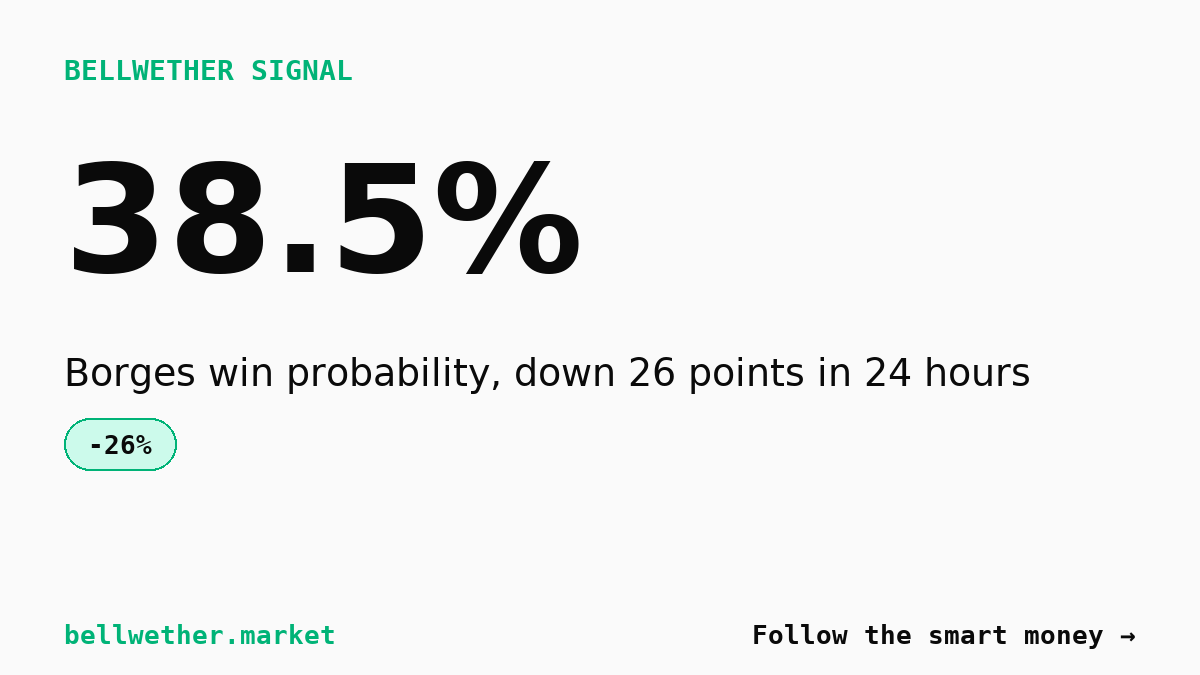
A first-round match at the Cincinnati Open between Nuno Borges and Thanasi Kokkinakis became one of the most liquid sports markets on Polymarket over the past day, and the odds repriced sharply against the Portuguese player. Borges now stands at 38.5% to win, down 26 percentage points in 24 hours, while more than $676,000 changed hands on the outcome.
That is a big move on substantial volume for a routine ATP tour match. It tells you that informed money entered the market with a strong view, and did so in size. Whether that view was grounded in injury information, recent form or something else is not directly visible in the headlines retrieved for this market.
What moved
Borges opened the 24-hour window somewhere near 64.5% implied probability. He closed it at 38.5%, a fall of 26 points. The market saw $676,178 in total volume, which places it among the top five sports markets on Polymarket by liquidity over the same period. The other high-volume markets in that window were League of Legends playoff matches and a mid-August Wolverhampton fixture, all of which drew between $300,000 and $1 million in turnover.
The 24-hour move flipped the favourite. At 38.5%, Borges is now the underdog. Kokkinakis, by implication, sits above 60%. That is a material revision in a head-to-head tennis market, and it happened quickly.
What is driving it
The headlines retrieved for this market do not supply a clear public catalyst. Tennis.com published a match page on August 13, Sky Sports ran a generic sports-news digest, Robinhood listed a set-winner market, and Tennis Tonic published a preview with odds and pick on August 14. None of those items reports an injury withdrawal, a late change to the draw, or a statement from either player that would justify a 26-point swing in implied probability.
Tennis Tonic’s preview from August 14 may have included updated odds or a pick that reflected new information, but the headline itself does not indicate what that information was. The absence of a clear public news hook in the retrieved headlines suggests the move was driven by private information or by a large order from a trader with a strong directional view. That kind of flow can move a market quickly when the order book is not infinitely deep, even on $676,000 in volume.
It is also possible that the move reflects late-breaking information not yet indexed by the news sources queried here. Tennis odds can move sharply in the hours before a match if a player reports discomfort in practice or if sharp bettors at traditional sportsbooks signal a strong lean. Prediction markets often track that flow, sometimes with a lag, sometimes ahead of it. Without a timestamped injury report or a credible source naming a specific development, the safest conclusion is that this repricing coincides with informed positioning rather than a widely reported public event.
How strong is this signal
The Bellwether Signal Score for this market is 94 out of 100, which is classified as strong. That score is built from three components: liquidity, move magnitude and genuine uncertainty. Liquidity contributed 40 out of a possible 40 points, reflecting the $676,000 in 24-hour volume. Move magnitude contributed 35 out of 35, reflecting the 26-point fall in implied probability. Genuine uncertainty contributed 19 out of 25, which means the market started and ended far enough from the extremes of 0% or 100% to allow for real two-sided risk.
A score of 94 tells you the market had enough depth to absorb large orders, moved enough to signal a material change in expectations, and remained uncertain enough that the outcome is not foregone. What the score does not capture is whether the move was driven by information that will prove correct, whether the order flow was concentrated in a small number of large trades, or whether the move will reverse before the match begins. The score measures the quality of the signal as a price event, not its accuracy as a forecast.
How to read a price like this
An implied probability of 38.5% for Borges means the market estimates he has a little better than one chance in three of winning the match. In a two-outcome market, that also implies Kokkinakis has about a 61.5% chance. The 26-point move is more informative than the level. A market that drifts from 65% to 39% over 24 hours is telling you something changed, or that someone with conviction disagreed with the opening price and had the capital to move it.
Thin order books amplify price moves. If the market had $10,000 of resting liquidity on each side and someone placed a $50,000 order, the price would move sharply even if the informational content of that order was modest. The $676,000 in total volume suggests the book was not infinitely thin, but it does not tell you how much of that volume was genuine two-sided flow and how much was a single large trade walking through the book. On Polymarket, large orders can and do move prices, especially in niche sports markets where liquidity is concentrated rather than distributed.
The move also matters more than the level because it signals a change in the market’s assessment. A static 38.5% could reflect a stable consensus. A 26-point fall in 24 hours reflects new information or new capital, and that is the signal worth tracking. For a detailed explanation of how to interpret implied probabilities and what moves matter, see our guide on how to read prediction market prices.
What would change the picture
The most direct condition that would change this picture is the result of the match. If Borges wins, the market resolves at 100% in his favour. If Kokkinakis wins, it resolves at 0%. That outcome will validate or contradict the repricing, but it will not explain what information, if any, drove the move.
Before the match, a credible injury report naming either player would reframe the market. If Borges withdraws or discloses a physical issue, the 26-point fall would appear prescient. If no such report emerges and Borges plays without visible limitation, the move would look like flow-driven noise or a mistaken read of his chances. Similarly, if traditional sportsbooks show a parallel move in their odds, that would confirm the repricing was tracking broader market sentiment rather than an isolated order on Polymarket.
Another condition to watch is whether the price continues to move in the same direction or reverts. If Borges drifts further toward 30% or lower in the hours before the match, that would suggest ongoing conviction in the bearish view. If the price rebounds toward 50%, it would suggest the initial move was overdone or that the seller’s information was challenged by other participants.
The caveats
This market resolves on the official result of the match, which is binary and verifiable. There is no ambiguity in the resolution rules for a completed ATP match. However, if the match is postponed, suspended or one player withdraws before the first point, the resolution path may depend on how the market’s rules handle walkovers. Polymarket’s terms for tennis markets typically specify what happens in the event of a retirement or no-show, and those terms matter when implied probabilities are this close to even.
The $676,000 in volume is substantial for a first-round match outside a Grand Slam, but it does not guarantee the order book was deep or that the price reflects a true consensus. A single well-capitalised trader with a strong view can move a market of this size, especially if the resting liquidity is concentrated in a narrow range. That means the 38.5% should be read as the market-clearing price given the participants and capital present, not as an objectively correct probability.
Finally, the time to resolution is short. The match is scheduled for August 14, 2026, which means the market will resolve within a day or two of this analysis. Short-fused markets are less useful for tracking evolving information and more vulnerable to last-minute flow. The 26-point move happened in the final 24 hours before the event, which is when late-breaking information, genuine or speculative, tends to hit the tape.
For more on how prediction markets aggregate information and what their prices actually mean, see our guide on how prediction markets work.