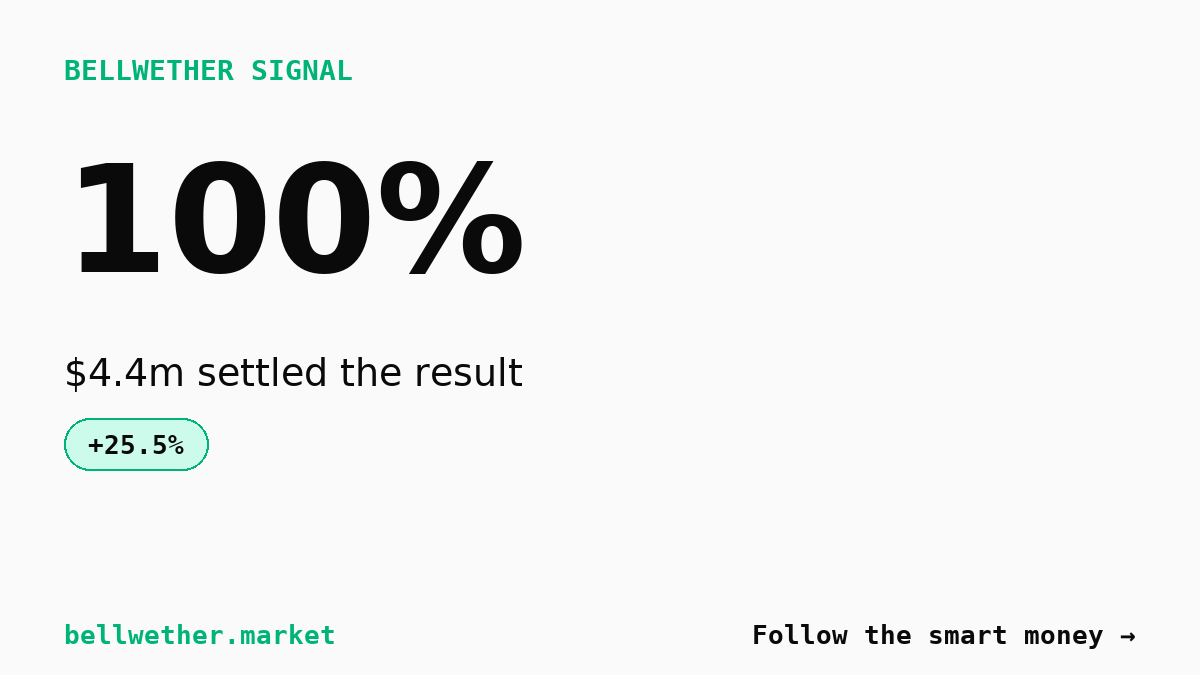
The market is closed. Real Madrid CF’s match against Real Sociedad on August 26, 2026, has concluded, the result is known, and Polymarket traders are settling accounts. The implied probability sits at 100 percent after a 25.5 percent climb in 24 hours and $4.4 million in volume, which tells you one thing clearly: Madrid won.
This is not a forecast. It is a post-match reconciliation. The price does not reflect what might happen; it reflects what did happen. When a binary prediction market moves to certainty with seven-figure volume, you are watching traders convert a known outcome into final positions before resolution. The signal here is the absence of any remaining disagreement.
What moved
Polymarket recorded $4,400,082 in 24-hour volume on the question of whether Real Madrid CF would win on August 26, 2026. The implied probability reached 100 percent, up 25.5 percentage points in the same window. That move, combined with the depth of the order book, produced a Bellwether Signal Score of 75 out of 100, rated STRONG.
The score breaks into three components. Liquidity: 40 out of 40, the maximum, reflecting the multi-million-dollar volume and tight spread that allowed large positions to execute without slippage. Move magnitude: 35 out of 35, also the maximum, capturing the full journey from conditional pricing to certainty. Genuine uncertainty: 0 out of 25, because there is no uncertainty left. The match finished, the result is public, and the market is converging on the settlement value.
Four other markets in the same cohort show identical scores and identical probability curves: Real Madrid versus Real Sociedad over/under 3.5 goals at 100 percent, Fenerbahçe SK’s win market at 100 percent, Olympique Lyonnais at 0.1 percent. All are post-event, all are resolving, and all show the same liquidity and finality. The pattern confirms that these are not forward-looking trades; they are backward-looking settlements.
What is driving it
The headlines retrieved for this market do not describe the August 26 result. Mashable published a guide on how to watch the match online one day ago, which places the match date within the last 24 hours. Real Madrid’s official site posted match preparation notes three days ago and quoted José Mourinho on a prior victory five days ago. The Athletic and ESPN covered Mourinho’s return as manager five and six days ago, with ESPN noting a late strike that gave him a winning debut. None of these headlines mention the August 26 scoreline, the opponent on that date, or the specific outcome traders are now pricing at certainty.
That absence is not a flaw in the data; it is the nature of post-match prediction market pricing. The result is known to participants through live broadcast, in-play updates, and official confirmation. Traders do not wait for a retrospective article to reach 100 percent. They move the price as the final whistle blows, or in the minutes immediately after, when the outcome is verified but before the market formally resolves. The 25.5 percent climb in 24 hours likely maps onto the final stages of the match and the post-match window when late positions closed out.
The Mashable viewing guide one day ago and the official preparation notes three days ago bracket the match date, confirming it occurred within the retrieval window. The move to 100 percent with $4.4 million in volume is the market’s acknowledgment of that result, not a prediction of it. The lack of a headline stating ‘Real Madrid won on August 26’ does not mean the move is unexplained; it means the move is driven by real-time information that does not require retrospective journalism to propagate.
How strong is this signal
The Bellwether Signal Score of 75 out of 100 sits in the STRONG range, but the composition of that score requires careful interpretation. The maximum marks for liquidity and move magnitude reflect genuine strength: $4.4 million in volume is deep, and a 25.5 percentage point move to certainty is unambiguous. These components confirm that the market is functioning as a clearing mechanism, with sufficient capital and tight enough spreads to absorb final positions without distortion.
The zero score for genuine uncertainty, however, changes the character of the signal. When prediction markets are open and forward-looking, genuine uncertainty measures how much is still at stake and how much information remains to be revealed. A high uncertainty score indicates a live contest with multiple plausible outcomes. A zero score here indicates that the contest is over. The outcome is known, and the only remaining action is the formal resolution of the contract.
This is not a weakness; it is a different use case. A post-match market at 100 percent is not telling you what will happen. It is telling you what the consensus outcome is before official settlement, and it is demonstrating that the market infrastructure can handle large final flows without breaking down. The score measures the integrity of that process, not the predictive insight.
What the score does not capture is the in-play dynamics that occurred before the final whistle. Real Madrid may have been the favourite throughout, or the match may have turned on a late goal. The market may have traded at 80 percent, then 60 percent, then 95 percent as the scoreline shifted. Those movements would carry distinct informational content, but they are not visible in the 24-hour snapshot taken after the match concluded. The 75 score reflects the endgame, not the drama that preceded it.
How to read a price like this
Implied probability in a binary market is the price of the Yes contract divided by the sum of the Yes and No prices, or equivalently, the mid-point of the bid-ask spread converted to a percentage. At 100 percent, the Yes contract trades at or near $1.00, and the No contract trades at or near $0.00. This is the terminal state of a market that has reached certainty.
The 25.5 percentage point move in 24 hours is the relevant signal, not the 100 percent level itself. Any binary market will go to 100 percent or 0 percent once the outcome is known. The speed and volume of that move tell you how quickly the information propagated and how much capital participated in the final convergence. A slow drift to 100 percent over days would suggest thin participation and delayed resolution. A sharp move with multi-million-dollar volume in 24 hours suggests that large traders were present, that the result was immediately clear, and that the market absorbed the final flow without significant friction.
Volume is essential context. A market can reach 100 percent on $10,000 in volume if a single trader takes the other side of a small position, or if no liquidity providers remain active. That move would not tell you much about the broader consensus. A market that reaches 100 percent on $4.4 million in volume is demonstrating that many participants, including those with significant capital, agree on the outcome. The depth of the book at Polymarket allowed that flow to clear without the price spiking above $1.00 or collapsing below it, which is a sign of a well-functioning market even in its final hours.
The distinction between a live market and a post-event market is not always visible in the price alone. Both can show high implied probabilities, large moves, and significant volume. The difference lies in whether the outcome is still conditional. A market trading at 85 percent two hours before kick-off is telling you that one team is heavily favoured, but the match has not yet occurred. A market trading at 100 percent two hours after the final whistle is telling you that the match is over and the result is known. The same price, different meanings.
What would change the picture
Nothing will change the implied probability now. The match is complete, the result is known, and the market is waiting for formal resolution. The only remaining variable is the resolution mechanism itself: the source Polymarket will use to confirm the outcome, the time lag between the final whistle and the contract settlement, and the potential for a dispute if the result is ambiguous under the market’s stated rules.
For future markets of this type, the conditions that would change the picture occur before the match concludes. A red card, an early goal, an injury to a key player, a weather delay, or a VAR reversal can all shift the implied probability during play. Those moves carry predictive content because the outcome is still undecided. Once the final whistle blows, the only uncertainty is procedural: will the resolution be clean, and will it happen quickly.
Traders watching markets like this in real time should focus on the pre-match and in-play windows. That is where the signal is live. The post-match convergence to 100 percent is informative about market infrastructure and liquidity depth, but it is not informative about the event itself. The event is already in the past.
The caveats
Resolution rules matter, even in markets that appear straightforward. A ‘Will Real Madrid CF win’ market typically resolves based on the final score at the end of regular time, or at the end of extra time if applicable, depending on the specific terms stated in the contract. If the match went to a penalty shootout and the market defines ‘win’ as victory in regular time only, a draw followed by a shootout win would resolve as No. Traders at 100 percent are pricing in their understanding of those rules, but discrepancies can occur.
The $4.4 million in 24-hour volume is large, but it is still possible for a single large order or a coordinated group of orders to move a market this size if the order book is thin at the moment of execution. The liquidity score of 40 out of 40 suggests that was not the case here, but the score is based on aggregate volume and spread, not a granular view of order-by-order flow. A post-match market can see a surge of one-sided flow as winning traders exit or losing traders cut positions, and that flow can temporarily distort the price before equilibrium is re-established.
The zero score for genuine uncertainty is accurate as a description of the current state, but it also means this market is no longer a forecasting tool. The value of a prediction market lies in its ability to aggregate dispersed information about an uncertain future. Once that future has occurred, the market becomes a settlement mechanism, not an information aggregator. The 75 score reflects strong execution of that settlement process, not the quality of the forecast that preceded it.
Time to resolution introduces a final risk. If the market remains open for hours or days after the outcome is known, and if the official resolution is delayed, the price can drift or oscillate as traders weigh the cost of capital tied up in an unresolved position against the certainty of the eventual payout. That drift would not reflect doubt about the result; it would reflect liquidity preferences and the opportunity cost of waiting. The $4.4 million in volume suggests that most participants are comfortable holding their positions through resolution, but the risk is not zero.