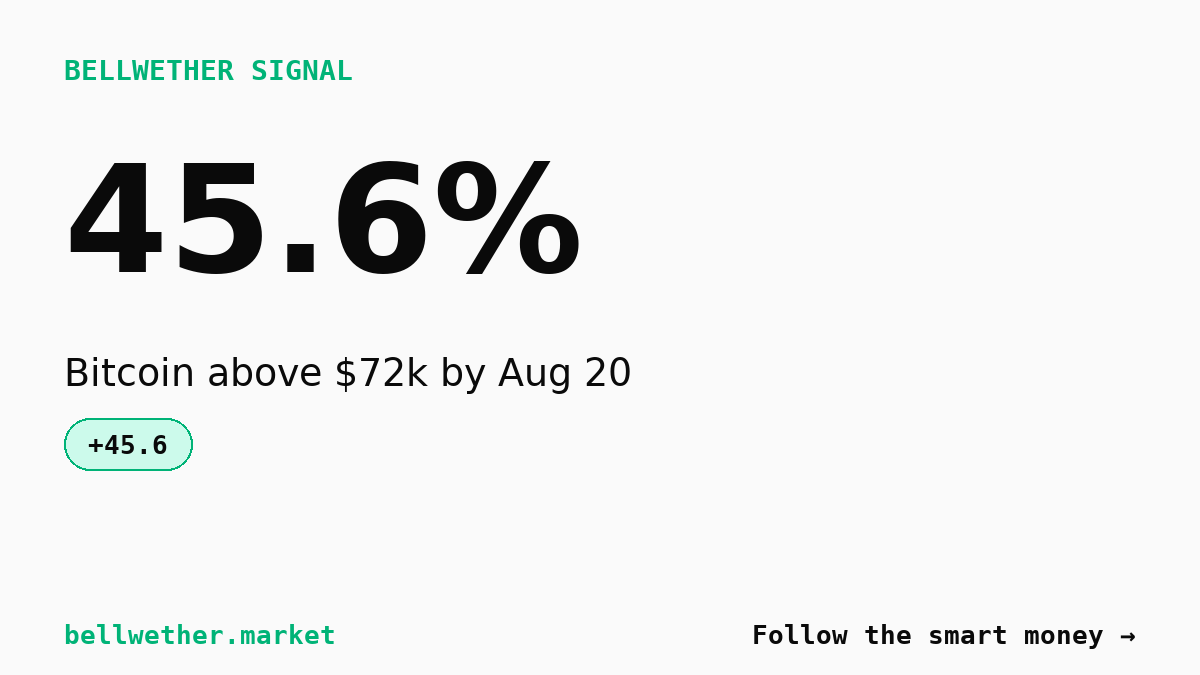
The Polymarket binary on Bitcoin closing above $72,000 by August 20 moved from effectively zero probability to 45.6% in a single day, a rare vertical repricing that suggests either new information arrived or a large trader entered a position the market had left untouched. The 340,000 dollar 24-hour volume is substantial for a mid-tier crypto derivative, and the Bellwether Signal Score of 98 out of 100 flags this as one of the highest-conviction moves we track. The question is whether the headlines support that conviction or whether this is purely flow-driven.
The verdict right now is that this looks like a positioning event rather than a response to fundamental news. Bitcoin traded around $65,000 as recently as August 10 according to the Yahoo Finance headline, and the TradingView piece from August 11 described repeated failures at that level with downside risk to $62,800. Nothing in the retrieved headlines describes a breakout, a macro catalyst, or a technical shift that would justify a 45-point probability jump for a $72,000 close nine days out. That does not make the signal wrong; it makes it a tell about trader belief rather than realized price action.
What moved
The market went from dormant to live in 24 hours. Volume of $340,131 is enough to establish a two-sided book, and the 45.6% implied probability is now the market’s central estimate. The 24-hour move of positive 45.6 percentage points is as large as a binary can move without going from zero to one hundred, and that magnitude is what drives the signal score. The companion market asking whether Bitcoin will reach $72,500 in August sits at 87%, which tells you the market sees a reasonable chance Bitcoin touches that level but a much lower chance it closes above $72,000 on the specific date of August 20. The $75,000 August market at 47% is effectively tied with this one, suggesting that if Bitcoin gets to $72,000 by the twentieth, traders see it continuing higher rather than stalling.
Volume alone does not explain urgency. The context markets include eSports binaries with higher volume and lower signal scores, which means those are liquid but slow-moving. This market moved fast and drew capital, and that combination is what the Bellwether algorithm privileges. The magnitude component scored 35 out of 35, the maximum, because a 45-point move in 24 hours is as sharp as prediction markets get outside of election-night tallies or breaking scandal.
What is driving it
The retrieved headlines do not explain the move. The most recent price reference is from August 10, when Yahoo Finance reported Bitcoin breaking past $65,000 again, and the August 11 TradingView analysis described that level as a point of failure with downside risk. None of the headlines mention a rally to $70,000 or above, none cite a macro trigger such as Fed commentary or ETF inflows, and none reference a technical breakout. The OddsShopper piece on Kalshi odds versus an AI panel is undated in the retrieval but appears to be a comparison of probability models rather than a report of price action.
That leaves three possibilities. First, Bitcoin may have rallied sharply in the hours before this analysis, and the headlines have not yet caught up. Second, a single large trader or a coordinated group may have taken a directional position, and the market is repricing around that order flow rather than around new public information. Third, the market may be responding to private signals such as on-chain metrics, whale wallet movements, or derivatives positioning that do not make it into traditional news feeds. Prediction markets on crypto often front-run headline news because the participants are trading the asset in real time and have access to exchange data, funding rates, and liquidation cascades that journalists cover only after the fact.
What we can say with confidence is that this is not a reaction to the headlines we retrieved. The market is pricing a 20% rally from the $65,000 level described in the August 10 report to above $72,000 by August 20, and it is doing so with conviction. That repricing happened in 24 hours, and it happened on volume, which means someone with capital believes the path to $72,000 is now open. Whether that belief is grounded in realized price movement, anticipated volatility, or simply a trader’s thesis, the headlines do not tell us.
How strong is this signal
The Bellwether Signal Score of 98 out of 100 is as high as our model assigns outside of major political or economic events. The liquidity component scored 40 out of 40, which means the $340,000 in 24-hour volume is enough to establish confidence that this is not a single market-maker painting the tape. For reference, reading prediction market prices requires distinguishing between a number that reflects one large order and a number that reflects continuous two-sided flow. This market cleared the threshold.
The move magnitude component scored 35 out of 35 because a 45-point jump is the maximum a binary can move without going from zero to one hundred. The genuine-uncertainty component scored 23 out of 25, slightly below maximum, which reflects the fact that the market is now at 45.6% rather than near fifty. A market at exactly fifty represents maximum uncertainty; a market at 45.6% has a lean, and that lean reduces the uncertainty premium. The score does not tell you whether the market is correct. It tells you the market is liquid, the move was large, and the probability is not pinned to an extreme. It does not tell you whether Bitcoin will actually close above $72,000, and it does not tell you whether the move was driven by information or by flow.
What the score does not capture is the absence of supporting headlines. A 98 signal on a Treasury-rate market or a Fed-decision binary would typically coincide with a policy statement, a data release, or a Fed speaker. This 98 signal has no equivalent public trigger, which makes it a pure prediction-market tell rather than a reaction to known events. That is valuable in its own way, because it tells you where the money is going before the narrative catches up.
How to read a price like this
An implied probability of 45.6% means the market sees this outcome as slightly less likely than a coin flip. In a liquid market, that number is the consensus view of participants who are willing to put capital at risk on both sides. In a thin market, it can be the view of a single large trader who moved the price and is now waiting for someone to take the other side. The volume here suggests the former, but how prediction markets work is that even in a liquid market, a large order can move the price sharply if the resting limit orders are sparse.
The move is more informative than the level. A market sitting at 45% for a week is less interesting than a market that moved from zero to 45% in a day, because the move tells you something changed. Either new information arrived, or a new participant entered, or the collective belief shifted. The fact that this market was dormant and is now active means someone decided the price was wrong and put money behind that view. Whether that someone has better information or simply a stronger thesis, the move itself is the signal.
Compare this market to the $72,500 August binary at 87%. That market is pricing a high probability that Bitcoin touches $72,500 at some point in the month, while this market is pricing a much lower probability that Bitcoin closes above $72,000 on the specific date of August 20. The difference tells you the market sees path risk: Bitcoin might spike to $72,500 and then pull back, in which case the touch market pays and the close market does not. The 47% probability on the $75,000 August market tells you that if Bitcoin gets to $72,000, the market sees it continuing higher rather than stalling. These are not independent bets; they are a term structure, and reading them together gives you a picture of the market’s expectations around volatility, momentum, and mean reversion.
What would change the picture
The most direct catalyst would be Bitcoin trading visibly above $70,000 in the next 48 hours. If the spot price on major exchanges breaks that level and holds it, this market should move higher, because the distance to $72,000 shrinks and the time to resolution shrinks in parallel. If Bitcoin instead trades down toward $63,000, the market should collapse back toward zero, because a $9,000 rally in nine days requires a catalyst this market is not currently pricing.
Macro news could shift the picture. A Fed speaker signaling a near-term rate cut, a headline around spot Bitcoin ETF inflows, or a liquidity event in traditional markets that drives capital into crypto would all be reasons for this market to reprice higher. Conversely, a risk-off move in equities, a spike in the dollar, or a regulatory headline out of the SEC or CFTC could send this market lower. The fact that none of those things appear in the retrieved headlines is part of why this move is hard to explain with public information.
Resolution is August 20, which is nine days out as of this writing. That is enough time for meaningful volatility but not enough time for a multi-week trend to develop. The market is pricing a scenario where Bitcoin rallies sharply in the next week and holds above $72,000 through the resolution date. If that rally happens but Bitcoin closes at $71,800 on August 20, this market pays zero. The binary structure is unforgiving, and that is why a 45% probability on a $72,000 close is lower than the 87% probability on a $72,500 touch, even though $72,000 is the lower strike.
The caveats
Resolution depends on the specific data source Polymarket names in the market rules, which we do not have in front of us but which is typically a major exchange such as Coinbase or a pricing index such as the CoinGecko aggregator. If the rules specify a single exchange, a wick on that exchange at 11:59 PM UTC could determine the outcome even if the broader market closed lower. If the rules specify an index, the market will resolve to the index value, which may differ from the price on any single venue. Read the fine print before taking a position.
The book may be thin despite the volume. A single large order can generate substantial volume if it sweeps through multiple price levels, but that does not mean there is continuous depth on both sides. If the current 45.6% probability reflects a large buy order that cleared the offers and is now sitting alone, the next trade could move the price sharply in either direction. We do not have access to the order book, so we cannot say whether this is a two-sided market or a one-sided position waiting for a counterbid.
This analysis is based on data as of the time of writing. Bitcoin is a 24-hour market, and the price may have moved materially between the time the signal was computed and the time you read this. The retrieved headlines are days old, and newer information may have emerged. Bellwether.market earns referral commission from Polymarket, but this analysis is not an invitation to trade, and prediction markets carry risk of loss. The fact that a market moved sharply does not mean it moved correctly, and the fact that the Bellwether Signal Score is high does not mean the outcome is more likely. It means the signal is loud, and loud signals can be wrong.