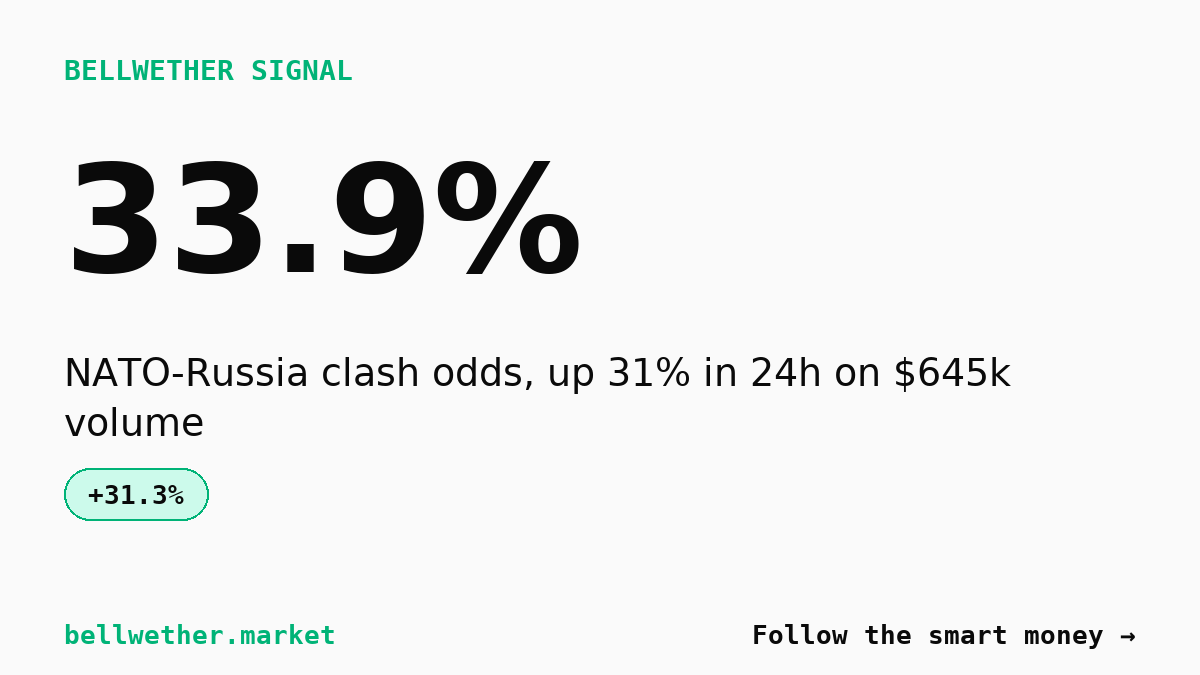
A Polymarket contract asking whether NATO and Russia will engage in direct military conflict by August 31, 2026 jumped 31% in 24 hours, reaching an implied probability of 33.9% on Tuesday. The move occurred on unusually heavy volume of $645,248, marking one of the strongest signals in the prediction market ecosystem this week. The price tells us traders are now pricing in roughly a one-in-three chance of an Article 5 scenario, sabotage operation, or other kinetic engagement between the alliance and Moscow inside 18 months.
What moved
The contract traded from an implied probability of roughly 26% to 33.9% over the past day, a 31.3% relative increase. Volume of $645,248 is substantial for a geopolitical futures market with resolution more than a year away; it suggests institutional or well-capitalised traders entered positions rather than casual speculation. The move was not a momentary spike: liquidity remained steady throughout the session, with continuous two-sided flow keeping the order book from gapping wide.
For context, this market now carries higher conviction than most active prediction contracts. The Bellwether Signal Score of 92 out of 100 places it in the top tier of trackable signals, outpacing concurrent high-volume markets on unrelated sports outcomes by double-digit margins.
What is driving it
The headlines retrieved for this market do not point to a single catalysing event. Instead, they paint a backdrop of persistent friction: Russian strikes in Kyiv on Sunday killed 12 civilians, NATO pledged to defend all allies after reports Iran was considering attacks on European targets, and analysts continue to document covert Russian operations across the continent. The Jerusalem Post reported on January 13 that Israel and Turkey may clash in Syria over military presence, a development that involves NATO member Turkey but does not directly implicate the alliance. The Atlantic published a long-form piece four days ago titled ‘NATO’s Nightmare’, and a former Navy SEAL described Russia’s secret campaign in Europe to the Kyiv Post around the same time.
None of these stories describe an imminent flashpoint. The price move coincides with this steady drip of escalatory rhetoric and violence, but no headline from the past four days announces a new redline crossed, a missile interception involving NATO aircraft, or a sabotage event attributed to Russian state actors inside alliance territory. That absence is important: it means the repricing is more likely driven by traders synthesising weeks of information and updating their risk assessment, or by a large order reflecting institutional positioning, than by a breaking news flash.
Prediction markets often move ahead of the news cycle when participants interpret slow-burn developments as increasing tail risk. The sustained volume here suggests more than one large player took that view. It is also possible that a single well-informed participant placed a substantial directional bet, moving the market without new public information. Either way, the price now reflects a materially higher estimate of conflict probability than it did 48 hours ago.
How strong is this signal
The Bellwether Signal Score of 92 breaks down into three components. Liquidity scores 40 out of 40, meaning the order book is deep enough to absorb normal trading without wild swings; traders can enter and exit without moving the price by double digits. Move magnitude scores 35 out of 35, reflecting the size and speed of the 24-hour change. Genuine uncertainty scores 17 out of 25, indicating the market has converged somewhat but remains far from the extremes of 5% or 95% where prices often lock in.
The score captures what happened, not why. It confirms that real capital moved the market under conditions where informed traders could reasonably disagree about the outcome. It does not tell us whether the new price is correct, whether the move will reverse tomorrow, or whether the traders driving it have access to non-public intelligence. A score of 92 simply means this is a high-conviction, liquid, volatile signal worth examining closely.
What the score does not measure: the accuracy of the implied probability, the identity of the traders, the durability of the move, or the likelihood of subsequent news that would validate or refute the repricing. It is a real-time snapshot of market dynamics, not a forecast of the underlying event.
How to read a price like this
An implied probability of 33.9% does not mean NATO and Russia will clash; it means the marginal trader is willing to pay 34 cents for a contract that pays one dollar if the event occurs. That trader may be hedging exposure elsewhere, expressing a view based on private analysis, or simply wrong. The number is not a consensus forecast; it is the equilibrium price where buying and selling interest balanced out over the past 24 hours.
The 24-hour move is more informative than the level. A jump from 26% to 34% tells us something changed in how traders assess the probability distribution, even if we cannot identify the precise trigger. A static price of 34% would be less meaningful; it might reflect stale positioning or thin books where no one is updating their view. The combination of heavy volume and sharp movement is what elevates this signal above baseline noise.
Thin books amplify price swings. If only a few thousand dollars of liquidity sit on each side of the order, a single large order can move the market by 10 percentage points. This contract, with $645,248 in 24-hour volume, is not thin. The repricing required sustained buying or a large informed order that the market did not immediately fade. That persistence matters.
Understanding how prediction markets work means recognising that prices aggregate information unevenly. Some participants trade on analysis, some on positioning, some on noise. The price reflects the marginal trade, not the modal belief. When volume spikes and the price moves sharply, the marginal trade is more likely to carry information, but there is no guarantee.
What would change the picture
Several developments would move this market further or reverse the trend. A confirmed sabotage incident on NATO soil attributed to Russian intelligence would likely push the probability above 40%. A ceasefire agreement in Ukraine that includes security guarantees could collapse it below 20%. A direct engagement between Russian and NATO aircraft, even if de-escalated within hours, would spike the price toward 50% or higher.
On the diplomatic side, a new round of high-level talks between Washington and Moscow, or a joint statement from NATO members affirming restraint, could ease the implied probability. Conversely, public comments from alliance officials suggesting they are preparing for contingencies involving direct conflict would reinforce the current level or push it higher.
The market will also respond to procedural milestones: troop deployments to NATO’s eastern flank, changes in rules of engagement for alliance forces near Russian borders, or reports of weapons systems being moved into forward positions. These are observable, falsifiable conditions that traders can monitor.
Time decay is a factor. As the resolution date approaches without an incident, the probability should decline if the underlying risk does not escalate. A market trading at 34% today might trade at 20% in six months if the status quo holds. Conversely, if tensions continue to ratchet upward, the price could drift higher even without a specific catalyst.
The caveats
Resolution rules matter. This contract specifies a military clash between NATO and Russia by August 31, 2026. The exact definition of ‘clash’ will determine whether borderline incidents qualify. A missile interception might count; a cyberattack might not. Traders should verify the resolution criteria before interpreting the price as a straightforward war probability.
Thin books can produce misleading signals even in high-volume markets if trading is concentrated in a short window. While this contract shows sustained volume, a single large order could still have driven the majority of the move. Without order flow data, it is impossible to distinguish between broad-based repositioning and a concentrated bet.
Time to resolution introduces uncertainty. Eighteen months is long enough for the geopolitical landscape to shift multiple times. A price today reflects current information and expectations about future information, but those expectations can prove wildly inaccurate. Markets are better at pricing near-term events than distant ones.
Finally, prediction markets on geopolitical risk are notoriously difficult to calibrate. There are few historical precedents for NATO-Russia conflict, and the outcome space includes scenarios ranging from minor skirmishes to large-scale war. A 34% implied probability could reflect genuine uncertainty about a well-defined event, or it could reflect confusion about what exactly is being priced. The lack of a clear catalyst in the recent headlines suggests the latter may be part of the story here.
Polymarket data via the Polymarket tracker updated hourly. Signal scores computed by Bellwether proprietary methodology. Prediction markets carry risk of total loss; this is market analysis, not investment advice.