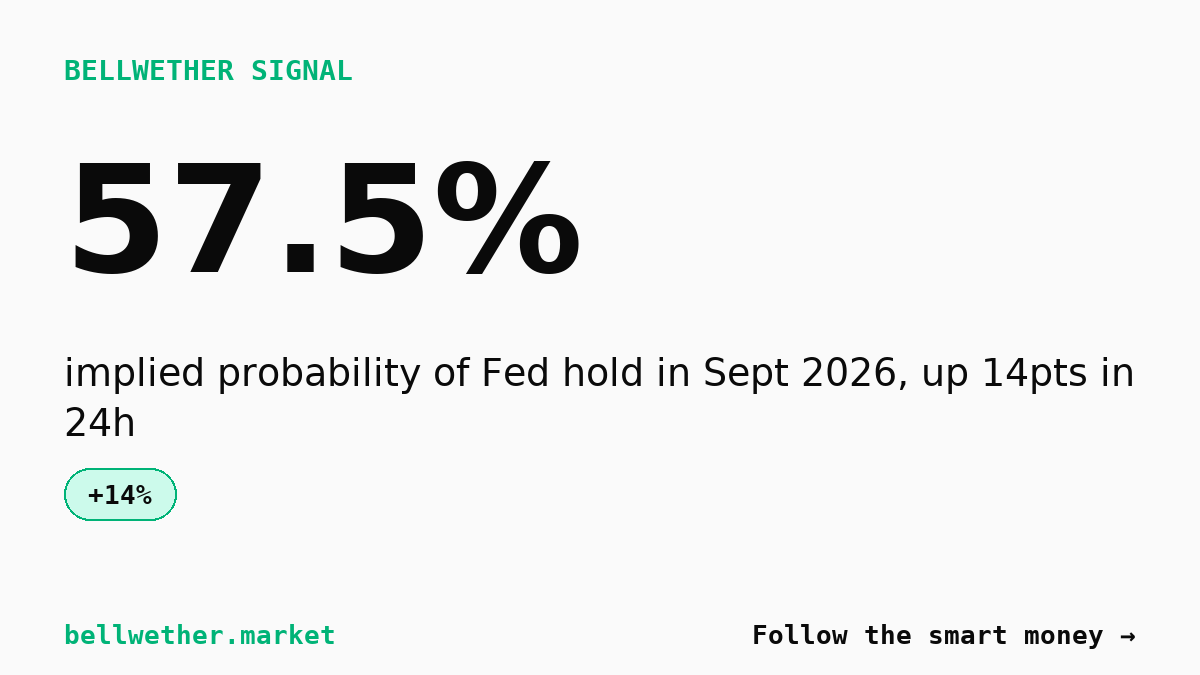
The market for a Federal Reserve hold in September 2026 has repriced sharply higher, reaching 57.5% implied probability on nearly $1.8 million in 24-hour volume. This is not a drift. Over the past day, the probability of no rate change jumped 14 percentage points, turning what CNBC called a coin flip seven days ago into a lean toward inaction. The companion market, pricing a 25-basis-point hike at the same meeting, now sits at 42.5%. Together they tell a clear story: traders who were pricing a September hike as the baseline a week ago have reversed course.
The verdict is that the most likely outcome, as of this writing, is that the Fed will leave rates unchanged when it meets in September 2026. The confidence behind that view, however, is thin. The gap between hold and hike is 15 percentage points, and the liquidity underneath both markets is deep enough to move fast if incoming data tilts one way or the other. This is not a consensus view baked into static prices. It is a live bet subject to revision.
What moved
Volume on the no-change market hit $1,796,825 in the past 24 hours, placing it in the top tier of active Fed-path contracts. The 14-point move in implied probability is unusually large for a market this liquid and this far from resolution. For context, the hike market moved in mirror image, and the two are mechanically linked: they represent opposite outcomes of the same binary event. The size of the move and the depth of the order book combine to produce a Bellwether Signal Score of 96 out of 100, which is about as strong as a forward-looking rate market gets.
The score breaks down as follows: 40 out of 40 points for liquidity, reflecting the nearly $3 million in combined volume across the two Fed September contracts; 35 out of 35 points for move magnitude, reflecting the 14-point swing; and 21 out of 25 points for genuine uncertainty, reflecting the fact that the outcome remains contested and the market has not collapsed into a one-sided view. The missing four points in the uncertainty component reflect the reality that one side now holds a modest edge, so the market is no longer a pure toss-up.
What is driving it
The repricing coincides directly with remarks made by Kevin Warsh at the Jackson Hole conference six days ago. PBS reported on August 22 that Warsh, widely viewed as a potential future Fed chair, raised the stakes for the central bank’s next meeting. CNBC followed on August 23 with a headline stating that the September Fed decision is now a coin flip and that rate hike odds increased post-Warsh. No transcript or direct quote appears in the retrieved headlines, but the timing and the specificity of the coverage leave little doubt that Warsh’s comments introduced new uncertainty about the path of policy.
What Warsh said, or what the market inferred he said, was apparently hawkish enough to push the probability of a hike higher in the immediate aftermath. But the subsequent move, which occurred in the past 24 hours, has reversed that initial reaction. The hold market is now priced 15 points higher than it was before the Jackson Hole remarks entered the conversation. That suggests one of two things: either traders believe Warsh’s comments were overinterpreted and do not reflect the consensus view of the Federal Open Market Committee, or they believe that incoming data between now and September will undercut the case for tightening.
Support for the latter interpretation appears in the ABC News headline from one day ago, which states that Fed Governor Christopher Waller says the central bank’s next rate move depends on the upcoming inflation report. This is an explicit conditional. Waller is not signaling a predetermined path. He is tying the decision to data that has not yet been released. That framing shifts the burden of proof onto the inflation numbers, and it implies that a hike is not automatic. If the market believes the inflation report will come in softer than the threshold required to justify tightening, then the hold outcome becomes more likely, and the price moves accordingly.
Morningstar posed the question two days ago in a headline: will the US Fed hike interest rates in September? The fact that the question is still being asked in a neutral frame suggests that the market has not converged on a strong consensus in either direction. Marketplace.org reported four days ago that interest rate expectations are pointing north, which at the time would have supported the hike side. But the 14-point move in the hold market over the past day suggests that the northward drift has stalled or reversed. The Bank of Canada’s decision to hold its own rate on September 2, reported by TD Stories two days ago, may also be contributing to a broader reassessment of the global rate cycle, though the headline does not specify whether the hold was expected or surprising.
What the headlines do not provide is a single, decisive piece of economic data or a direct Fed communication that would justify a 14-point move in 24 hours. The repricing is likely a combination of positioning unwind, updated probability estimates following the Warsh-Jackson Hole episode, and anticipation of the inflation report that Waller flagged. It is also possible that large orders moved the market in the absence of offsetting liquidity, though the volume figures suggest genuine two-sided flow rather than a one-way bet.
How strong is this signal
The Bellwether Signal Score of 96 reflects three components: liquidity, move magnitude, and genuine uncertainty. The liquidity score of 40 out of 40 is based on the nearly $1.8 million in 24-hour volume on the hold market alone, plus the $1.17 million on the hike market. That is sufficient depth to absorb large orders without slippage and sufficient activity to suggest that informed participants are present. The move magnitude score of 35 out of 35 reflects the 14-point jump in a single day, which is rare for a market this far from expiry. The uncertainty score of 21 out of 25 reflects the fact that both outcomes remain plausible and that the market has not converged on a single view.
What the score does not capture is the reliability of the news flow driving the move. The score tells you that the market moved, that the move was large, and that liquidity was present. It does not tell you whether the move is justified by new information or whether it represents a correction of an earlier overreaction. It also does not tell you whether the move will persist. A high signal score means the market is sending a strong message, but it does not guarantee that the message is correct.
How to read a price like this
An implied probability of 57.5% does not mean the Fed will hold rates in September 2026. It means that if you surveyed the participants in this market and aggregated their capital-weighted bets, the average expectation would correspond to a 57.5% chance of no change. That expectation can shift rapidly as new information arrives. The useful insight is not the level of the probability, but the direction and speed of the change. A 14-point move in 24 hours tells you that something in the information environment shifted, even if the headlines do not spell out exactly what.
Implied probabilities are derived from prices, and prices are set by the marginal participant willing to trade at a given level. In reading prices, the depth of the order book matters. A thin book can be moved by a single large order, while a deep book requires sustained flow to shift. The nearly $3 million in combined volume across the two Fed markets suggests that this repricing is not an artifact of low liquidity. It reflects genuine repositioning by participants who are allocating capital on the basis of their updated expectations.
For more on the mechanics of how prediction markets work, the key principle is that prices aggregate information from participants with different beliefs, different time horizons, and different access to data. The result is a forward-looking estimate that updates continuously. The estimate is only as good as the information available to the participants, but it is often more responsive than official forecasts or surveys, which tend to lag real-time developments.
What would change the picture
The picture would change sharply if the inflation report that Waller referenced comes in hotter than expected. A surprise on the upside would push the probability of a hike higher, potentially reversing the 14-point move and then some. Conversely, a softer-than-expected report would likely cement the hold as the baseline outcome and could push the probability above 60% or even 65%.
It would also change if another Fed official delivers a speech or interview that explicitly signals a preference for tightening or easing. The Warsh remarks moved the market once, and a follow-up statement from Waller, Powell, or another governor could do the same. The timing of such communications matters: the closer to the September meeting, the more weight the market will assign them.
Finally, the picture would change if volume drops and the order book thins. A high signal score today does not guarantee a high signal score tomorrow. If liquidity evaporates, the market becomes more vulnerable to single large orders, and the implied probability becomes less reliable as a measure of consensus belief. Monitoring volume and the bid-ask spread is as important as monitoring the price itself.
The caveats
The resolution rule for this market is straightforward: it resolves to yes if the Federal Reserve does not change the federal funds rate target at the conclusion of its September 2026 meeting. It resolves to no if the rate changes in either direction. That rule eliminates ambiguity around the outcome, but it does not eliminate the risk that the market misreads the Fed’s intentions between now and then.
The September 2026 meeting is more than a year away. That is a long time horizon for a prediction market, and it introduces multiple sources of uncertainty. Economic data will be revised, forecasts will shift, and the composition of the Federal Open Market Committee may change. The market is pricing the most likely outcome given today’s information, but that outcome can and will change as new data arrives.
The thin gap between the hold and hike probabilities, 57.5% versus 42.5%, also means that this is not a strong directional signal. A 15-point spread can flip on a single headline or a single data release. Traders should not interpret the current price as a stable forecast. It is a snapshot of a moving target. Additional discussion of the risks inherent in forward-looking rate markets can be found in our guide to Polymarket, where this contract is listed.
Finally, the usual warning applies: prediction markets reflect the aggregated expectations of participants, but they are not guarantees. Participants can be wrong, and they can be wrong collectively. The market assigns probabilities, not certainties, and those probabilities are conditional on the information available at the time of the bet. The best use of a price like this is as a real-time measure of how informed participants are repositioning in response to new developments, not as a crystal ball.