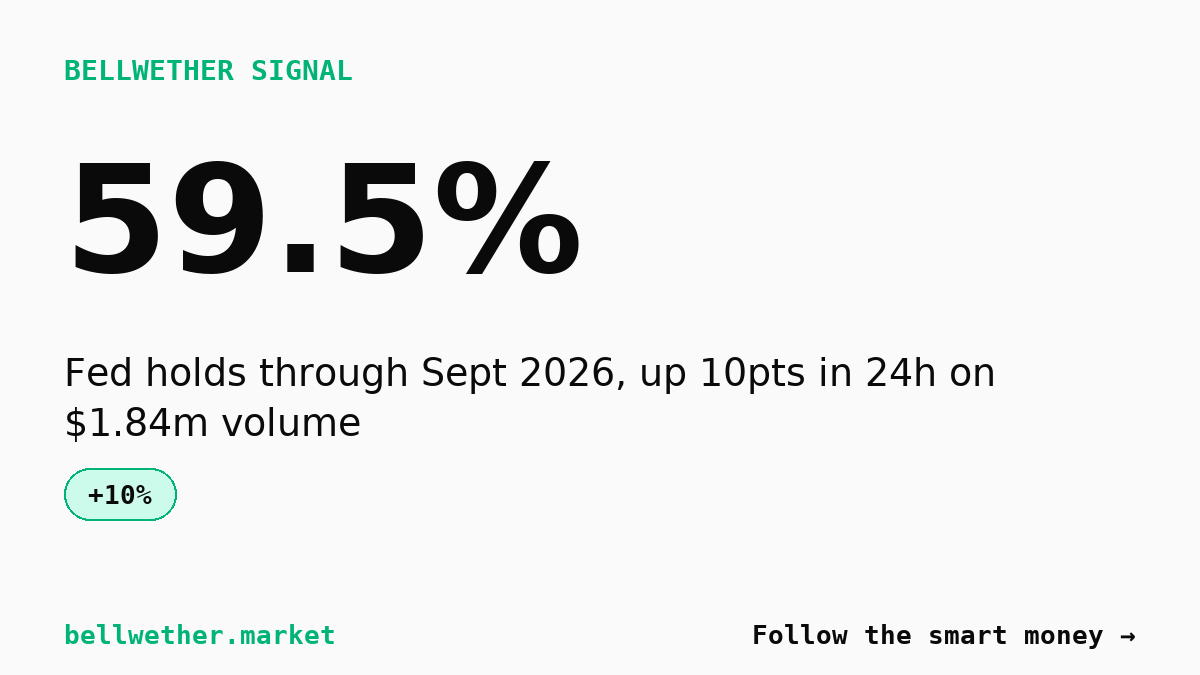
The market for a Fed hold through September 2026 traded up ten points in 24 hours to 59.5%, closing the week with nearly $1.85 million in daily volume. This is not a repricing driven by new data. It is a recalibration following a speech that briefly made a September hike look inevitable, then stopped mattering as the tape absorbed it.
The concrete verdict: traders now see a narrow majority chance the Fed leaves rates unchanged through September 2026, reversing a week of panic that followed Kevin Warsh’s Jackson Hole address. The probability of a 25 basis point increase sits at 40.5% on the companion contract. The move tells you that the initial overreaction to Warsh’s remarks has unwound, not that new information has arrived to justify a hold.
What moved
The primary contract saw $1.84 million in 24-hour volume, a figure that places it in the top tier of macro prediction markets by liquidity. Implied probability rose from 49.5% to 59.5%, a ten-point jump that erased most of the prior week’s hawkish drift. The companion market asking whether the Fed will increase rates by 25 basis points in September 2026 moved in mirror image, falling to 40.5%. Together these contracts represent a binary view of the meeting outcome, and the current split implies genuine uncertainty rather than consensus.
Volume concentration matters here. This is not a thinly traded novelty contract. It is a liquid two-sided book where size can trade without moving the price violently. The ten-point move happened across hundreds of thousands of dollars in turnover, which suggests broad participation rather than a single large order walking the book.
What is driving it
The headlines explain the setup but not the trigger. On September 7, Kevin Warsh delivered remarks at the Jackson Hole conference that sent rate hike odds spiking. CNBC reported the day after that September had become a coin flip, and Politico noted Warsh signaled the Fed may need to raise rates. That speech drove the hold probability down and the hike probability up, turning what had been a relaxed summer market into a twitchy referendum on a single official’s tone.
Then nothing happened. No new inflation print, no fresh labour data, no follow-up remarks from Warsh or other officials. The headlines from the past four days describe a static environment. Reuters covered an ECB rate path poll on September 11. Morningstar asked whether the Fed would hike in September on September 10, a question framed as open rather than settled. Marketplace.org discussed rising rate expectations on September 8, but offered no new catalyst. The most recent headline with any informational content is six days old.
The move, then, coincides with the absence of confirmation. Traders who bought the hike after Warsh spoke have had a week to wait for supporting data or rhetoric. None arrived. The market is now pricing in a reversion to uncertainty rather than a dovish pivot. This is not the Fed signalling a hold; this is the market deciding that one speech at Jackson Hole does not lock in a hike 11 months out.
It is also possible this reflects positioning flow rather than view-driven trading. A ten-point move in a liquid book can happen when early entrants take profit or when late shorts cover. The headlines do not provide a concrete catalyst for the timing of this reversal, which suggests the driver is internal to the market rather than external news. That is not a weakness in the signal; it is information about how traders are managing risk on a long-dated binary.
How strong is this signal
The Bellwether Signal Score for this market is 95 out of 100, placing it in the highest tier of tracked contracts. The score breaks into three components. Liquidity contributes 40 out of 40, reflecting the $1.84 million in 24-hour volume and the depth of the order book. Move magnitude adds 35 out of 35, driven by the ten-point swing in implied probability over a single day. Genuine uncertainty accounts for 20 out of 25, a reflection of the 60/40 split rather than a lopsided consensus.
The score rewards this market for being tradable, for moving meaningfully, and for remaining open-ended. It does not assess whether the move is justified by fundamentals, whether the price will prove correct, or whether the catalyst is public or private. A high score tells you the market is liquid and active, not that it is right. In this case, the score confirms that real money is trading a real view in size, which makes the price worth watching even if the driver is unclear.
What the score does not capture is the resolution date. September 2026 is 11 months away, and the probability of a hold depends on inflation paths, employment trends, and policy decisions that have not yet been made. A 95 score on a 24-hour signal does not mean the market has discovered the future; it means the market moved sharply on decent volume and is still open to both outcomes.
How to read a price like this
An implied probability of 59.5% is not a forecast. It is the price at which the market clears right now, given the orders currently resting in the book and the flow currently crossing it. You can think of it as the odds a risk-neutral trader would accept to take either side of the bet, adjusted for the cost of capital and the chance of being wrong.
The ten-point move is more informative than the level. A shift from 49.5% to 59.5% in 24 hours tells you something changed in how traders are thinking about September 2026, even if that change is just the unwinding of a prior overreaction. A static price at 59.5% would tell you less, because it could reflect either stable conviction or a lack of interest. Movement on volume is the signal; the level is context.
Thin books amplify moves. Deep books absorb them. This market falls into the latter category. The $1.84 million in daily volume and the 40 out of 40 liquidity score mean that the ten-point move required substantial flow rather than a single large order. That makes the repricing more credible as a reflection of aggregate sentiment, though it does not eliminate the possibility of a few large participants driving the action.
Finally, consider what the price does not tell you. It does not tell you whether the Fed will actually hold in September 2026. It tells you what traders are willing to pay today for exposure to that outcome. Those are different things, and the gap between them is where the edge lives.
What would change the picture
A credible shift in this market requires new information about the Fed’s reaction function or the data the Fed will see. Concrete checkable conditions include: a CPI or PCE print that comes in meaningfully above or below consensus, a labour market report showing acceleration or deceleration in wage growth, or public remarks from multiple Fed officials indicating a shift in the central tendency of the committee’s thinking.
If inflation prints remain sticky above target through the next two quarters, the hike probability rises. If inflation continues to trend toward 2% without renewed acceleration, the hold probability rises. If the labour market softens materially, the hold probability rises and the conversation shifts toward cuts. These are not predictions; they are the inputs that would logically move the price if they arrived.
Near-term, watch for follow-up from Warsh or from other officials who spoke at Jackson Hole. If his remarks represented a broader shift in the committee’s thinking, others will echo them. If they were an outlier, the silence will be informative. Watch also for the next FOMC minutes or Summary of Economic Projections, which will provide a fuller picture of where the committee sees policy heading in 2026.
The caveats
Resolution depends on the official outcome of the September 2026 FOMC meeting. The contract resolves to yes if the target range for the federal funds rate remains unchanged after that meeting. It resolves to no if the Fed raises, cuts, or makes any other adjustment to the target range. This is a binary with no middle ground, which means small changes in language or forward guidance do not matter unless they accompany an actual move.
Eleven months is a long time in monetary policy. The probability of a hold in September 2026 depends on inflation, employment, financial conditions, and political developments that have not yet occurred. The current price reflects the market’s best guess given today’s information, but that information set is incomplete and will change. Long-dated contracts are more about positioning and less about forecasting than short-dated ones.
Thin books on long-dated contracts can produce false signals, but that is not the issue here. The liquidity score of 40 out of 40 and the $1.84 million in daily volume place this market in the upper tier of macro prediction contracts. That said, even a liquid book can be dominated by a small number of well-capitalised participants, and their positioning can drive price moves that look like consensus shifts but are really just flow.
Finally, the binary structure of the contract obscures nuance. The Fed might signal a hold in September 2026 while leaving the door open for action later that year, or it might hold while revising its forward guidance in a hawkish direction. Those distinctions matter for markets but do not show up in the resolution. The price tells you what traders expect the meeting outcome to be, not what it means.
For more on interpreting probabilities and volume in markets like this, see our guide on how to read prediction market prices. For background on how these contracts work and settle, see prediction markets explained. This contract trades on Polymarket.