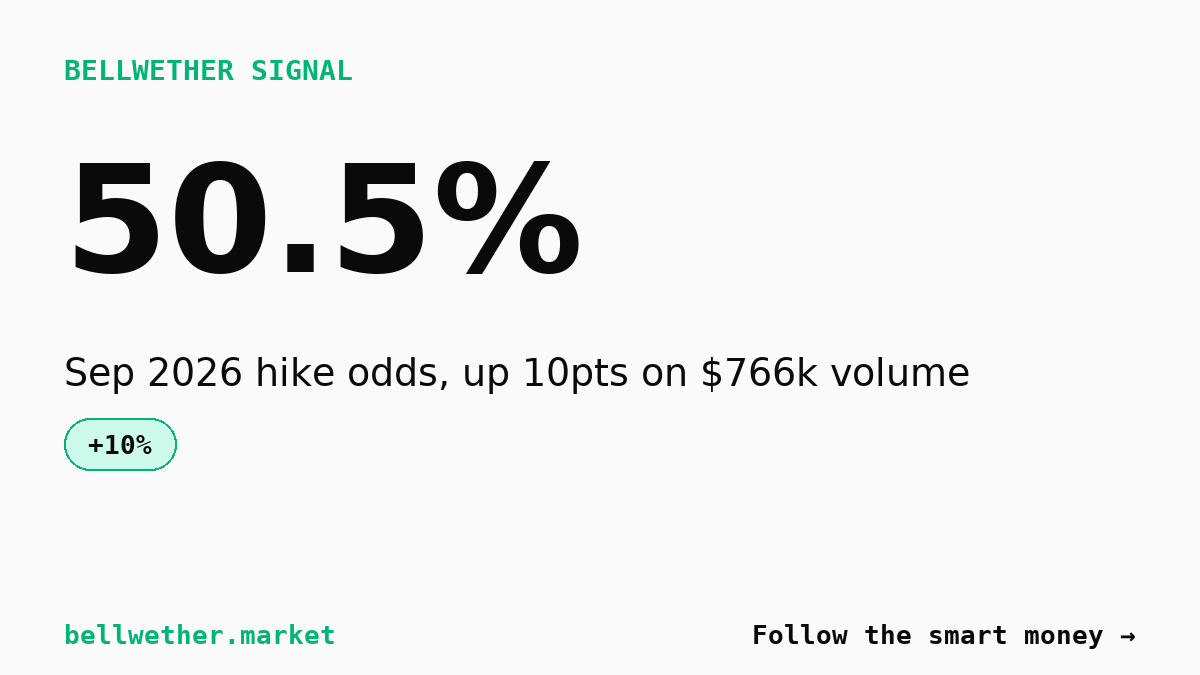
The market for a 25 basis point Federal Reserve rate increase following the September 2026 meeting has repriced to 50.5 percent implied probability, up 10 percent in 24 hours on $766,257 in traded volume. The odds now sit at a true coin flip: traders who bought Yes contracts at 50 cents will profit if the Fed hikes, those who bought No at 49.5 cents will profit if it holds or cuts. This is not a market drifting on low conviction. It is a liquid, contested repricing driven by new information.
The move comes as the Federal Reserve itself sends mixed signals about its next steps. The headline driver appears to be strong employment data released in recent days, which Reuters reported as signaling a potential Fed hike even as political pressure mounts for rate cuts. That same day, PBS noted that Fed Governor Christopher Waller muddied the outlook for a possible rate move later this month, introducing fresh uncertainty about the central bank’s path. The combination of solid economic data and ambiguous forward guidance from a voting member creates exactly the kind of environment where prediction markets reprice sharply.
What moved
The 24-hour move was plus 10 percentage points, from an implied probability near 40 percent to the current 50.5 percent. Volume of $766,257 in a single day on a contract resolving in September 2026 is substantial. For context, the inverse market on this same platform, which asks whether there will be no change in Fed rates after the September 2026 meeting, traded $1,246,163 and sits at 48.5 percent. The two probabilities do not sum to 100 because a third outcome, a rate cut, also exists. The fact that both markets moved in tandem and with high volume tells you this was not a single whale placing a directional bet. It was a broad reassessment of the Fed’s reaction function.
The Bellwether Signal Score for this market is 100 out of 100, the maximum possible rating. That score reflects three components: liquidity (40 out of 40), move magnitude (35 out of 35), and genuine uncertainty (25 out of 25). The liquidity component captures the fact that three-quarters of a million dollars traded in a single day, giving the price real information content. The move magnitude component reflects the 10 percentage point jump, a material repricing rather than noise. The genuine uncertainty component captures the fact that we are not yet in September 2026, that the Fed has not telegraphed its decision, and that the economic data between now and then could support multiple outcomes. All three components firing at once is rare. When you see it, the market is telling you something.
What is driving it
The repricing coincides with a cluster of headlines about Fed policy and upcoming data releases. On the day the market moved, Reuters published a report stating that strong job gains signal a Fed hike even as political pressure for rate cuts intensifies. That same day, PBS reported that Governor Waller introduced new ambiguity about the timing and direction of the Fed’s next move. Two days prior, MarketWatch ran a piece noting that new doubts had emerged about whether the Fed would raise rates this month, and ABC News reported that Waller said the central bank’s next rate move depends on an upcoming inflation report. Forbes, also two days before the move, noted that rate hike expectations had fallen as the dollar weakened and gold rose.
The pattern in these headlines is clear: the Fed is data-dependent, the data are mixed, and the central bank’s own communication is deliberately ambiguous. Strong employment supports a hike. Falling rate hike expectations and a weaker dollar suggest the market had been pricing cuts or holds. Waller’s comments, which emphasize dependence on the next inflation print, mean a single data release could tip the balance. Prediction markets reprice when new information arrives or when existing information is reinterpreted. Here, the reinterpretation appears to be that the labor market strength reported by Reuters outweighs the dovish drift captured by Forbes and MarketWatch earlier in the week.
It is important to note that none of these headlines contain a smoking gun, a single Fed statement or economic report that unambiguously shifts the odds by 10 points. Instead, the move reflects the aggregation of incremental signals: a jobs report, a governor’s remarks, a shift in inflation expectations. This is exactly how prediction markets are supposed to work. They do not wait for certainty. They reprice continuously as the probability distribution shifts, even when that shift is driven by subtle changes in tone rather than headline events.
How strong is this signal
The Bellwether Signal Score of 100 tells you this is a high-quality signal. The liquidity component of 40 out of 40 means the order book is deep enough that the price reflects genuine aggregated belief rather than the whim of a single large trader. The move magnitude component of 35 out of 35 tells you the repricing was large enough to be statistically meaningful, not just intraday noise. The genuine uncertainty component of 25 out of 25 reflects the fact that the outcome is not yet determined and that reasonable traders can disagree about the Fed’s path based on the same set of facts.
What the score does not capture is the quality of the traders in the market, the possibility of correlated error, or the risk that the market is reacting to a headline without fully pricing in the data. A perfect score does not mean the market is correct. It means the market is liquid, the move is real, and the uncertainty is genuine. If every trader in this market is overweighting the jobs report and underweighting inflation dynamics, the price can be wrong even as the signal strength is high. The score measures the informativeness of the move, not the accuracy of the prediction.
How to read a price like this
An implied probability of 50.5 percent means the market is pricing the September 2026 hike as a pure coin flip. If you bought a Yes contract at 50.5 cents and the Fed hikes by 25 basis points, your contract pays one dollar and you profit 49.5 cents. If the Fed holds or cuts, your contract expires worthless. The fact that the price is near 50 percent tells you the market sees no clear edge in either direction. This is not a case of the market leaning dovish and then correcting. It is a case of the market moving from a slight dovish lean to perfect ambiguity.
The 10 percentage point move in 24 hours is more informative than the 50.5 percent level itself. A static price near 50 percent could mean genuine uncertainty or it could mean nobody is trading. A 10 point jump on $766,257 in volume means real money changed hands as traders reassessed the odds. In thin markets, a single large order can move the price without conveying information. In this market, the volume and the presence of a highly correlated inverse market both trading heavily suggest the move is signal, not noise.
It is also worth noting that the order book depth matters. If the next $100,000 in buy orders would move the price to 55 percent, the current price is fragile. If the next $500,000 would barely budge it, the 50.5 percent level is robust. Polymarket does not publish full order book data publicly, so you cannot see the depth directly. But the fact that three-quarters of a million dollars traded without moving the price to 60 or 70 percent suggests there is genuine two-sided flow, not a single directional bet overwhelming the market.
What would change the picture
The next inflation print is the obvious catalyst. Multiple headlines, including the ABC News report on Waller’s comments, explicitly state that the Fed’s next move depends on upcoming inflation data. If core CPI comes in above consensus, the market will likely reprice toward a higher probability of a hike. If inflation continues to moderate, the probability will fall. The timing matters: if the data arrive before the Fed’s next meeting and show acceleration, the market will move quickly. If the data lag the meeting, the Fed will have to act on older information, which introduces a different kind of uncertainty.
Labor market data will also matter. The Reuters headline emphasizes strong job gains as a signal for a hike. If the next jobs report shows continued strength or acceleration, the case for a rate increase strengthens. If payrolls disappoint or the unemployment rate ticks up, the case weakens. The Fed’s dual mandate of maximum employment and stable prices means both inflation and employment data can shift the probability distribution.
Fed communication between now and September 2026 is the third lever. If multiple Fed governors begin signaling a tightening bias in speeches or interviews, the market will reprice higher. If they emphasize patience and data dependence, the market will remain near 50 percent. If they lean dovish, the probability will fall. The challenge is that Fed communication is often deliberately ambiguous, as evidenced by the PBS report on Waller’s muddying of the outlook. Traders must interpret tone, emphasis, and context, not just explicit forward guidance.
The caveats
This contract resolves on a binary outcome: either the Fed increases rates by 25 basis points after the September 2026 meeting, or it does not. A 50 basis point hike would count as Yes because the question asks whether the Fed increases rates by 25 bps, not whether it increases by exactly 25 bps. A hold or a cut would count as No. The resolution mechanism depends on the official Federal Reserve statement, which is unambiguous and publicly verifiable. There is no room for interpretation or dispute about the outcome once the Fed announces.
The order book for a contract resolving in September 2026 is thinner than it would be for a contract resolving next month. Fewer traders have strong views about monetary policy that far out, and those who do face significant uncertainty about the economic conditions that will prevail at that time. Thin books mean larger price swings per dollar traded, which cuts both ways: the signal can be stronger because only informed traders are active, or it can be noisier because a single large order has outsized impact. The $766,257 in 24-hour volume suggests the book is not so thin that noise dominates, but it is not as deep as it would be for a near-term contract.
A single large trader or a coordinated group could move this market deliberately, either to take a genuine position or to signal confidence in an attempt to move other markets or public opinion. There is no way to rule this out from price data alone. The presence of high volume on the inverse market provides some protection against manipulation, because it means both sides of the trade are active. But the risk always exists in prediction markets that the price reflects the beliefs of a small number of well-capitalized traders rather than a broad consensus.
Finally, the time to resolution is long. Between now and September 2026, the Fed will hold multiple meetings, the economy will evolve, inflation and employment data will shift, and political conditions will change. The current 50.5 percent probability is not a forecast of the final outcome. It is a snapshot of the market’s belief today, conditional on today’s information. That belief will change as new data arrive. The value of this signal is not in telling you what the Fed will do in September 2026. It is in telling you that, as of now, the market sees the decision as a pure toss-up, and that this assessment has shifted materially in the past 24 hours.