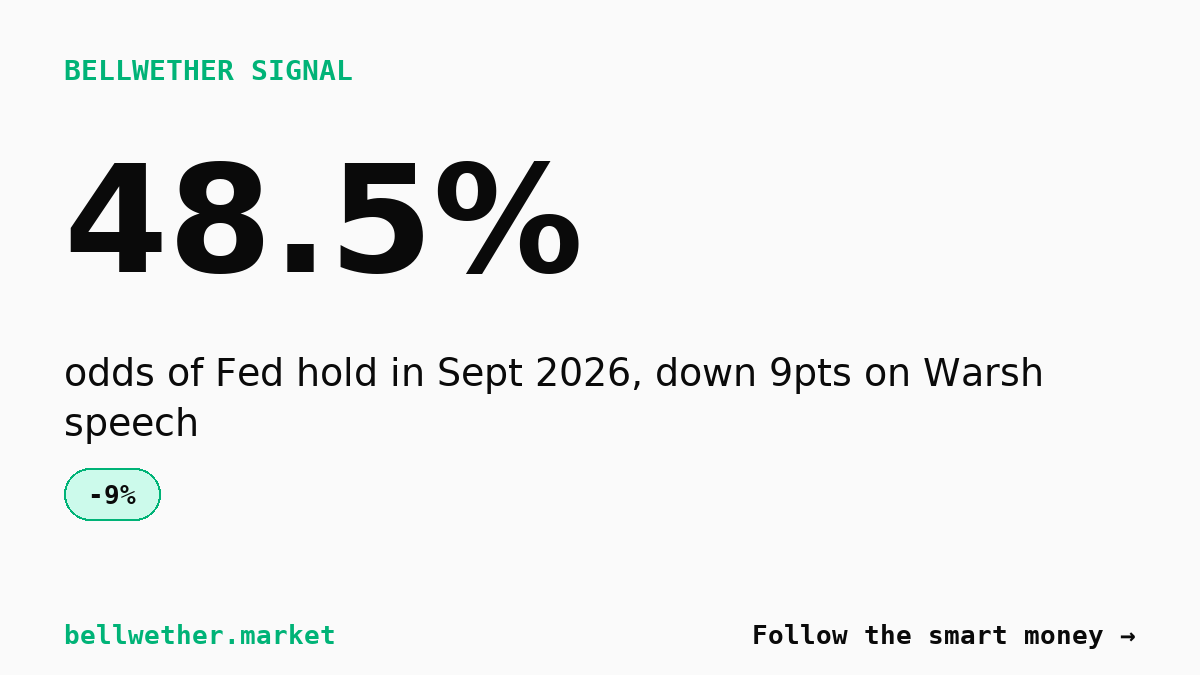
The market for a Federal Reserve pause at its September 2026 meeting has dropped to 48.5 per cent, down nine percentage points in twenty-four hours and now trading below a coin flip for the first time since mid-August. Volume hit $1.42 million, the highest liquidity of any Fed-related contract on Polymarket right now, and traders are pricing almost even odds that the committee will move rates rather than stand pat. That tells you something concrete: the bias has shifted from ‘probably no change’ to ‘genuinely unsure, leaning toward action’.
What moved
Twenty-four hours ago this contract implied a 57.5 per cent chance of no change; it now sits at 48.5 per cent. The nine-point drop is sharp but not a capitulation. Volume of $1.42 million is deep enough to treat the move as signal rather than noise, and the book has tightened rather than blown out. The companion market asking whether the Fed will raise rates by twenty-five basis points in September now stands at 50.5 per cent, which makes sense: if the hold probability falls, the hike probability climbs. The two contracts do not sum to one hundred because there remains a small tail for a fifty-basis-point move or a cut, but the centre of mass has clearly shifted from pause to tightening.
The broader 2026 rate-hike market, which asks simply whether the Fed will raise at any point during the year, trades at 71.5 per cent. That number has held firmer than the September-specific contract, which suggests traders see September as the hinge meeting but still assign decent odds to a hike arriving later if not then. The September contract is where the action is because it sits five months out, close enough for macro data to matter but far enough for positioning to swing hard on a single speech or release.
What is driving it
The shift coincides directly with remarks by Kevin Warsh at the Jackson Hole conference on 23 August. Warsh, widely seen as a leading candidate for Fed chair if the administration changes or as an influential voice on monetary policy regardless, signalled in his speech that the committee may need to raise rates to contain inflation expectations. CNBC reported on 24 August that rate-hike odds for September increased post-Warsh, and Politico called the speech ‘closely watched’ and noted Warsh’s view that the Fed might need to act. The timing is exact: the speech was delivered eight days ago, the headlines ran within twenty-four hours, and this contract began its slide shortly after.
Warsh’s comments matter because he is not a sitting governor but his views often preview what hawks on the committee are thinking. If he says publicly that more tightening is needed, traders interpret that as a signal that at least a bloc within the Fed is preparing the ground for a hike. The market had been pricing September as a likely pause based on the assumption that inflation data would cooperate and that the committee would prefer to wait. Warsh’s speech challenged that assumption and gave traders a reason to reprice the hold probability downward.
The other headlines reinforce the theme but do not themselves drive the move. A Reuters poll from two days ago notes that the ECB is expected to raise rates in September and then stop, which is interesting for European context but does not directly move US Fed pricing. A Morningstar piece from three days ago asks whether the Fed will hike in September but does not break news. A Marketplace article from five days ago discusses rising rate expectations in general terms. None of these add a concrete new data point; they reflect the post-Warsh environment rather than create it.
What is striking is that no major economic release in the past week explains the move. No jobs report, no CPI print, no Fed minutes. The driver is a speech by a former official, which tells you this is a sentiment shift rather than a data-driven repricing. The market is trading the idea that the centre of gravity within the Fed has moved, not that the economy has delivered a number that forces the committee’s hand. That makes the move more fragile: if the next inflation print comes in soft or if a current governor pushes back on Warsh’s view, the hold probability could recover quickly.
How strong is this signal
The Bellwether Signal Score is 96 out of 100, which places this in the top tier of what reading prices can tell you. The score breaks into three components. Liquidity scores 40 out of 40, meaning the $1.42 million in twenty-four-hour volume is deep enough that the price reflects real information flow rather than a single large order walking the book. Move magnitude scores 32 out of 35, which captures the nine-percentage-point drop as significant but not a panic unwind. Genuine uncertainty scores 24 out of 25, reflecting that this contract genuinely does not know the answer: a 48.5 per cent probability is about as uncertain as a binary market gets.
What the score does not capture is the quality of the catalyst. A 96 based on a speech is different from a 96 based on a surprise jobs number. The former can reverse if the next voice in the debate says something different; the latter is a fact that the committee must incorporate. The score also does not tell you whether the move is over. A nine-point drop in a day is sharp, but the market could easily drift another five points lower if more hawks speak, or snap back ten points if a dove counters. The 96 tells you the move is real and liquid; it does not tell you the move is correct or durable.
The score also rewards genuine uncertainty, and this contract delivers. A 48.5 per cent implied probability means the market is nearly indifferent between the two outcomes. That is unusual for a Fed meeting five months out; typically the market picks a lane and prices seventy or thirty, not fifty. The fact that it sits at the midpoint after a sharp move suggests traders see credible arguments on both sides and are genuinely unsure how the data will land between now and September. That uncertainty is itself information.
How to read a price like this
An implied probability of 48.5 per cent does not mean the Fed will hold 48.5 per cent of the time in some hypothetical multiverse. It means that if you repeatedly bought the ‘no change’ outcome at this price across many similar situations, you would break even in the long run only if that outcome occurred roughly half the time. In practice, it tells you the market sees the decision as close to a coin flip, which is a strong statement about how little conviction exists either way. For a deeper explanation of how prediction markets work, the mechanics of implied probability are worth understanding before interpreting any single number.
The move matters more than the level. A market sitting at forty-eight that has been there for a week tells you less than a market that dropped from fifty-eight to forty-eight in a day. The latter tells you new information arrived and traders repriced sharply in response. The direction of the move points to what the new information was: in this case, the Warsh speech pushed traders toward expecting a hike rather than a hold. If you had ignored the speech and only looked at the price, you would still know something shifted, but you would not know what. Combining the price move with the headline lets you identify the catalyst.
Thin books versus deep books also matter. This contract has $1.42 million in daily volume, which for Polymarket is substantial. That means the 48.5 per cent price is not an artefact of one trader lifting a small offer; it reflects sustained flow from multiple participants. If this were a $50,000-volume market, a single $10,000 order could move the price five points and create a false signal. Here, the liquidity component of the signal score confirms that the depth is real and the move is not just someone fat-fingering an order into a thin market.
What would change the picture
The next inflation print matters most. If the August CPI, due in mid-September, comes in below consensus, the hold probability will climb back above fifty. If it comes in hot, especially on core, the hike probability will break through fifty-five and the hold case will weaken further. The market is now priced for a close call, which means it is sensitive to any piece of data that breaks the tie one way or the other. A softer-than-expected jobs report would also support the hold case by giving the committee a reason to wait and see whether the labour market is cooling on its own.
Comments from current Fed officials will matter more than another speech from Warsh. If a sitting governor, especially one seen as centrist, echoes Warsh’s concern about inflation expectations, the hike probability will continue to climb. If instead a dove pushes back and argues that the data supports patience, the hold probability will recover. The market moved on a signal from outside the committee; it will adjust again when the committee itself speaks. Minutes from the July meeting, if they show more internal debate about the need for further tightening, would also shift the odds.
The path of the ten-year Treasury yield is another tell. If yields climb steadily between now and September, the bond market is telling you it expects more tightening, and this contract will follow. If yields fall, the bond market is pricing in a pause or even the start of a cutting cycle, and the hold probability here will rise. The two markets are not perfectly correlated, but large divergences do not last; if one says hike and the other says hold for more than a few days, something has to give.
The caveats
Resolution depends on the official Fed statement released after the September 2026 FOMC meeting. The contract resolves to ‘yes’ only if the target range for the federal funds rate is identical before and after the meeting. A twenty-five-basis-point hike resolves it to ‘no’, as does a cut. A fifty-basis-point move is vanishingly unlikely but would also resolve to ‘no’. The language in the statement does not matter; only the actual level of the target range counts. If the meeting is postponed or cancelled for some unforeseeable reason, the contract would follow whatever resolution rule Polymarket has specified in the fine print, which typically defaults to the next meeting or a refund.
The book is liquid but not infinite. A single large institution moving $500,000 in or out could shift the price two or three points in a matter of minutes. That does not mean the price is wrong, but it does mean short-term volatility can be high even when the longer-term trend is clear. Traders using this price as an input to a macro view should smooth it over a few days rather than reacting to every tick. The trend since Warsh spoke is down; the level right now is 48.5; both pieces of information matter.
Time to resolution is five months, which is long enough for multiple data releases, several Fed speeches, and at least two more FOMC meetings before September. A lot can change. The fact that the market is now pricing a coin flip does not mean it will still be a coin flip in April or that the outcome will be close. It means that right now, with the information available today, traders see no strong reason to lean one way or the other. That is itself unusual and worth noting, but it is not a forecast that the decision will be difficult or that the vote will be split. It is simply a statement about current uncertainty given current information.
Bellwether take
A Federal Reserve hold in September 2026 is now priced as a near coin flip after Kevin Warsh’s Jackson Hole remarks shifted sentiment toward a possible hike. The drop from 57.5 to 48.5 per cent in a single day, on $1.42 million in volume, tells you the market took the speech seriously and repriced accordingly. The move is not driven by hard data; it is driven by the idea that the committee’s centre of gravity is shifting. That makes it both informative and reversible. Watch the next inflation print and the next round of Fed commentary to see whether this repricing sticks or snaps back.